Still Alice

Still Alice. Effective and depressing. Moore is awesome, but the movie isn’t very adventurous, and sometimes a little tedious. Unfortunately strays a bit into advertorial/advocacy/message territory. Which is fine, it’s a great cause, etc. But I think it would have been stronger if it had stuck with the family.

It’s Kind of Cheesy Being Green

In one good little segment about product management, there’s this:

It’s Kind of Cheesy Being Green

Haywire

Haywire. Second viewing (the first). Sometimes it could use a little spark, but I do appreciate it’s overall reserve and steady rumble. If I were in charge, I’d probably do some trimming at the end. Nice, though, to let the side characters like MacGregor and Douglas shine a bit.

Lucy

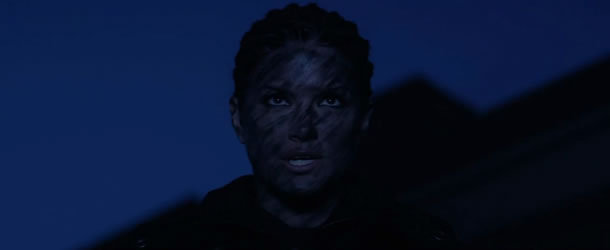
Lucy. Movie trailers can be deceiving. In this case, they sold it as a pretty yawner-looking action movie, but the story is delivered with more spirit and weirdness than you’d expect. There’s this really wonderful ongoing pattern of spliced-in nature footage as counterpoint to the story. A few moments are delightfully heightened (e.g. opening the briefcase), or thoughtfully disorienting (not translating other languages). Most of that is early on, though, and it unfortunately falls back on serviceable scifi/action pastiche, including plenty of Matrix-y philosophy talk. What really helps the early going is that Johansson is more fun to watch. It’s too bad that our hero basically turns into robot, loses affect. There’s an ongoing theme of conquering time via reproduction/evolution, and how knowledge transforms. Notice how they smuggle drugs in their stomach (womb). Also makes me think of study drugs, nootropics, etc. Also reminded me of Ted Chiang’s story Understand in his (really really good) collection Stories of Your Life. So maybe the overall problem here is that it was too good too soon, and once you’ve got the premise up and running, it’s hard to keep it weird. I’d place The Fifth Element ahead of this in my Luc Besson power rankings.

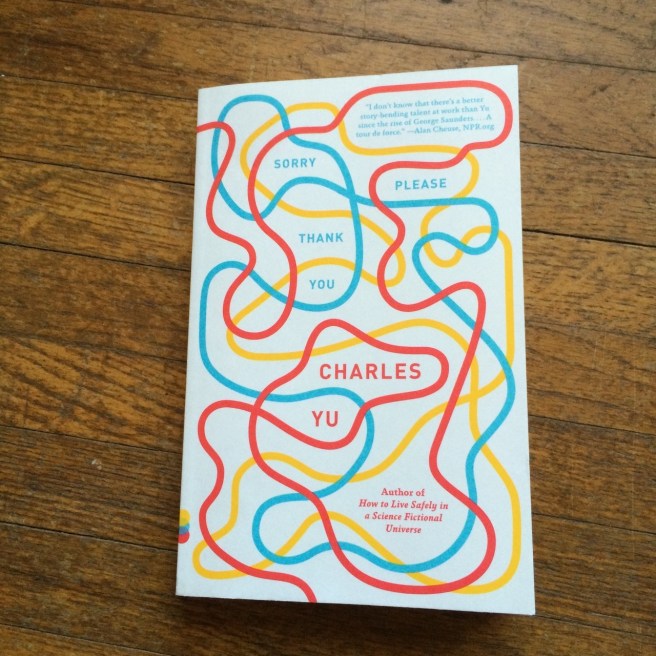
Sorry Please Thank You

I read Charles Yu’s Sorry Please Thank You, which I picked up after two of his other books made my 2014 favorites list. The opener “Standard Loneliness Package”, is one of the best in the book (a somewhat different version is online)…

Some genius in Delhi had figured out a transfer protocol to standardize and packetize all different kinds of experiences. Overnight, everything changed. An industry was born. The business of bad feeling. For the right price, almost any part of life could be avoided.

”Troubleshooting” and “Open” are other good examples of what you’re in for: short stories that are a little bit wistful or cynical, a little bit of comic exasperation, and a sort of tech- and/or scifi bent to them. Most of them work with a brain-teaser/experimental premise, but don’t feel as emotionally compelling as his earlier stuff. Third Class Superhero and How to Live Safely in a Science Fictional Universe are definitely worthwhile, though. If you like those first, you’ll probably enjoy this, too.

Batman Returns

Batman Returns. It had been a long time since I’d seen it. This Christmas tale also begins with a birth, but it’s so much more desperate and twisted than the traditional one. Too bad Catwoman is the only villain that stresses me out. Penguin is just kinda lame and pitiful. :( I like the staging and framing for many of the scenes. Like during Penguin PR speech, back at the mansion Alfred is decorating the Christmas tree while Bruce watches TV. (Speaking of, kinda funny how Batman learning about about rising threats through television seems so dated now.) And there’s some silly-exhilarating stuff, like when Kyle falls through layers of awnings. That scene at the masquerade (Superfreak!) is a masterpiece. Lovely to look at, and charmingly mental, but the story progression is too herky-jerky for my tastes, and not as fun as the 1989 for me.

Aside from my notebooks about what I’m reading (which I’ve kept pretty religiously for years), I’ve been a terrible journaler. Never got into a groove and stayed there. But a couple months ago, I started using Day One, and have consistently knocked out a few entries every single day, mostly from my phone. I even went through and back-filled a few memorable trips/days from the months before I had the app. Who knows if it will last, but I definitely don’t regret it.

<

p>I set up a couple reminders to give me an extra nudge in the morning and afternoon. Sometimes it just ends up as a few bullet points on the day’s goals or failures. Sometimes just a photo and caption. Sometimes something longer. But always something, which is what I’ve been looking for. And, there’s already a few solid, reliable options for exporting, so I have peace of mind if want to jump ship. But so far, so good.

StrengthsFinder 2.0

I and a few dozen folks I work with read Tom Rath’s StrengthsFinder 2.0. Good stuff. The assessment results tell me that my top strengths/themes are: Restorative®, Intellection®, Ideation®, Input®, and Relator®. Basically, I like fixing things; stockpiling ideas and connecting them; and sticking with people I’m close with. Sounds pretty fair, and there’s much more depth on each of those in the book and in their online thingy. At the very least, it explains why I love my job as much as I do. Also has some good ideas to invest in those strengths for TrueUltimatePower®. I was a bit skeptical, but it’s worth a read!

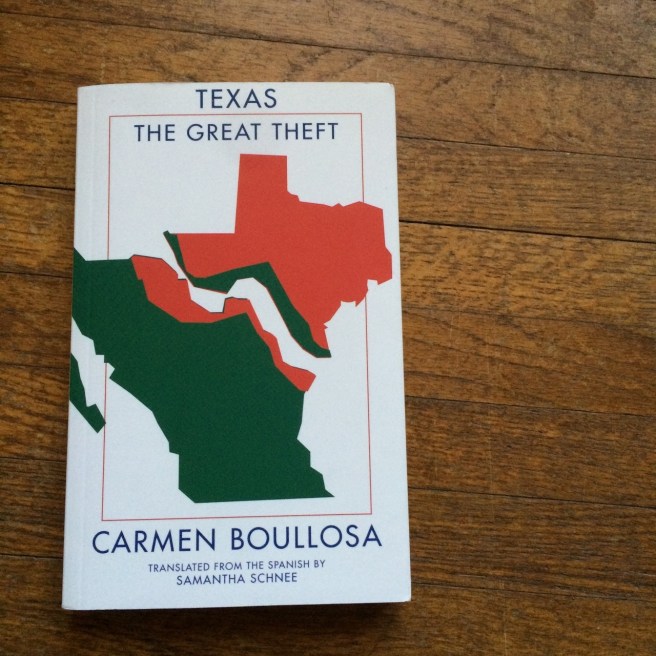
Texas: The Great Theft

I read Carmen Boullosa’s Texas: The Great Theft. It took me a while to catch on, but then I was able to coast along with the dozens and dozens of side characters and tangents. I didn’t love it, but haven’t read anything else where you get about ten thousand vivid snapshots of a time and place. Also, this book was the first release from Deep Vellum, a specialty translated lit operation run my friend Will Evans. So far my subscription is paying off. More to come.

Paris Review – The Art of Fiction No. 158, Shelby Foote

On research and not being tooooo organized:

I’ve never had anything resembling a secretary or a research assistant. I don’t want those. Each time I type, it gives me another shot at it, another look at it. As for research, I can’t begin to tell you the things I discovered while I was looking for something else. A research assistant couldn’t have done that. Not being a trained historian, I had botherations that led to good things. For instance, I didn’t take careful notes while reading. Then I’d get to something and I’d say, By golly, there’s something John Rawlins said at that time that’s real important. Where did I see it? Then I would remember that it was in a book with a red cover, close to the middle of the book, on the right-hand side and one third from the top of the page. So I’d spend an hour combing through all my red-bound books. I’d find it eventually, but I’d also find a great many other things in the course of the search.

Paris Review – The Art of Fiction No. 158, Shelby Foote

The Babadook

The Babadook. I, uh, wasn’t too anxious to go to bed after watching this. If I were a child actor, I wouldn’t have survive it psychologically intact. Awesome movie, though, and like many horror flicks, has a lot of material ripe for interpretation. Some lovely foreshadowing – a children’s author, “Mom is very lucky to have you, isn’t she?”, hands on throats, etc. I like the editing, particularly the transitions from night to day, how they often use timelapse or a just a shift in lighting. It keeps the momentum up. Love the sound design (insectoid sound effects were an inspired choice) and those cool blue-grey palettes. Interesting to see TV and the movies as both comfort/entertainment (for the elderly neighbor) and a nudge over the edge. We could see the babadook as repressed memories/guilt/sadness/anger over the husband that fester and spoil as they – and she – are increasingly isolated from work, hobbies, family, community. The refuge where you flee becomes a trap. Eventually, we have to make some sort of peace with our inner torment. Acknowledge it just enough, with proper fear, no more, and move on as best we can, knowing we’ll need to tend to it again later. Another good movie about the fallout after a father’s death: A Letter to Momo.
On Sentimentality: A Critique of Humans of New York

I’ve never followed HONY, and I’m not sure if I’ve actually seen any of the posts, but I’m familiar with the project. Interesting how it’s pretty much inevitable that even our most noble efforts will be compromised somehow. You can’t observe and document people as some kind of inert, neutral, sociology-less being… so it’s important to take criticism well when you run with projects like this.

On Sentimentality: A Critique of Humans of New York

From ‘American Sniper’ to ‘Macbeth,’ a Reporter’s Moviegoing Spree – NYTimes.com

I love this essay about a two-day bender at the movie theaters.

Henry Higgins has a song in “My Fair Lady” in which he talks about how even-keeled his life was before Eliza Doolittle came along and messed it up. That is true at the movies, too. Alone, you can respond any way you want; the only negotiation is between you and the screen. Let another person in, and everything changes. My friend was gracious, but I could tell that he wished the seats were farther back and that he was repelled by what he perceived to be the unpleasant jingoism cascading around the theater. I felt responsible, because the movie had been my idea.

That was a bummer. I began to believe that maybe art is better experienced alone, which is not a healthy belief.

And this too:

The movie was “Night at the Museum 3: Secret of the Tomb,” and it was pretty bad. It was a perfect thing to see alone, because I really liked it and would not have wanted to explain myself to anyone.

From ‘American Sniper’ to ‘Macbeth,’ a Reporter’s Moviegoing Spree – NYTimes.com