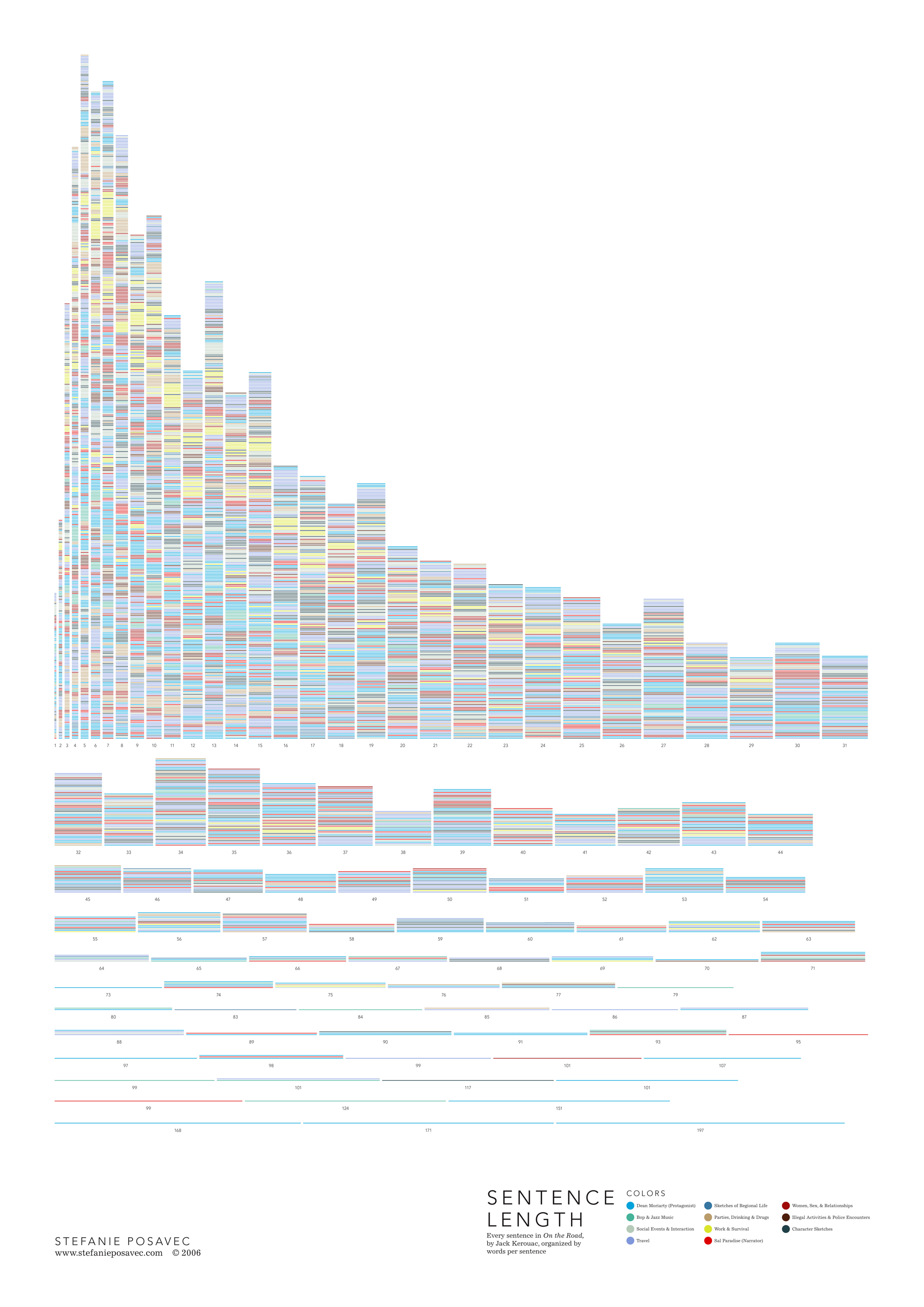
Then!

A short story written by the 6-year-old brother of one of my co-workers:

One day I woke up. I was haf chipmunk and bus. Then! I stareted to driv bep bep. Then I stareted to run wee. Thes is fun driving and runing. Then I crasht in to a treey. Ach

The third sentence is one of the best bits of writing I’ve seen in a while.

There’s a really good, really funny interview with Richard Price in the Believer:

I have to be a little intimidated by what I’m writing about. I have to feel a little bit like I don’t think I can do this, I don’t think I can master this, I don’t think I can get under the skin of this, because when you’re a little scared, you’re bringing everything to the table because you’re not sure you can do it unless you bust your balls and really, really get into it. Terror keeps you slender. I need a sense of awe. Oh, shit! I can’t believe I just saw that! But then what do you do with what you saw? That’s the bottom line. That’s the novel.

On writing novels vs screenplays:

BLVR: Do you wake up every morning and write right away?

RP: It depends. It depends if there’s anybody waiting for it. If there’s not anybody waiting for it, I can get slack. That’s also the good thing about screenwriting, is that there are other people involved. If you’re writing a novel, once you sign a contract and have a couple years to write it, that’s it. You’re on your own. You can have cobwebs, you can look like Miss Haversham’s wedding cake before anybody gives a shit.

Against Happiness (review: 2.5/5)

Eric Wilson‘s book Against Happiness: In Praise of Melancholy “challenges the recent happiness trend and celebrates the meditative virtues of melancholy.” He’s most successful when talking about the meditative virtues. The argument is simple: acknowledging the tragic, the struggle, the rain, and the inevitable decline of all things makes joy, success, the sun, and livelihood all the richer in the here and now.
Our manic urge to avoid mere discomfort keeps us from exploring these fuzzy edges, keeps us from knowing the whole. At our most important and emotional events like birth, death, and marriage, these edges become painfully, joyfully clear:

The tiny body quickly follows the head. A baby appears. You who have been watching are torn between weeping and laughing. You lament this infant’s tragic fall into the pain of time; you celebrate new life. While the baby cries in lamentation and celebration, you join it, with your tears washing over your ridiculous grin. You at this moment are two and one at once, melancholy and joyful, sorrowful and ebullient. You realize that the riches moments in life are these junctures where we realize, in our sinews, what is true all the time: the cosmos is a danced of joggled opposites, a jolted waltz.

The first quarter of the book, on challenging the happiness trend, should have been either much abridged or much expanded. It falls back on some tired excoriations of modern America (hitting all the right buzzwords: SUV, suburbs, McDonald’s, Botox, etc.), and ends up a little too thin and editorial. But later he does have some pretty interesting discussions of specific people, talking about the struggles of Colerige, Beethoven, and Keats, among others. On Beethoven:

Even though he clearly hates his inherited troubles—his melancholia, his gastric disorders, his hearing loss—he also acknowledges, though indirectly, that these very constraints are his muse. In rebelling against his “fate” by creating vital music, he actually transforms this same fate into an inspiration.

There are some funny parts, too, like talking about the strangeness of American Protestantism as a feel-good “happiness companies,” with “Jesus as some sort of blissed-out savior”.

Lastly, here are some works that Wilson referenced in his book that I also liked:

Graphing the accepted spelling of “ThunderCats, ho!”

ThunderCats, H--?
Based on some keyword research I did this afternoon. “ThunderCats, ho!” is a natural winner in Google search results. The long tail of enthusiasm extends to over 35 o’s, after which point I gave up.

The most interesting part is that HUGE drop in hits for the 3-o version. Among its neighboring easy-to-type competitors, “ThunderCats, hooo!” is a clear loser. If you want to stay in the safe, accepted, comfortable range, stick with the 1-, 2-, 4-, 5-, or 7-o versions. I’m drawn to the 10+ range for sheer exuberance.

The Well-Dressed Man With A Beard.

After the final no there comes a yes
And on that yes the future world depends.
No was the night. Yes is this present sun.
If the rejected things, the things denied,
Slid over the western cataract, yet one,
One only, one thing that was firm, even
No greater than a cricket’s horn, no more
Than a thought to be rehearsed all day, a speech
Of the self that must sustain itself on speech,
One thing remaining, infallible, would be
Enough. Ah! douce campagna of that thing!
Ah! douce campagna, honey in the heart,
Green in the body, out of a petty phrase,
Out of a thing believed, a thing affirmed:
The form on the pillow humming while one sleeps,
The aureole above the humming house…
It can never be satisfied, the mind, never.

Man, I really like Wallace Stevens. [via 1000timesno]

The Best American Science & Nature Writing 2007 (review: 3.5/5)

I found The Best American Science & Nature Writing 2007 when I was out hiking a couple few weeks ago. An Appalachian Trail hiker left it behind, recommending to whoever came by. I snagged it.
Any anthology will have some hits and misses. At least, in contrast with my frustrating experience with Flash Fiction Forward, all of my favorites from this book are available online, and only two of those are behind paywalls. Score. These were the ones I especially liked:

The Thurber & White send-up on the knee phenomenon:

Simply stated, the knee phenomenon is this: occasions arise sometimes when a girl presses her knee, ever so gently, against the knee of the young man she is out with… Often the topic of conversation has something to do with it: the young people, talking along pleasantly, will suddenly experience a sensation of compatibility, or of friendliness, or of pity, or of community-of-interests. One of them will make a remark singularly agreeable to the other person—a chance word or phrase that seems to establish a bond between them. Such a remark can cause the knee of the girl to be placed against the knee of the young man. Or, if the two people are in a cab, the turning of a sharp corner will do it. In canoes, the wash from a larger vessel will bring it about. In restaurants and dining-rooms it often takes place under the table, as though by accident. On divans, sofas, settees, couches, davenports, and the like, the slight twist of the young lady’s body incident to receiving a light for her cigarette will cause it… Now, a normal male in whom there are no traces of frigidity will allow his knee to retain its original position, sometimes even exerting a very slight counter-pressure. A frigid male, however, will move is knee away at the first suggestion of contact, denying himself the electric stimulus of love’s first stirring.

The Braindead Megaphone (review: 4.5/5)

There’s potential for a doctoral dissertation about The Rhetorical Use of Capital Letters in the Writing Of George Saunders. The usage comes in a couple flavors. There are the ineffable concepts, like Freedom and Humility. There’s the personalization of general categories, like Writers and the Little Guy. There’s the tongue-in-cheek categorization of human sub-groups, like, oh, People Who Analyze Capitalization. And it also appears when it’s simply more amusing, e.g. “Oversize Bright-Colored Toy Ships and Trucks.”
This was only my second try at Saunders. I aborted my attempt of In Persuasion Nation. Maybe it’s good. (I think I read so much non-fiction that I have trouble turning the switch every now and then.) And it wasn’t funny. But The Braindead Megaphone is funny. And it stays funny even though he writes about Serious Things and has a really earnest style.

To wander my way back to the Capitalization Issue, it reminds me of what Daniel Day Lewis said in a recent interview: “Perhaps I’m particularly serious because I’m not unaware of the potential absurdity of what I’m doing.” I think satirists like Saunders might agree. While the writing isn’t always serious, it is sincere, and I get the sense that he really kicks his own ass to come up with this stuff. Most of it is really, really good.

As for the meat of the book, the titular essay is a brilliant take on banal popular media. What’s really wonderful is the way he hedges and offers concessions along the way through his thought experiments. What could be a canned, all-too-familiar diatribe becomes a nice little Journey with George.

Another essay that I liked was about Kurt Vonnegut and Slaughterhouse-Five. In one part he talks about how Vonnegut gives up on detail:

“Vonnegut was skipping the lush physical details he had presumably put himself into so much danger to obtain. He was assuming these physical details; that is, he was assuming that I was supplying them. A forest was a forest, he seemed to be saying, let’s not get all flaky about it. He did not seem to believe, as I had read Tolstoy did, that his purpose as a writer was to use words to replicate his experience, to make you feel and think and see what he had felt. This book was not a recounting of Vonnegut’s actual war experience, but a usage of it.”

Later, in an essay on Barthelme‘s short story, “The School,” Saunders offers his own thoughts on the writer-reader relationship:

“The writer is right there with us—he knows where we are, and who we are, and is involved in an intimate and respectful game with us. I think of this as the motorcycle-sidecar model of reading: writer and reader right next to one another, leaning as they corner, the pleasure coming from the mutuality and simultaneity of the experience.”

In addition to those gems, there’s some great writing on patriotism in a mock-academic “survey of the literature”; a welcome twist on the tired Letters To & From An Advice Columnist genre; reporting on Minutemen and border patrol; and probably my favorite of a bunch, an awesome essay on what’s so difficult and wonderful about Huckleberry Finn. The only real duds for me were the foreign reporting essays in Dubai and in Tibet. Skip those, and read everything else.

Nick Hornby interviews David Simon, of The Wire fame:

There are two ways of traveling. One is with a tour guide, who takes you to the crap everyone sees. You take a snapshot and move on, experiencing nothing beyond a crude visual and the retention of a few facts. The other way to travel requires more time—hence the need for this kind of viewing to be a long-form series or miniseries, in this bad metaphor—but if you stay in one place, say, if you put up your bag and go down to the local pub or shebeen and you play the fool a bit and make some friends and open yourself up to a new place and new time and new people, soon you have a sense of another world entirely. We’re after this: Making television into that kind of travel, intellectually.

The Road (review: 5/5)

Cormac McCarthy‘s The Road takes place in a post-apocalyptic America. The novel centers on a father and son who, realizing they can’t survive another winter, start moving through the southeast towards the coast, trudging through snow and ash with their belongings in a scavenged shopping cart. Where they leave from, where exactly they are going, and what they hope to find are never made completely clear, just as the cause of society’s downfall is unexplained. But the beauty of the story is in everyday purpose they find in each other despite the struggle. There are a few tense moments avoiding bands of thieves and cannibals or other desperate nomads, but most of the book is a catalog of daily trials and conversations, simply and lovingly told.
McCarthy’s language is surprisingly simple and repetitive. It often called to mind a bit of the last stanza of “Thirteen Ways of Looking at a Blackbird“:

It was evening all afternoon.
It was snowing
And it was going to snow.

Like Wallace Stevens’ poetry, McCarthy’s book has something of music in it. At times, since the book has no chapters or divisions larger than a few paragraphs, it reads like a very long unbroken poem or chant or something you might read aloud. McCarthy occasionally disrupts this flow with some whiz-bang vocabulary (e.g. gryke, chary, kerf), but for the most part it’s just really wonderful.

From Nathan Ihara’s review of the Paris Review Interviews, II: “the art of the interview requires something very different from a mere investigation of the mechanics of fiction. Leave theory and technique to the essay or manual. An interview is a wonderful art form, similar to a one-act play, with an unswerving goal: to expose a human being.”
I really enjoyed Paris Review Interviews, I. I’ll see if I can get my hands on this latest one.