The Big Heat

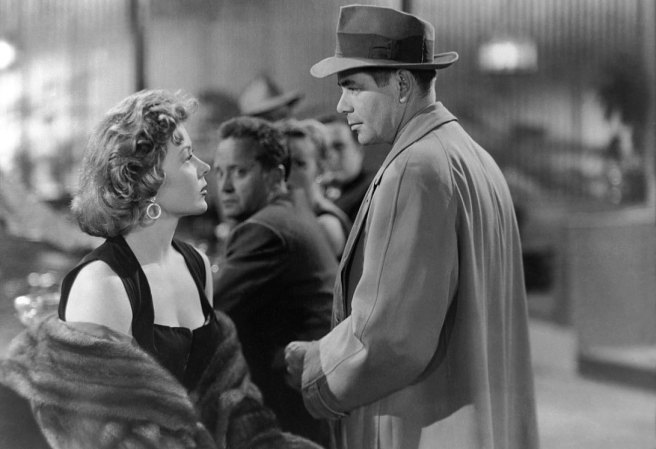
The Big Heat. Here we see the repercussions of a righteous anger, an uncompromising pursuit of justice. I love that our hero has a strong marriage and family life when he’s not on his beat. I haven’t seen that in film noir before. I really like this Glenn Ford guy (see also: 3:10 to Yuma, Gilda). Metropolis is the only other Fritz Lang I’ve seen. I should probably watch M at some point.

Hanna

Hanna. A blend of fairy tale and thriller-realism. I have some quibbles with premise, plot, and character, but a couple moments were pure cinematic delight for me. I’m thinking of the early chase in the bunker and the later one in the cargo container yard. The way that the natural ambient lighting, the camerawork, and the blocking all work in perfect sync… so cool. Great editing. I kinda wish Joe Wright had gone a little more in that style-over-substance/style-is-substance direction. Delightfully weird electronic-heavy score.

I beg you, to have patience with everything unresolved in your heart and to try to love the questions themselves as if they were locked rooms or books written in a very foreign language. Don’t search for the answers, which could not be given to you now, because you would not be able to live them. And the point is to live everything. Live the questions now. Perhaps then, someday far in the future, you will gradually, without even noticing it, live your way into the answer.

Rainer Maria Rilke, Letters to a Young Poet (via malevichsquare) Cf. George Saunders:

If I just stay fully engaged in whatever has presented itself, things will be fine. That is, I try not to think about things like: Next, I begin MY NOVEL!

Why Our Elites Stink – NYTimes.com

The problem is that today’s meritocratic elites cannot admit to themselves that they are elites. Everybody thinks they are countercultural rebels, insurgents against the true establishment, which is always somewhere else. This attitude prevails in the Ivy League, in the corporate boardrooms and even at television studios where hosts from Harvard, Stanford and Brown rail against the establishment. As a result, today’s elite lacks the self-conscious leadership ethos that the racist, sexist and anti-Semitic old boys’ network did possess. If you went to Groton a century ago, you knew you were privileged. You were taught how morally precarious privilege was and how much responsibility it entailed.

It’s hard to see yourself from the outside. This also made me think of arguments in favor of monarchy in Hoppe’s Democracy.

Why Our Elites Stink – NYTimes.com

Tom Bissell reviews Spec Ops: The Line and explores the reasons why we play shooter games. – Grantland

Couldn’t you argue that the men and women who make Battlefield and Modern Combat and Call of Duty are making the world a demonstrably worse place? I think you could. Sometimes I wonder how they sleep at night. Sometimes, when I can’t sleep at night, I play Call of Duty.

Tom Bissell reviews Spec Ops: The Line and explores the reasons why we play shooter games. – Grantland

Haywire

Haywire. I love when genre films are cooler than they need to be. There’s plenty of moments of playing color and camera angles and audio cuts. The long shots of just running or driving in reverse (!). Quiet fights. Shower-time rummaging. The house with the lights out. The sunset beach scene. The careful, cautious rooftop chase was a nice change from the insane parkour we often see. The use of moody soundtrack reminded me of Manhunter. Carano is a little bit of a robot. It fits, though. Dialogue isn’t too special, but there’s a certain magic that a recognizable ensemble cast brings. I need to see more Steven Soderbergh. Out of Sight was great.

The Fall

The Fall. Storytelling narrated by an injured stuntman paired with visuals imagined by a young girl. The hokey melodrama and goofy costuming is perfect. Awesome, awesome location shooting and set design. This movie is a lot of fun.

The Millions: The Stockholm Syndrome Theory of Long Novels

If you’re the kind of reader who doesn’t intend to give up on a Great Big Important Novel no matter how inhumanely it treats you, then there’s a sense in which Joyce or Pynchon or Gaddis (or whoever your captor happens to be) owns you for the duration of that captivity. In order to maintain your sanity, you may end up being disproportionately grateful for the parts where they don’t threaten to bore you to death, where there seems to be some genuine empathic connection between reader and writer.

The Millions: The Stockholm Syndrome Theory of Long Novels

Forms, styles, structures–whatever word you prefer–should change like skirt lengths. They have to; otherwise we make a rule, a religion of one form; we say, “This form here, this is what reality is like,” and it pleases us to say that (…) because it means we don’t have to read anymore, or think, or feel.

Zadie Smith, in an essay on George Eliot and the Victorians and the evolution of the novel and such.

On the other side of the class and educational divide (…) it’s easy to forget what it’s like not to know.

Zadie Smith, in an essay on E.M. Forster collected in Changing My Mind. The context is whether or not readers pick up on literary/cultural references. It made me think of Ezra Klein.

Abebe: Why Frank Ocean’s Coming-Out Was Unique

It’s become, I think, a straight American commonplace to want to dignify same-sex relationships by treating them the same way we would heterosexual ones — which means that when someone tells us, for instance, that he’s gay, some of us who are straight might silently assume his relationships are not just as valid as ours but fundamentally the same as ours. As habits go, it’s politically useful and often accurate, but it also means we don’t see much mainstream discussion of the way that figuring out a sexual identity, via any one of the million different paths we all manage it, influences a person’s experience of love itself and the stories they have to tell about how it feels.

Nitsuh Abebe, as thoughtful as ever.

Abebe: Why Frank Ocean’s Coming-Out Was Unique

markrichardson:

Steve Reich’s tape piece “Come Out”, from 1966. When people talk about someone “coming out” this track often shows up in my head, unannounced. Even though it is, obviously, about something very different.

From listening to this track, I learned something about how my mouth makes sounds and my brain turns those sounds into meaning. Say “come out to show them” over and over for a minute and understand the difference between a vowel and a “sh”, and how the “sh” can very easily become a rhythmic device not unlike a hi-hat. And when you say it over and over you can feel how the phrase turns from “words” into “sounds” and you can get a sense of how your brain has been trained to extract meaning from these sounds but can sort of fall asleep on the job, lulled by repetition. 

Steve Reich reblog rule in effect. Reich on “Come Out” in 2002:

I remember being invited up to NYC or WBAI–before they became so political they were very musical–and being asked to play “Come Out,” and the switchboard lit up like a tree. “Your transformer’s broken and the needle’s stuck in the groove! Will you PLEASE fix it?”

The novels we know best have an architecture. Not only a door going in and another leading out, but rooms, hallways, stairs, little gardens front and back, trapdoors, hidden passageways, et cetera. It’s a fortunate rereader who knows half a dozen novels this way in their lifetime. I know one, Pnin, having read it half a dozen times. When you enter a beloved novel many times, you can come to feel that you possess it, that nobody else has ever lived there. You try not to notice the party of impatient tourists trooping through the kitchen (Pnin a minor scenic attraction en route to the canyon Lolita), or that shuffling academic army, moving in perfect phalanx, as they stalk a squirrel around the backyard (or a series of squirrels, depending on their methodology). Even the architect’s claim on his creation seems secondary to your wonderful way of living in it.

Zadie Smith, opening an essay on two opposing philosophies of the reader-writer relationship, pitting Barthes vs. Nabokov. Collected in Changing My Mind, which I recommend. I’ll probably post some more quotes from this book in the near future.

Beasts of the Southern Wild

Beasts of the Southern Wild. I loved this movie and recommend it to all living creatures. It’s about endings, and how we react to and prepare ourselves and others for the inevitable. What we leave behind. Best soundtrack of the year so far? I might have cried twice. YMMV.

Also, I read about aurochs after watching this and was intrigued to find the connection to the old rune Ur, which has also been used to mean water or rain. Cool!

LeBron James Is a Sack of Melons – NYTimes.com

James has always been harder to place. On the court, he’s a whole anthology of players: an oversize, creative point guard like Magic Johnson; a bodybuilder-style space-displacer like Karl Malone; a harassing, omnipresent defender like Scottie Pippen; a leaping finisher like Dr. J. He does everything that a human can possibly do on a basketball court; he is 12 different specialists fused, Voltron-style, into a one-man All-Star team.

Somehow this doesn’t quite track. Even as we admire James’s unique skill set, we’re always forced to think about the tension that holds all of the disparate parts together — the contradictory philosophies of the game that all of those different skills imply.

LeBron James Is a Sack of Melons – NYTimes.com

Online fraud: Blatancy and latency | The Economist

Blatancy is a means of weeding out all but the most credulous respondents. (…) A big cost for [spammers] is the time they spend coaxing fully into their net those who show initial interest. So they need to select the most promising targets, rather than timewasters or the wary. “By sending an e-mail that repels all but the most gullible, the scammer gets the most promising marks [victims] to self-select.”

Online fraud: Blatancy and latency | The Economist