Man On Cusp Of Having Fun Suddenly Remembers Every Single One Of His Responsibilities | The Onion

Memento mori – Wikipedia, the free encyclopedia.
Timepieces were formerly an apt reminder that your time on Earth grows shorter with each passing minute. Public clocks would be decorated with mottos such as ultima forsan (“perhaps the last” [hour]) or vulnerant omnes, ultima necat (“they all wound, and the last kills”).
The Jefferson Bible – The Life and Morals of Jesus of Nazareth by Thomas Jefferson
I figured I should read this eventually. I mean look at this thing. It cuts off the miraculous bookends of Jesus’ life and focuses on the Enlightenment-friendly moralizing. There was nothing in here I hadn’t heard before, but reading it in all in one go made me remember how many common phrases come out of the Bible. A quick run-through, just from the Sermon on the Mount:
- blessed are the…
- salt of the earth
- light of the world
- town upon a hill
- turn the other cheek
- left hand knowing what the right hand is doing
- serving two masters
- can’t serve God and mammon
- lilies of the field
- ye of little faith
- tomorrow will worry about itself
- just not, lest you be judged
- cast pearls before swine
- seek and you will find
- do to others what you would have them do to you
- wolf in sheep’s clothing
- by their fruit you will recognize them
- bearing bad fruit
And that section is only, what, 2500 words? That’s some influential shit.
The Jefferson Bible – The Life and Morals of Jesus of Nazareth by Thomas Jefferson

My first upholstery project. I made this.
The Antidote (review)

As the Buddha said two and a half thousand years ago, we’re all out of our fucking minds! That’s just the way we are. – Albert Ellis
What a fine book. If, like me, you have ongoing interest in stoicism, happiness, mindfulness meditation, thinking about death and failure, and tend to be a skeptical of your Rhonda Byrne/Tony Robbins types (but are at the same time, kind of amused by them), you’ll probably like Oliver Burkeman’s The Antidote: Happiness for People Who Can’t Stand Positive Thinking. In every chapter, there’s some kind of personal connection–an interview, an experiment, field research–but it doesn’t turn preachy or antagonistic. He’s not much for dishy takedowns or “turns out” revelations. He examines a few traditions or lines of thinking, and connects them with an experience. I think he strikes a good balance between his first-person narrative and his research and exploration.
Early on, Burkeman suggests that one weakness in happy thinking is what you might call a reductionist problem: life is messier than that. Most things aren’t binary. Life is full of uncertainty, there are constant threats to our precarious hold on whatever we’ve got going for us, and, to top it all off, there’s a shitty, guaranteed end result:
No matter how much success you may experience in life, your eventual story will be one of failure. Your bodily organs will fail, and you will die.
You have to make peace with that. And blinding, sunny optimism doesn’t always afford the opportunity.
Burkeman finds a practical objection to positive thinking that I hadn’t considered: Kind of like the challenge “do not think of a pink elephant”, when you try to live the admonition to “think positive”, you end up with this constant meta-cognitive scanning. Am I thinking happy? Is this a negative thought? Am I successfully not thinking about bad things X, Y, and Z? You naturally think of negative things while policing yourself for negative thoughts. How can you change this? One alternative is a more stoic approach. Avoid or minimize the labeling in the first place, or confront it honestly and let it go. After all,
Nothing outside your own mind can properly be described as negative or positive at all.
It’s a more global perspective. Outside events run through a filter (our beliefs) and then generate some interior reaction. If you really embrace this, you get more power over how you (choose to) feel.
And how bad can it be, really? That’s another more stoic/realist tactic: face the disaster head-on. Imagine, in detail, how bad it could be. One advantage of this worst-case scenario approach: it “turns infinite fears into finite ones”. I love that.
Another practical barrier to positive thinking I thought was interesting was about affirmations: we simply don’t internalize them very well. And when things like “I’m good enough, I’m smart enough…” just don’t ring true with how we already conceive of ourselves, thinking them is only going to make us more anxious. Even positive visualization can make you relax instead of pumping you up. And I love this line about advice and motivation:
Motivational advice risks making things worse by surreptitiously strengthening your belief that you need to feel motivated before you can act. By encouraging an attachment to a particular emotional state, it actually inserts an additional hurdle between you and your goal.
So, the stoic approach is valuable: it’s gonna suck, you don’t feel like it, and you won’t anytime soon, it might be a disaster, but do it anyway. Whatever “it” is.
In the chapter on Buddhism, non-attachment, and meditation, he brings up Albert Ellis‘ idea of “musturbation”. We become obsessed with things we want. We become absolutist about the results we need. There’s a related idea here: “goalodicy” (coined by Christopher Kayes), where we hang on to and internally defend faulty goals as a way of preserving our identity, because we’ve already invested so much of ourselves in a particular happy outcome. Build things up too much, and you get burned. So meditation is both practice in giving up control, and a way to honestly confront what life brings you. Burkeman quotes a great, great line from Barry Magid:
Meditation is a way to stop running away from things.
A related idea: considering any problems you face, how many of those problems are problems right now? As in, now now. Probably none or few–most problems we have (and our compulsively recycled thoughts about them) are about the past or about the future. Meditation brings you back to this moment, when you can actually do something.
Another way to think about the problem of optimism is that it can turn into a way of chasing security, and fleeing vulnerability. The problem, as Alan Watts says, is that
If I want to be secure, that is, protected from the flux of life, I am wanting to be separate from life.
I loved the final sections about death, too. Burkeman talks about memento mori, and mono no aware, and more broadly the idea of failure and “letting death seep back into life”. Carol Dweck comes up in a short discussion of talent and success, specifically her idea that the mindset we have about success tends to be either “fixed” or “incremental”. That is, we see success in terms of innate talent/ability vs. growth/learning, and thus tend to see failure in terms of dread/threat/identity crisis vs. improvement/opportunity/adaptation. (Let’s make better mistakes tomorrow!) So in the midst of a failure-shy, success-worshipping culture, we get a better sense of community and empathy when we acknowledge mess-ups as an expected, normal, more-than-likely-than-not occurrence. And more practically:
Failure is a relief. At last you can say what you think.
his book would pair well with Marcus Aurelius’ Meditations or Alain de Botton’s Religion for Atheists–I detect similar attitudes in each. For good books on happiness, I recommend Jonathan Haidt’s The Happiness Hypothesis, and Mark Kingwell’s In Pursuit of Happiness.
My first upholstery project
It had been a while since my last significant hands-on project, when I refinished a
table I inherited from my grandpa. I figured I could use a padded bench/ottoman kind of thing. And I dove right in. This was my first attempt at any kind of upholstery. I got the original bench on the cheap from an antiques store. It was hideous, but I saw potential:


Floral
stripes + gold tassel fringe really ain’t my thing. First step, strip
all of that junk off of the frame. The previous owner/builder really half-assed
the internal seat support, and the frame itself:

After I added a few metal brackets to reinforce the frame, I
installed new jute webbing with some 5/8″ upholstery tacks. The webbing with the red stripe is stronger than the black-striped rolls, FYI, and hence better for areas that bear weight. I also made some
rookie mistakes at one ends by not weaving first. Whoops:


After that, I covered it with some burlap to help reduce wear and tear, and stapled it down:

I added some dense, firm foam as the bottom layer for the seat, and reused the previous
main cushion, which was still in decent shape (which also saved me another
$50-70, give or take). Both of those pads were attached to the base and
to each other with some spray adhesive:

For a little extra give, the bench gets swaddled in a few strategically-placed layers soft batting (focusing on the top of the seat and the corners of the frame), also affixed with some spray adhesive:

I completely forgot to take pictures of the final fabric-covering stage, but
basically it’s more staples and more tacks, with a little tugging and
tucking here and there to make sure the fabric is lined up correctly.
Like military bed-making, but permanent. Finished it off with a dust
cover underneath…

…et voilà!:

This simple project didn’t offer any special technical challenges, but it did provide some insight into how much of a pain in the ass it is to do a great job. So much of the material and so much of the effort is hidden when you’re all done. Shout-out to my mom, who I’ve seen refurbish
and reupholster about a million pieces of furniture, and who gave me a
great guidebook and some specialty tools that probably saved me 300-400 hours of tears and
frustration. I want to do this again.

Over the fireplace in the first house my parents owned together, the house I was brought back to when I was born, the words BOIS TORTU FAIT FEU DROIT were painted on the brick in Gothic script. Crooked logs make straight fires.
The way I choose to make its meaning: out of something gnarled, tough, flawed comes something with use and power.
Or, even busted shit can work if put to use in the right way.
Or, twisted bizarro brains shine bright too.
Crooked wood, straight fires! It was a cold house, and I don’t remember it. I’ve heard many times from my parents about glasses of water that froze solid on bedside tables over night.
Can authenticity be aware of itself as such and still be authentic?
Michael Pollan, talking about the way we talk about food, specifically, the bullshitting/storytelling endemic to Southern barbecue culture (which is part of its charm, right?).
Fast & Furious

Fast & Furious. Decent. Most franchises don’t stay strong after three movies. It’s definitely grown up: multi-national settings, gratuitous helicopter flyover shots, fancier locations, and pretty fireball explosions among the big-budget must-haves. The obvious CGI in the tunnel scenes was a bit of a letdown. The races more frenetic and choppy; the crashes were definitely more… comprehensive. I was also thinking this is first in the series that’s felt wholly like a work of the 2000s. Even has teal and orange in full force, along with some shaky-cam here and there. Good to see Vin Diesel back in a bigger role here, though sometimes it seems like he’s following instructions or something. Gotta like him, though. I also really, really enjoy John Ortiz as a villain. So good. He has a knack for balancing the malice and the charm without turning into a sideshow (see also his role in Miami Vice). I don’t think the music is as strong as in the previous three. Also, border crossings and expendable, replaceable labor force? Where have I heard that before? Final thought: I’d love to know how many times in movie history there’s been a woman/man/couple carrying groceries into a house, unloading in the kitchen, and then devolving into an argument/outburst/tears/etc. It’s movie boilerplate.
I’m now four deep into the F&F franchise. My top and my bottom picks are pretty secure, but for the middle ones, right now I think I’d rank them like…
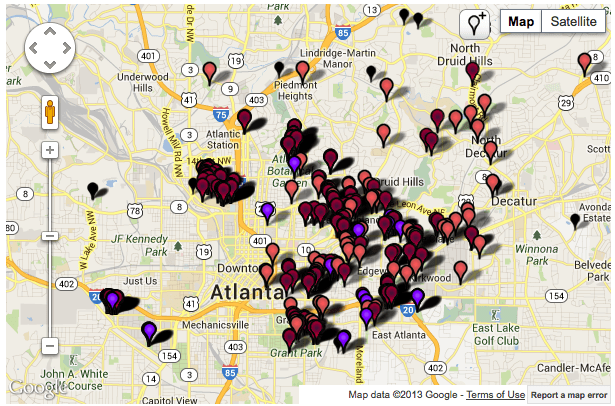
An ongoing project to document food sources in the Atlanta area. It is very incomplete and constantly changing, so if you know about a great fruit tree or other food source that you think should be on the map, please add it to the map!
Currently in season: blackberry, mulberry, plum, and serviceberry. Gotta get my harvest on.
Intelligent Artifice – The three most common techniques for telling stories in games
Mainstream games, or at least a significant subset that I’m too lazy to define here, make use of three big techniques to tell stories:
- Cut-scenes.
- Invisible boxes.
- Environmental storytelling.
I think both game developers and players understand these techniques by now, and in fact I think players are getting tired of them. I know I am.
Intelligent Artifice – The three most common techniques for telling stories in games
Alex Payne — Letter To A Young Programmer Considering A Startup
Here are some things to consider that, in my experience, you’re less likely to hear about working in startups.
Good essay. I’ve been thinking this for a while:
Startups are portrayed as an exciting, risky, even subversive alternative to traditional corporate work. Startups are thought of as more free, more open and flexible. Some companies surely begin that way, but a few interviews at later-stage startups will make clear just how quickly they ossify into structures that look very much like the organizations that came before them.
As there was in the first dot com bubble, there is a current proliferation of startups, incubators, accelerators, angel/seed funding, and so forth. In order for the “startup community” to replicate itself, nanobot-like, the mechanics of “doing a startup” have been reduced to an easily transmitted sequence of actions accompanied by a shared set of values, norms, and language.
Alex Payne — Letter To A Young Programmer Considering A Startup

Cinema du WTF – UPSTREAM COLOR (Shane Carruth 2013) – Bright Lights After Dark.
Even at its most obscure, Upstream Color keeps the viewer involved thanks to the aforesaid music score and the flow of its nature-derived imagery – sunlight, water, animals, insects, and birds (see still at top of page) and the archetypal blue flower motif. The consistent beauty of the imagery gives the movie the feel of poetry:
O Rose thou art sick.
The invisible worm,
That flies in the night
In the howling storm: Has found out thy bed
Of crimson joy:
And his dark secret love
Does thy life destroy.(“The Sick Rose” by William Blake.)
I can’t seem to stop reading about this movie since I watched it a few weeks ago. That blue flower connection is a good find.
Does reading have a future? A noted Canadian philosopher gazes into the future
Via Alan Jacobs, who rightly encourages you to read the whole thing.
It’s not technophobic or Luddite to recognize that the techie questions are largely beside the point. The scope of their effects lies on a time scale that none of us can foresee, thus creating not genuine questions but opportunities for self-serving predictions.
Ha! Also:
The specific concern for the future of the bound-page book should be seen for what it is: a form of fond special pleading whereby a particular (how I like to read) masquerades as a universal (reading!).
His essay is more thoughtful and substantial than those quotes, by the way. I just thought they were funny.
Does reading have a future? A noted Canadian philosopher gazes into the future

Part of my drinking was so much about trying not to feel things, to not feel how I actually felt, and the terrible thing about being so hidden is if people tell you they love you… it kinda doesn’t sink in. You always think, if you’re hiding things, How could you know who I am? You don’t know who I am, so how could you love me? Saying who I am, and trying to be as candid as possible as part of practicing the principles, has permitted me to actually connect with people for the first time in my life.
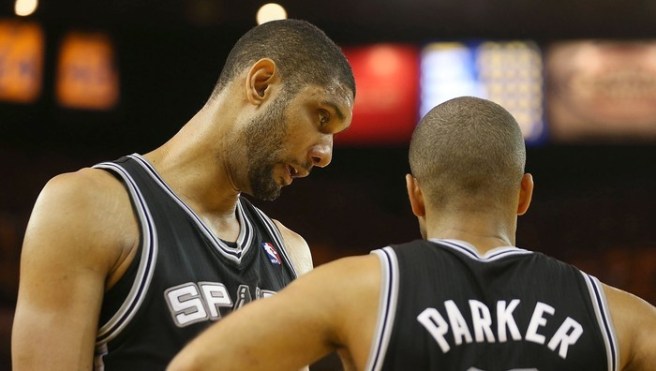
Tim Duncan Encourages Teammates To Be Fathers First, Basketball Players Second | The Onion.
“What you do on this court is nothing compared to what you do at home for your children,” said Duncan, adding that what this country lacks most is not basketball players but mature men. “The playoffs end in June, but the responsibilities of fatherhood? Those are year-round. Guys, it doesn’t matter if you score 10,000 points or win three NBA championships—spending time with your kids: that’s the championship.”
The Onion and Tim Duncan go way back.
The Fast and the Furious: Tokyo Drift

The Fast and the Furious: Tokyo Drift. Now we’re getting somewhere! Better than the first, way better than the second. I like how the physical/technical strain of the driving is more evident. Definitely a contrast with the delinquent joyride thrills of the second movie. And the change to mostly night-time, dense, urban driving makes for all kinds of crazy lighting and colors that gives the restless camera more to ogle. The two opposing father-son stories work. One son rebellious, one obedient. A possibly inadvertent dramatic bonus: what with the setting not being conducive to reckless gun-play in the streets, the few times when a gun is drawn are a bit more potent. Great job on audio across the board. Also, the scene with Neela driving is reminiscent of Toretto’s “10 seconds” monologue, but it also instantly made me think of the balcony scene in Heat.
2 Fast 2 Furious

2 Fast 2 Furious. Not as good as the first one, bro. Seemed more exploitative, more dopey, more juvenile. Tyrese is funny and charismatic, whereas Paul Walker’s performance reaches new levels of… subtlety (Ebert perfectly describes him as Don Johnson lite). BUT, those chases are fun. Nice to see them driving in legitimate traffic this time around. Also: Luda + Eva Mendes. Out of Sight and Miami Vice are far better Miami movies. I still haven’t seen either of the Bad Boys films, unfortunately.
 Mark Larson