What should we be without the sexual myth,The human revery or poem of death?
Castratos of moon-mash—Life consists
Of propositions about life. The humanRevery is a solitude in which
We compose these propositions, torn by dreams,By the terrible incantations of defeats
And by the fear that defeats and dreams are one.The whole race is a poet that writes down
The eccentric propositions of its fate.
Category: writing
The New Kings of Nonfiction (review: 3/5)

Ira Glass curated this collection of nonfiction. The New Kings of Nonfiction is a selection of favorites that he’s had filed away for a while, articles that he keeps passing along to others. The focus is on good storytelling found in original reporting:
I wish there were a catchy name for stories like this. For one thing it would’ve made titling this collection a lot easier. Sometimes people use the phrase “literary nonfictioni” for work like this, but I’m a snob when it comes to that phrase. I think it’s for losers. It’s pretentious, for one thing, and it’s a bore. Which is to say, it’s exactly the opposite of the writing it’s trying to describe. Calling a piece of writing “literary nonfiction” is like daring you to read it.
Not only is it a pretty good collection, but almost all of them are available online, in their entirety. Someone is listening to my prayers. My comments on each, roughly listed from Must Read to Don’t Bother…
“Losing the War” is easily my favorite work in the book (made obvious by the dog-ears). And I tend to have severe World War II nausea, so I was surprised to like it so much. Lee Sandlin explores the “collective anxiety attack” of the war, the impressions of the war that Americans got through the weak, cheerful reporting from the frontlines, and how we remember and how we forget. Highly recommended.
In one of the better tales in the book, Michael Lewis wrote about “Jonathan Lebed’s Extracurricular Activities.” Lebed, at 15 years old, was called out by the Securities and Exchange Commission for stock market manipulation and doesn’t seem very much phased by it. Fun story.
Jack Hitt‘s “Toxic Dreams: A California Town Finds Meaning in an Acid Pit” is another good one that covers ballooning litigation over the Stringfellow Acid Pit, a local dumping ground made to spur business. Naturally, with a name like that, you’re going to end up with a lawsuit. This one has 4,000 plaintiffs and doesn’t look to end anytime soon. Recommended.
Susan Orlean profiles a ten-year-old in “The American Man, Age Ten.” Interesting voice in this one.
Michael Pollan bought a cow and writes about its journey from birth to beef in “Power Steer.” And he touches on how our food chain all interconnects and the twin scourges of oil and cheap corn.
Though I’m not much for card games, I did like James McManus‘ story in “Fortune’s Smile.” McManus learns the ins and outs of no-limit hold’em and enters the World Series of Poker, and walks out with $250,000. A lot of the lingo flew over my head, but the spirit is right and the story is good.
“Tales of the Tyrant” is Mark Bowden‘s profile of Saddam Hussein. The scale of the vanity and self-delusion are incredible. It makes the guy a lot more human and a lot more disgusting. Pretty good read.
“Crazy Things Seem Normal, Normal Things Seem Crazy” is Chuck Klosterman‘s profile of Val Kilmer. I’d recommend it, keeping in mind what Ira Glass says about Klosterman in the introduction: When Klosterman does reporting, the superstructure of ideas and the aggressiveness with which he states those ideas are a big part of what makes the stories stand out.”
“Shapinsky’s Karma” [excerpt] by Lawrence Weschler follows an improbably cheerful, persistent Indian man who has found his calling in promoting the artwork of Harold Shapinksy, an undiscovered peer of Jackson Pollock, Mark Rothko, and others, who is in his 80s at the time.
Bill Buford reports on hanging out with a bunch of rowdy Manchester United loyalists in “Among the Thugs.” It takes a while to warm up, but the later bits about group psychology and inevitable soccer mob violence are good (and downright scary).
“Host,” by David Foster Wallace, is the longest in the book (surprise!). It’s a profile of a conservative radio personality in California. I couldn’t get much into it, but I do like this bit from one of the many sidebars:
It’s hard to understand Fox News tags like “Fair and Balanced,” “No-Spin Zone,” and “We Report, You Decide” as anything but dark jokes, ones that delight the channel’s conservative audience precisely because their claims to objectivity so totally enrage liberals, whose own literal interpretation of the tag lines makes the left seems dim, humorless, and stodgy.
Dan Savage‘s “My Republican Journey” is about being homosexual and infiltrating a local Republican group. Eh.
“Six Degrees of Lois Weinberg” is Malcolm Gladwell’s exploration of one woman’s social network. Not recommended.
“The Hostess Diaries: My Year at a Hot Spot” by Coco Henson Scales is okay, but feels out of place here and doesn’t measure up to the other writing in the book.
“Masterpieces are not single and solitary births; they are the outcome of many years of thinking in common, of thinking by the body of the people, so that the experience of the mass is behind the single voice.”
George Orwell’s essay Poetry and the Microphone talks about broadcasting verse over the radio, but I think there are some internet parallels here, another way to cross distances. People who are interested can find and enjoy just as easily as those who aren’t interested can move along. That combination of distance and intimacy affects how you perceive your own work:
It is reasonable to assume that your audience is sympathetic, or at least interested, for anyone who is bored can promptly switch you off by turning a knob. But though presumably sympathetic, the audience has no power over you. It is just here that a broadcast differs from a speech or a lecture. On the platform, as anyone used to public speaking knows, it is almost impossible not to take your tone from the audience. It is always obvious within a few minutes what they will respond to and what they will not, and in practice you are almost compelled to speak for the benefit of what you estimate as the stupidest person present, and also to ingratiate yourself by means of the ballyhoo known as ÄúpersonalityÄù. If you donÄôt do so, the result is always an atmosphere of frigid embarrassment. That grisly thing, a Äúpoetry readingÄù, is what it is because there will always be some among the audience who are bored or all but frankly hostile and who canÄôt remove themselves by the simple act of turning a knob…
The poet feels that he is addressing people to whom poetry means something, and it is a fact that poets who are used to broadcasting can read into the microphone with a virtuosity they would not equal if they had a visible audience in front of them. The element of make-believe that enters here does not greatly matter. The point is that in the only way now possible the poet has been brought into a situation in which reading verse aloud seems a natural unembarrassing thing, a normal exchange between man and man: also he has been led to think of his work as sound rather than as a pattern on paper. By that much the reconciliation between poetry and the common man is nearer. It already exists at the poetÄôs end of the ether-waves, whatever may be happening at the other end.
Writers really do die young, especially poets, based on research in The Cost of the Muse [$, or use your library’s access]. [via maud newton]
Rob Giampietro is blogging via postcard this week. I got my first one this afternoon:

I tracked down John Haines’ poem, Return to Richardson, Spring 1981, which I first came across in the recent profile of composer John Luther Adams.
Then!
A short story written by the 6-year-old brother of one of my co-workers:
One day I woke up. I was haf chipmunk and bus. Then! I stareted to driv bep bep. Then I stareted to run wee. Thes is fun driving and runing. Then I crasht in to a treey. Ach
The third sentence is one of the best bits of writing I’ve seen in a while.
There’s a really good, really funny interview with Richard Price in the Believer:
I have to be a little intimidated by what IÄôm writing about. I have to feel a little bit like I donÄôt think I can do this, I donÄôt think I can master this, I donÄôt think I can get under the skin of this, because when youÄôre a little scared, youÄôre bringing everything to the table because youÄôre not sure you can do it unless you bust your balls and really, really get into it. Terror keeps you slender. I need a sense of awe. Oh, shit! I canÄôt believe I just saw that! But then what do you do with what you saw? ThatÄôs the bottom line. ThatÄôs the novel.
On writing novels vs screenplays:
BLVR: Do you wake up every morning and write right away?
RP: It depends. It depends if thereÄôs anybody waiting for it. If thereÄôs not anybody waiting for it, I can get slack. ThatÄôs also the good thing about screenwriting, is that there are other people involved. If youÄôre writing a novel, once you sign a contract and have a couple years to write it, thatÄôs it. YouÄôre on your own. You can have cobwebs, you can look like Miss HavershamÄôs wedding cake before anybody gives a shit.
PLEASE STOP MOWEING YOUR LAWN SO EARLY
 Today I spent some time sorting through a bunch of old documents, notes, letters, tickets, playbills, etc. I came across an old letter placed in the mailbox back home when I was away at college. A summer of cutting the grass earned me a bad reputation that Dad must have continued into the fall that year.
Graphing the accepted spelling of “ThunderCats, ho!”

Based on some keyword research I did this afternoon. “ThunderCats, ho!” is a natural winner in Google search results. The long tail of enthusiasm extends to over 35 o’s, after which point I gave up.
The most interesting part is that HUGE drop in hits for the 3-o version. Among its neighboring easy-to-type competitors, “ThunderCats, hooo!” is a clear loser. If you want to stay in the safe, accepted, comfortable range, stick with the 1-, 2-, 4-, 5-, or 7-o versions. I’m drawn to the 10+ range for sheer exuberance.
A collection of 100 great opening lines. I wonder, for comics, what a collection of great opening panels would look like…? [via sbh]
The Well-Dressed Man With A Beard.
After the final no there comes a yes
And on that yes the future world depends.
No was the night. Yes is this present sun.
If the rejected things, the things denied,
Slid over the western cataract, yet one,
One only, one thing that was firm, even
No greater than a cricket’s horn, no more
Than a thought to be rehearsed all day, a speech
Of the self that must sustain itself on speech,
One thing remaining, infallible, would be
Enough. Ah! douce campagna of that thing!
Ah! douce campagna, honey in the heart,
Green in the body, out of a petty phrase,
Out of a thing believed, a thing affirmed:
The form on the pillow humming while one sleeps,
The aureole above the humming house…
It can never be satisfied, the mind, never.
Man, I really like Wallace Stevens. [via 1000timesno]
Not Ideas about the Thing but the Thing Itself by Wallace Stevens.
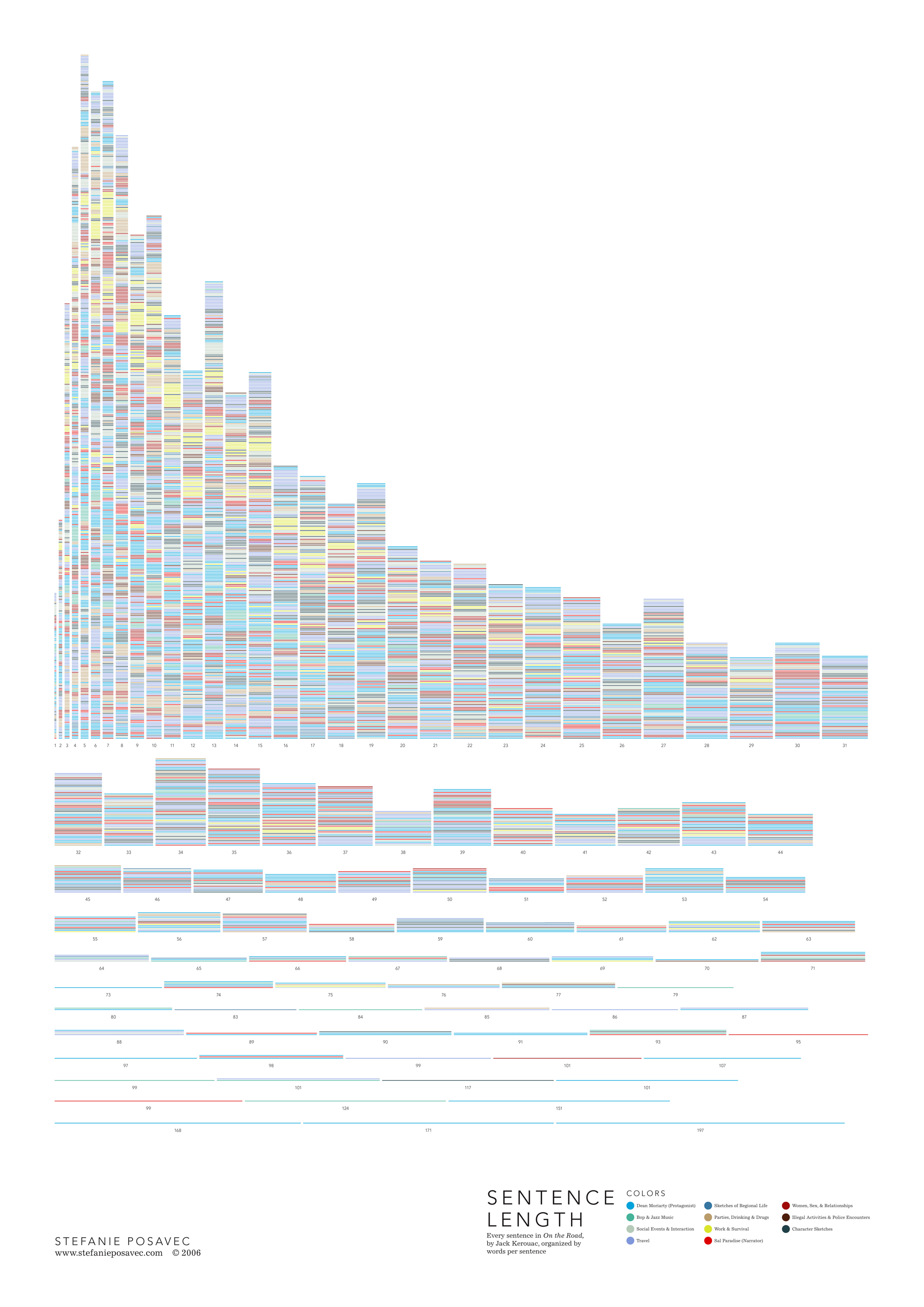
Stefanie Posavec made a diagram of every sentence in On the Road organized by words per sentence. Here are more literary diagrams.
This fictional Paris Review Interview with “Constance Eakins” is a clever bit of promotion for The Mayor’s Tongue. Here’s a pdf of the interview [1.5mb]. Eakins started with comics:
Interviewer: Was it when you ran away from home that you began to feel that you were going to be a writer?
Eakins: No, I always wanted to be a writer, even before I was born. My first story was what I like to call an image-story. When I hadn’t yet learned how to speak, my dear mother would give me a parcel of rusty nails, which I used to draw abstract shapes on the walls of our home.
I: How do you know that these were stories? I mean, doesn’t every child make drawings if given some sort of writing implement?
E: They were image-stories and if you went to look at them now they would make you weep from the beauty of their narrative swoop.
The classic nuts and bolts…
I: When do you begin writing each day? As soon as you wake up?
E: Yes, when I wake up in the morning I always have the desire to sit down to write. The first thing I do is write down my dreams, then I get to my fiction, poetry, theater, film scripts, monographs, critical essays, and journalism—in that order. But then I constantly am receiving telephone calls, gawking fans come up to my house, friends try to visit, and I am all the time interrupted. Somehow I manage to keep on writing.
[via maud newton]
The Thurber & White send-up on the knee phenomenon:
Simply stated, the knee phenomenon is this: occasions arise sometimes when a girl presses her knee, ever so gently, against the knee of the young man she is out with… Often the topic of conversation has something to do with it: the young people, talking along pleasantly, will suddenly experience a sensation of compatibility, or of friendliness, or of pity, or of community-of-interests. One of them will make a remark singularly agreeable to the other person—a chance word or phrase that seems to establish a bond between them. Such a remark can cause the knee of the girl to be placed against the knee of the young man. Or, if the two people are in a cab, the turning of a sharp corner will do it. In canoes, the wash from a larger vessel will bring it about. In restaurants and dining-rooms it often takes place under the table, as though by accident. On divans, sofas, settees, couches, davenports, and the like, the slight twist of the young lady’s body incident to receiving a light for her cigarette will cause it… Now, a normal male in whom there are no traces of frigidity will allow his knee to retain its original position, sometimes even exerting a very slight counter-pressure. A frigid male, however, will move is knee away at the first suggestion of contact, denying himself the electric stimulus of love’s first stirring.
The seven deadly words of book reviewing. There are over 200 comments now that add to the list, most of them very good.
Die Sonne (review: 4/5)
A man chases the sun through city, sky, and sea in this wordless story by Frans Masereel. Here’s my favorite sequence from Die Sonne:
[update: images removed due to copyright complaint from Verwertungsgesellschaft Bild-Kunst. no more free publicity—you’ll have to trust me that it’s worth your time]
Take a look at some other woodcuts from Die Sonne. This is the first of four Masereel books that I recently picked up at the Emory library. I’m sure I’ll enjoy the others over the next week or two.
I rediscovered Chuck Klosterman this week. Even when I don’t buy a word he writes, it’s usually just plain fun to read. From a good review of his book I’m reading now, Chuck Klosterman IV:
Younger generations of Americans urgently need to learn to refuse their culture at face value, lest the stories sold by media conglomerates and advertising firms come to define them individually (more than they already do). IÄôm not arguing that a North Dakotan with a stack of KISS albums and a bong is going to single-handedly change the country. But he might be an enzyme for some sort of progression…
One interesting twist to all this may be KlostermanÄôs own melee with celebrity. Chuck Klosterman IV will serve as a benchmark on KlostermanÄôs own celebrity arc—heÄôs that much closer to the falling action on this ride to success. What personal crisis must follow? What could becoming a celebrity mean to someone whose purpose is to decipher the spaces inhabited by celebrities and their metaphors?
 Mark Larson