Playboy Interview: Metallica (April 2001)

This interview is packed with wonderful tidbits. James Hetfield on day jobs and the early tour routine:

We worked at day jobs. After that, we’d throw parties, take the furniture out of the house and smash the joint. We smashed dressing rooms just because you were supposed to. Then you’d get the bill and go, “Whoa! I didn’t know Pete Townshend paid for his lamp!” Come back off the tour and you hadn’t made any money. You bought furniture for a bunch of promoters.

Hetfield on growing up differently from Lars Ulrich:

I could afford maybe one record a week, and he would come back from the store with 20. He bought Styx and REO Speedwagon, bands he’d heard of in Denmark. I would go, “What the fuck? Why did you buy Styx?“

Kirk Hammett on Hetfield’s Nothing Else Matters:

All I could think of at the time was, James wrote a fucking love song to his girlfriend? That’s just weird.

Hetfield on alcohol abuse and parenthood:

You can’t be hung over when you got kids, man. “Dad, get the fuck off the couch!” Well, they don’t say that—yet.

Ulrich on Matt Damon:

PLAYBOY: Your wife, Skylar, used to date Matt Damon, and he made her the model for the female lead in Good Will Hunting. A few years ago, Matt described you as “a fucking rock star who’s got $80 million and his own jet—a bad rock star, too.”

ULRICH: He said that before we met. And he’s apologized about a hundred times. The first five times I saw him, he would spend 10 minutes apologizing profusely. He really is a sweetheart.

Ulrich on collecting art:

Hanging out backstage with Kid Rock is an amazing turn-on, no less so than sitting and staring at my Dubuffet for an hour with a fucking gin and tonic.
Playboy Interview: Metallica (April 2001)

Playboy Interview: Metallica (April 2001)

This interview is packed with wonderful tidbits. James Hetfield on day jobs and the early tour routine:

We worked at day jobs. After that, we’d throw parties, take the furniture out of the house and smash the joint. We smashed dressing rooms just because you were supposed to. Then you’d get the bill and go, “Whoa! I didn’t know Pete Townshend paid for his lamp!” Come back off the tour and you hadn’t made any money. You bought furniture for a bunch of promoters.

Hetfield on growing up differently from Lars Ulrich:

I could afford maybe one record a week, and he would come back from the store with 20. He bought Styx and REO Speedwagon, bands he’d heard of in Denmark. I would go, “What the fuck? Why did you buy Styx?“

Kirk Hammett on Hetfield’s Nothing Else Matters:

All I could think of at the time was, James wrote a fucking love song to his girlfriend? That’s just weird.

Hetfield on alcohol abuse and parenthood:

You can’t be hung over when you got kids, man. “Dad, get the fuck off the couch!” Well, they don’t say that—yet.

Ulrich on Matt Damon:

PLAYBOY: Your wife, Skylar, used to date Matt Damon, and he made her the model for the female lead in Good Will Hunting. A few years ago, Matt described you as “a fucking rock star who’s got $80 million and his own jet—a bad rock star, too.”

ULRICH: He said that before we met. And he’s apologized about a hundred times. The first five times I saw him, he would spend 10 minutes apologizing profusely. He really is a sweetheart.

Ulrich on collecting art:

Hanging out backstage with Kid Rock is an amazing turn-on, no less so than sitting and staring at my Dubuffet for an hour with a fucking gin and tonic.

Playboy Interview: Metallica (April 2001)

The Simple Art of Murder – Raymond Chandler

Chandler on the detective story and how it resists criticism. This bit reminded me of Joan Acocella’s recent article about Stieg Larsson:

The murder novel has also a depressing way of minding its own business, solving its own problems and answering its own questions. There is nothing left to discuss, except whether it was well enough written to be good fiction, and the people who make up the half-million sales wouldn’t know that anyway.

A bit cynical, but there you go. Also provocative:

There are no vital and significant forms of art; there is only art, and precious little of that. The growth of populations has in no way increased the amount; it has merely increased the adeptness with which substitutes can be produced and packaged.

And of course:

Everything written with vitality expresses that vitality; there are no dull subjects, only dull minds. All men who read escape from something else into what lies behind the printed page; the quality of the dream may be argued, but its release has become a functional necessity. […] I hold no particular brief for the detective story as the ideal escape. I merely say that all reading for pleasure is escape, whether it be Greek, mathematics, astronomy, Benedetto Croce, or The Diary of the Forgotten Man. To say otherwise is to be an intellectual snob, and a juvenile at the art of living.

See also Woody Allen on escapism. The next-to-last paragraph about the nature of the crime/detective story hero is also worthwhile.

The Simple Art of Murder – Raymond Chandler

Raymond Chandler – The Simple Art of Murder

Chandler on the detective story and how it resists criticism. This bit reminded me of Joan Acocella’s recent article about Stieg Larsson:

The murder novel has also a depressing way of minding its own business, solving its own problems and answering its own questions. There is nothing left to discuss, except whether it was well enough written to be good fiction, and the people who make up the half-million sales wouldn’t know that anyway.

A bit cynical, but there you go. Also provocative:

There are no vital and significant forms of art; there is only art, and precious little of that. The growth of populations has in no way increased the amount; it has merely increased the adeptness with which substitutes can be produced and packaged.

And of course:

Everything written with vitality expresses that vitality; there are no dull subjects, only dull minds. All men who read escape from something else into what lies behind the printed page; the quality of the dream may be argued, but its release has become a functional necessity. […] I hold no particular brief for the detective story as the ideal escape. I merely say that all reading for pleasure is escape, whether it be Greek, mathematics, astronomy, Benedetto Croce, or The Diary of the Forgotten Man. To say otherwise is to be an intellectual snob, and a juvenile at the art of living.

See also Woody Allen on escapism. The next-to-last paragraph about the nature of the crime/detective story hero is also worthwhile.

Raymond Chandler – The Simple Art of Murder


http://mlarson.tumblr.com/post/1116156258/audio_player_iframe/mlarson/tumblr_l8p5ngdnPt1qzcye0?audio_file=http%3A%2F%2Ftraffic.libsyn.com%2Fphilosophybites%2FCynthia_Freeland_on_Portraits.mp3

Philosophy Bites: Cynthia Freeland on Portraits. This is a really great episode. Art history, portraiture, photography, self-representation, etc. One of the topics that came up was Roland Barthes’ book Camera Lucida, a short volume on photography written after his mother’s death. (See also his journal excerpts from the same time period.) Given the choice, Freeland would like David Hockney to do her own portrait.

The toy is the child’s earliest initiation into art, or rather for him it is the first concrete example of art…

Charles Baudelaire, “A Philosophy of Toys” (via) cf. “[Making art is] practicing a physical activity with a certain state of mind. It’s similar to a kid who is absorbed in deep play. A kid with a toy is in a relationship with that toy. The toy is playing with him just as much as he’s playing with the toy.” – Lynda Barry (via austinkleon)

Art really saved my life because art is how I proved that I wasn’t a malingerer.

Interview with Chuck Close. A long, wonderful discussion of his life and work. Topics include playing to your strengths, supportive parents, taking art classes in a brothel, and much much much more.

American Drink: Purist Intentions

Not everyone agrees with my No Rules Rule. Siiiiiiigh. Naturally. After all, this is America, where the only art more popular than the art itself is the art of being a dick about the art. Same as baseball, jazz, porn, and every other invented-for-fun pastime, drinking is rife with fundamentalist nutjobs (see “purists”) who have one way of doing things–by the book. And not that book either. This book, with the leather binding and 6pt Century Gothic. The old one.

American Drink: Purist Intentions

wnbrgr:

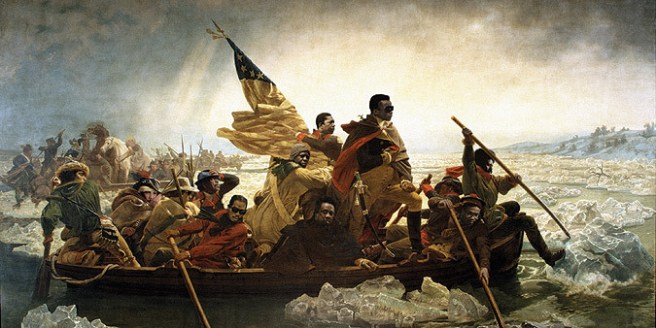
Jazzcats Crossing the Hudson

Jazzcats Crossing the Hudson is an 1851 oil-on-canvas painting by German American artist Emanuel Gottlieb Leutze. It pre-emptively commemorates the arrival in New York City of jazz greats Miles Davis, John Coltrane, Sun Ra, Pharoah Sanders, Steve Kuhn and others. The painting is remarkable for the fact that it was created decades before the birth of any of these jazz artists.”

via mastertone

Movie directors, or should I say people who create things, are very greedy and they can never be satisfied, … That’s why they can keep on working. I’ve been able to work for so long because I think next time, I’ll make something good.

You can afford to expose yourself to uncertainties in art that you wouldn’t allow yourself in real life. You can allow yourself to get into situations where you are completely lost, and where you are disoriented. You don’t know what’s going on, and you can actually not only allow yourself to do that, you can enjoy it.