austinkleon:

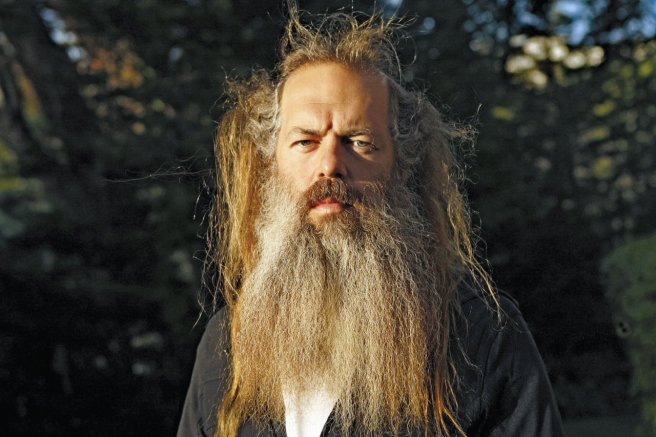
An interview with Rick Rubin

On not-knowing:

I never decide if an idea is good or bad until I try it. So much of what gets in the way of things being good is thinking that we know. And the more that we can remove any baggage we’re carrying with us, and just be in the moment, use our ears, and pay attention to what’s happening, and just listen to the inner voice that directs us, the better. But it’s not the voice in your head. It’s a different voice. It’s not intellect. It’s not a brain function. It’s a body function, like running from a tiger.

On producing:

So how would you describe your role as a producer, in general?

Just as fan. Making music that I want to hear. You’re so close to something when you write it that it’s hard to have any perspective on how it hits someone else. My job is to be a professional version of the outside world—a listener who is not attached to any of it, who doesn’t know the story of how it was written, who doesn’t know how it works, who doesn’t know why this is important to you.

On stripping things down:

There’s a tremendous power in using the least amount of information to get a point across.

Wonderful interview.

So great. That part about being a “professional version of the outside world” reminded me of Jeremy Denk’s New Yorker essay about recording, and how hard it is to get perspective. A favorite quote:

In the moment of playing, the logistics of just hitting the notes distract you somewhat from the continuous choices you are making. In the edit you have nothing but choice. And yet you feel helpless, since everything has already been played.

And since he talked about Kanye, remember the rules: No hipster hats. No acoustic guitar in the studio.

Side Effects

Side Effects. I made this a Soderbergh-takes-on-controlled-substances double-feature with Traffic. Hitchcockian psycho-thriller here. It gets too clever in the final act, but I like that you see new facets of these characters all the way up to the end. I think his understated style helps manage those swings. Soderbergh can be pretty overt with his themes, especially with some side characters that are basically there for social commentary. The leads are strong, though. I totally forgot about the intro and did the jaw-drop forehead-slap thing with the kitchen scene. Good soundtrack tends to linger and push things along, like in Contagion.

And now to catch up on rankings for all the Soderbergh movies I’ve seen:

  1. Haywire
  2. Out of Sight
  3. Magic Mike
  4. The Girlfriend Experience
  5. Solaris
  6. Contagion
  7. The Informant!
  8. Ocean’s Eleven
  9. Traffic
  10. Side Effects
  11. Ocean’s Twelve
  12. Ocean’s Thirteen

Seriously, what a great director. I don’t think you can credibly use the word “mediocre” or even “average” about any of those movies until you get down to number 10 or 11 maybe.

Traffic

Traffic. It took a good hour before I realized I’d seen it before. It took a good two seconds before I remembered that I have a huge man-crush on Benicio del Toro. He’s so good. Don Cheadle, too. The movie as a whole is pretty straightforward, docudrama-ish style, not played up for emotions like Babel or other multi-storyline, “highbrow globalist tearjerkers”. A few interesting things… the cool blue tint for U.S. interiors vs. the overexposed yellows in Mexico; the tension between identity and professional image; and the anecdote about Khrushchev and the two letters:

You know, when they forced Khrushchev out, he sat down and wrote two letters to his successor. He said, “When you get yourself into a situation you can’t get out of, open the first letter, and you’ll be safe. When you get yourself into another situation you can’t get out of, open the second letter”. Well, soon enough, this guy found himself into a tight place, so he opened the first letter. Which said, “Blame everything on me”. So he blames the old man, it worked like a charm. He got himself into a second situation he couldn’t get out of, he opened the second letter. It said, “Sit down, and write two letters”.

Hilary Mantel reviews ‘Tormented Hope’ by Brian Dillon · LRB 5 November 2009

Anxiety about a specific symptom is more bearable and easier to rationalise than the diffuse ontological malaise that used to be known as spiritual despair. It is easier to say ‘my knee is killing me,’ because we know it isn’t, than to dwell in the belief that the clock is ticking and that the journey from birth to death is a journey to extinction; it is better to have a symptom than to have a void inside.

Hilary Mantel reviews ‘Tormented Hope’ by Brian Dillon · LRB 5 November 2009

The French Connection

The French Connection. It’s a great “mean cop” flick. Gene Hackman’s “Popeye” Doyle is pretty unlikeable, but you still find yourself on his side despite all the recklessness and disregard for, y’know, the law. I love the attention to detective details here, the surveillance stuff with all the stake-outs, and the car tails, and the cat-and-mouse following on foot with a switching team. Also: that final chase is legit.

Frank Chimero × Blog × Web Tableaus

The past week has provided a few notable redesigns of popular web services, including Squarespace and MailChimp. It’s interesting to note the visual similarities in how they have chosen to present themselves: photographed tableaus with props around laptops, tablets, and phones.

See also Matt Thomas’s great post on depicting knowledge work in film, and Felix Salmon’s recent tumble on marketing for mobile banking apps.

Both feature a cup of artisanal coffee on a dark wood counter, next to an iPhone 4 displaying the app in question. How to choose between them?

Surface Tension

As the different court surfaces are modified to play more similarly, players whose game is well-suited to those physics will dominate more and more. I’d never thought about this before.

Maybe relevant here: The same four players have won every major and Olympic gold medal except one in the past eight years. That’s 34 big titles for Federer, Nadal, Djokovic, and Andy Murray, and one for every other tennis player on earth.

Surface Tension

The Conversation

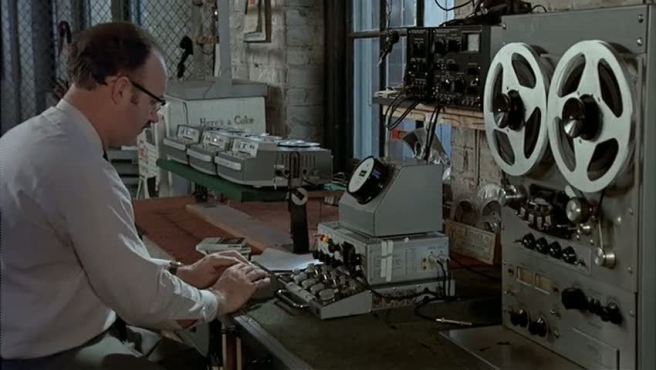
The Conversation. Great, great flick. The scale is so small and focused, and the protagonist is a perfect tragic character, in turns expert and inept. Themes: Surveillance and paranoia. Temptation vs. dull professionalism. Signal, noise, interpretation, expertise. I love how the movie’s opening and closing mirror each other, or maybe I should say echo each other. Gene Hackman is fantastic. Harrison Ford has one of the best scowls in the game. Fun fact: Coppola released both this and The Godfather Part II in 1974. That’s a good year, huh?

Sinking Into the World of ‘Upstream Color’ With Director Shane Carruth – Movies – BlackBook

I love narrative and how it exists and why it exists and how it’s meant to be used. You can come up with a paragraph full of some truth, something that’s universal, some exploration, and it can be really informative, but it’s likely to not be that interesting. But you can spin a story, you can tell a narrative, and you can infuse it with this stuff, and if you’ve done your job right, you haven’t just captured somebody’s attention long enough to take them on this journey, you’ve also figured out something about the exploration through the act of the story.

Says the guy who made one of the most interesting movies I’ve seen this year.

Sinking Into the World of ‘Upstream Color’ With Director Shane Carruth – Movies – BlackBook

Man of Steel

Man of Steel. The best part of this movie was seeing Michael Shannon in Kansas, which reminded me I need to watch Take Shelter again. Otherwise, very disappointing and a waste of a good cast. Snyder bit off more themes than he could chew, even with 2.5 hours to work with. All dull rush and no impact. Then it devolves into heartless, comprehensive destruction. This is not a Superman that speaks to me. Oh, well. I’ll always have the teaser.

Before Midnight

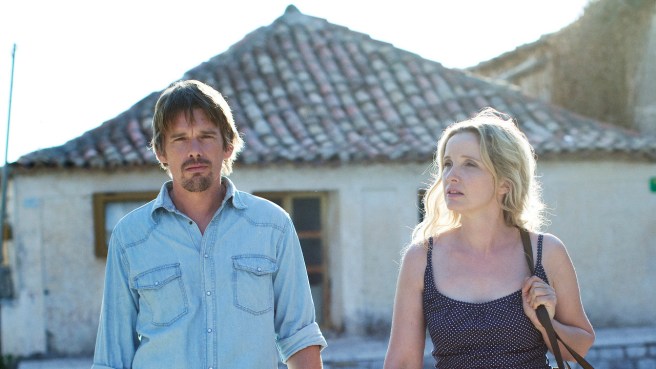
Before Midnight. I’d call it a must-see if you’ve seen and liked the previous two movies. It’s been a real treat to see these fictional people grow and change. There’s a couple moments in there (a dinner table monologue, a sunset countdown) that are so perfectly heartstring-tugging and bittersweet. I also liked the expanded cast with some couples older and younger to add some ground or contrast, and the timely nods to new technology and ways we connect. Somewhat in the same vein, I have to recommend Certified Copy, a brilliant walk-and-talk Mediterranean maybe-romance.

Choice And The Moral Universe Of ‘Man Of Steel’ [Opinion] – ComicsAlliance

Different heroes have different values, different roles, and they tell different stories. For much of the audience, Superman is the virtuous hero, and a story that doesn’t explore this is not a Superman story. And really, the makers of Man of Steel did not seem overly interested in telling a Superman story.

Ditto everything in this essay.

Choice And The Moral Universe Of ‘Man Of Steel’ [Opinion] – ComicsAlliance

Bronson

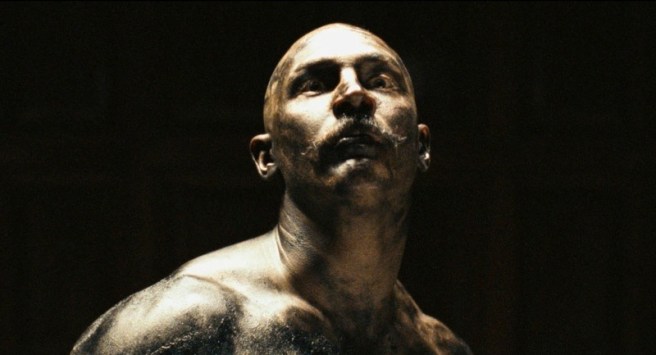
Bronson. It’s an oddball comedy-horror character portrait, goofier and more stylized than I expected, e.g. the frequent juxtaposed opera in the soundtrack. My respect for Tom Hardy keeps growing. Refn really has a thing for these violent loner types. Hunger is a very, very different look at a UK prison experience that’s worth seeing.