I was a music producer, and everyone was telling me that I had no business becoming a rapper, so it gave me the opportunity to tell everyone, “Hey, I need some time to recover.” But during that recovery period, I just spent all my time honing my craft and making The College Dropout. Without that period, there would have been so many phone calls and so many people putting pressure on me from every direction—so many people I somehow owed something to—and I would have never had the time to do what I wanted to.
Jack Reacher

Jack Reacher. Pulpy, ridiculous, and just barely passable thriller. Tom Cruise, though. I love how pretty much every female in the movie starts drooling whenever he passes by. He’s a pretty remorseless “hero”, but interesting to see him enact a very personal brand/blend of justice and opportunism.
Learning to Measure Time in Love and Loss
Her

Her. I expected to love it, I did, and I still was pleasantly surprised with some of the mordant humans-are-screwed humor and the science-fiction-y, speculative thoughtfulness. It’s pretty wonderful. Shout-out to movies that rely on conversation and subtle music. Also neat to see a movie set in the comfortable future – nothing crazy here, just a few plausible tweaks that have had some time to settle in. Some of the writing and face-acting didn’t work for me, but for ideas and smarts, I will forgive many things. Also, seeing Joaquin Phoenix and Amy Adams on screen together again made me want to re-watch The Master.
The Wolf of Wall Street

The Wolf of Wall Street. If Scorsese has any one gift, it is making a scene longer than it needs to be, and somehow not ruining it. If he has a second gift, it’s all the filmic energy that he gets out of moving a camera. Repulsive behavior has rarely been so much fun. Much better than Wall Street. Spring Breakers is another good debauched horror story.
American Hustle
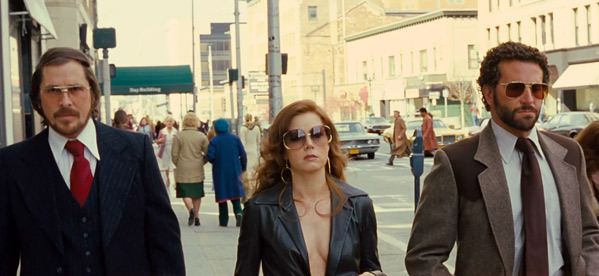
American Hustle. Disappointed with the ending, but that’s heist movies for ya. I should note that most of my disappointment was because most of the movie has such an enjoyable, playful ambiguity to it. You spend so much time on your toes, wondering what these folks are really up to, because there’s no real obvious villain or goal, and then it all wraps up too neatly for my taste. But Amy Adams is so good, the sets and stuff are a trip, and there’s some fun visual gags in there. I’d also recommend David O. Russell’s Three Kings, which has a lot of the same energy and restlessness.
Arbitrage

Arbitrage. Throws you in the middle and lets you figure out the details, as you watch a dude try to keep his composure while bullshitting his way through a very bad week. If you like this, you may also like Michael Clayton (I do), which is similar in its cool, polished tone – dig the soundtrack.
Miami Vice

Miami Vice. This second time around, I was more struck with 1) the noir-iness of the whole thing, and 2) the emphasis on non-verbal communication (gesture, expression, eye contact exchanges, posture, observation & reaction) instead of dialogue. It’s pretty compact storytelling. My first review – I might bump it to number 4 or 5 in my Michael Mann rankings now. Roderick Heath’s review is a must-read.
I Started a Joke: “PBR&B” and What Genres Mean Now | Pitchfork
This is what genres do really well, for good and for ill: They make large amounts of music easier to talk about (and, by extension, sell). Most often, genres do not stand up to scrutiny, yet they’re a fundamental part not only of music discussions online and off, but of any conversations we have about culture more generally. Particularly with the infinite online options for music access and conversation, pithy and memorable genre names can make it easier (if not necessarily accurate) to classify, discuss, and compare music. Genres arise out of tastes, and are often institutionalized (I wrote about one such example here), though online there’s infinitely more space to create, market, sort and search by micro-genres. (Remember “witch house”?) People have lengthy, years-long arguments using genres as combatants. If nothing else, genres make music easier to fight about.
I Started a Joke: “PBR&B” and What Genres Mean Now | Pitchfork
What I Discovered on My Flash Drive
I really like the whole mood and vibe of this review. A smart writer who’s not super-invested in the industry or the product in general, but still curious and open-minded, talking about a new-to-them thing.
I pulled the car — it resembles a growling alien insect — into her high school’s parking lot, and I half-accidentally revved the engine as I came into view. The resulting snort of sound made six dozen pairs of eyeballs swivel in our direction. The only way I can describe this blast is to borrow a phrase from the rock critic Lester Bangs: “imperative groin thunder.” I felt like an idiot. But I went with it.
Metropolitan, or How I Learned to Stop Kvetching and Love Christmas by Ben Mauk
The other first thing you notice is the vibe of Peanuts Take Manhattan. Metropolitan exists in a world populated solely by children and, moreover, by children who act comically adult-like. Parents are rarely mentioned, and even more rarely in-scene. (“I don’t think I’ve met anyone’s parents,” Tom notes.)
Good appreciation here. I need to watch Metropolitan again. I’ve liked all of the Whit Stillman movies I’ve seen.
Metropolitan, or How I Learned to Stop Kvetching and Love Christmas by Ben Mauk
Jerry Seinfeld on how to be funny without sex and swearing
“Comedians are known for having long marriages,” he says. Why? “I have to apologise for the self-serving answer I’m going to give you, but: we’re smart. If you’re smart, you stay married if you can. Marriage is hard for everyone – that’s a basic fact – but it’s a better life if you can do it. Very nice. Very relaxing. Very enjoyable.”
And:
To this day, Seinfeld still marks crosses on a calendar, keeping regular hours (albeit relaxed ones: most days, he says, he’ll meet a friend for a two-hour breakfast) and spending 20 minutes a day doing Transcendental Meditation, which is the only topic to jolt him from his default nonchalance into real enthusiasm: “I could do the whole interview about TM, to be honest, but we’d just lose everybody. I’ll describe it very simply: it’s like you have a phone, and somebody gives you a charger for it. And so now you can recover from this exhausting experience of being a human, twice a day. It’s deep rest. Now that’s something that can help people. As opposed to this idiotic calendar thing.”
http://api.soundcloud.com/tracks/127343178/stream?client_id=N2eHz8D7GtXSl6fTtcGHdSJiS74xqOUI?plead=please-dont-download-this-or-our-lawyers-wont-let-us-host-audio
2013: Roundup • Albums • Songs • Writing • Sounds
This is the third annual installment of my favorite sounds and moments from music this year. All sounds have been extracted from their songs and smashed together in the SoundCloud player above; the list is below so you can follow along.
For three years now I’ve enjoyed Matthew’s collage of his favorite sounds of the year; you might enjoy it too.
This is pretty wonderful.
The Year Music Failed to Blockbust
Music fans tend to regard the implosion of the record industry like most Americans think about overseas wars — we know it’s out there, and it’s very likely bad, but we quickly grow tired of hearing about it because it doesn’t appear to affect us directly.
See my Steven Hyden tag for a couple other of his music articles I’ve liked.
Njál’s Saga (review)
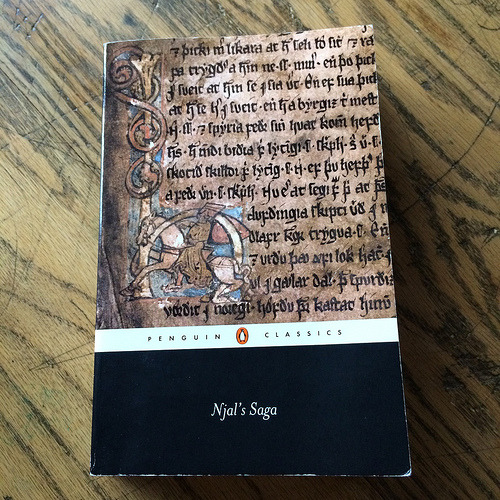
With law our land shall rise, but it will perish with lawlessness.
Poor Njál. He’s caught in the middle of a bunch of hotheads, and his own sons are among the worst of the lot. (“I’m not in on their planning, but I was seldom left out when their plans were good.”) Njál’s Saga is a tale of a multi-decade blood feud in Iceland, and it was one of the most fun, bizarrely addictive books I read this year.
Fun, because it’s full of dudes swinging axes at each other, and various neighborhood troublemakers that keep spurring them on. There was one battle that had me leaping out of my chair, where Njál’s sons get in a fight on a frozen river. Dudes are jumping and slashing and sliding across the ice like something out of a movie. It’s fantastic.
It’s not all action-hero bravado, though. (“Only speak out if you are pushed hard and intend to act.”) What made the page-turning feel so strange is that, for all the action there is, it’s balanced out by a lot of legal wrangling and arbitration. It helps that this story is so deeply rooted in real events, and real people (lots of folks can trace their heritage back to specific characters), and real places (many of which I traveled through a few years ago). It’s not quite strict history, but you can think of it as highly dramatized truth. And part of the messy truth of real life involves a lot of repetitive conversations and agreements and bargains and compromises.
You have this society, one of the earliest democracies we know about. They’re making a go at having laws, contracts, and legal procedures, and sticking to them. They’re eking by at the environmental and social fringe. It’s all so fragile. Heartbreaking.
You’re not letting another man’s woe be your warning, as the saying goes.
I have to mention another part of what made this book work for me: I read the introductory material. That extra bit of context helps it all come alive. I don’t think I’d still be chipping away at The Histories for 17 months and counting if I hadn’t read the opening essays. I used to always, always skip that stuff for… no good reason, really. Now I always, always read it. You never know what you’ll sell yourself on.
Taken

Taken. Preposterous fantasy fulfillment popcorn flick that has everything you need, if that’s all you seek. Tough guy does cool shit! Gérard Watkins was perfect in his brief appearance. Liam Neeson also has a great badass role in The Grey. If you’re looking for another good abduction/chase movie set in Paris, you need to watch À bout portant (Point Blank).
He who travels to be amused, or to get somewhat which he does not carry, travels away from himself, and grows old even in youth among old things. In Thebes, in Palmyra, his will and mind have become old and dilapidated as they. He carries ruins to ruins.
Ralph Waldo Emerson in Self Reliance. Pretty clear echoes of Seneca:
They undertake one journey after another and change spectacle for spectacle. As Lucretius says: “Thus ever from himself doth each man flee.” But what does he gain if he does not escape from himself? He ever follows himself and weighs upon himself as his own most burdensome companion.
Anorexia, the Impossible Subject
If you want to be a beautiful writer, not wanting to connect your illness to your brilliance is nearly impossible.
My Struggle (review)

It wasn’t a question of keeping away from something, it was a question of something not existing; nothing about him touched me. That was how it had been, but then I had sat down to write, and the tears poured forth.
It’s been a while since I finished My Struggle – mid-September, I think – but it has stuck with me. When I finished it, I wasn’t sure if I’d read Knausgård’s second volume, to say nothing of the third, fourth, fifth and sixth. I pre-ordered the second last week.
Reading this book is a strange experience. It’s rarely fun. The book opens with a reflection on death, closes with death, and in between are all manner of musings and journalings about muddling through life and fatherhood. But it’s a great exercise in being aware, a wake-up call. Despite relying on some pretty intense memory-dredging, it doesn’t quite feel sentimental (“Nostalgia is not only shameless, it is also treacherous.”). The challenge seems to be to examine the past so closely that you can let it go – the contrast with what’s actually here and now becomes too stark to ignore.
And there’s a weird addictive quality to it, despite how dark it is sometimes. The writing is mostly functional, rather than poetic or luminous or whatever. And the boldness of his oversharing helps. But it’s the occasional big, beautiful payoff that makes the slogging really worthwhile. (And some of it is indeed pure slog – the 100-page story of a New Year’s Eve beer run is… something else.) There are delights like this description, taken from a section about his college days, when he discovered Theodor Adorno’s writing:
This heavy, intricate, detailed, precise language whose aim was to elevate thought ever higher, and where every period was set like a mountaineer’s cleat.
Such a great image! Or this, trying to capture the feeling of falling in love with a painting:
Yes, yes yes. That’s where it is. That’s where I have to go.
Been there, for sure. I suppose when you write so much without filtering or apparent embarrassment (on life as a teen: “I have never been in any doubt that this is what girls I have tried my luck with have seen in my eyes. Too much desire, too little hope.”), there’s bound to be some memorable parts. Let it all pour out, and see what works. Like this passage early on, when he, a middle-aged guy, is thinking back to what it felt like to be a kid around his father, and using his now-adult perspective to reflect on what it was like to be his father, now that time has made him his father’s peer, in a way:
While my days were jampacked with meaning, when each step opened a new opportunity, and when every opportunity filled me to the brim, in a way which now is actually incomprehensible, the meaning of his days was not concentrated in individual events but spread over such large areas that it was not possible to comprehend them in anything other than abstract terms. “Family” was one such term, “career” another.
Speaking of being a father, here he is on the birth of first child:
There has never been so much future in my life as at that time, never so much joy.
So beautiful. But as Knausgård doesn’t seem to have much of a filter, nothing remains quite that simple or tidy:
Nothing I had previously experienced warned me about the invasion into your life that having children entails. […] Your own worst sides are no longer something you can keep to yourself.
He’s not afraid to acknowledge ambivalence. (That bit, by the way, reminded me of Carolyn Hax talking about introverts having children.) Along with the mundane details – like the dozens of scenes where’s he’s hanging out with someone and making coffee, tea, etc. – there are some more philosophical asides. In a passage that mirrors the opening and the closing of the book, he talks about death and and how our language mirrors the way we don’t quite accept it:
While the person is alive the name refers to the body, to where it resides, to what it does; the name becomes detached from the body when it dies and remains with the living, who, when they use the name always mean the person he was, never the person he is now, a body which lies rotting somewhere. […] Death might be beyond the term and beyond life, but it is not beyond the world.
These little excerpts don’t quite capture it, though. It really is a book better experienced in huge chunks. Recommended.
Filed under: books I’ve reviewed. I also enjoyed this LARB review and this Bookforum interview.
Joe Jonas: My Life As a Jonas Brother
Being a part of the Disney thing for so long will make you not want to be this perfect little puppet forever. Eventually, I hit a limit and thought, Screw all this, I’m just going to show people who I am. I think that happened to a lot of us. Disney kids are spunky in some way, and I think that’s why Disney hires them. “Look, he jumped up on the table!” Five, six, ten years later, they’re like, “Oh! What do we do?” Come on, guys. You did this to yourselves.
Who knows how much of this is just really good, massaged PR messaging, but still. An interesting look from the inside out.
 Mark Larson