Most things are hideous at birth.
@nikastates. I don’t know who this is, but it got the @millsbaker/Mills retweet endorsement and it strikes me as very wise.
Most things are hideous at birth.
Most things are hideous at birth.
Art elevates and refines and transforms experience. And sometimes it just fucks with you for the fun of it.

Fish-eye Picasso, 1963 by David Douglas Duncan. One of many of his awesome photos of Picasso in his collection at the Ransom Center. I learned about his work when I was looking at art in Tokyo a couple weeks ago.
You can tell if it’s your own plan by how lost you feel. People who do their own plans feel lost most of the time. People who do other peoples’ plans feel on track most of the time.

Picasso’s Upholstery. Design by Picasso, embroidered by Alice Toklas. (via via)
I visited a bunch of galleries when I was on vacation and wrote down and/or drew all that I found especially memorable. (Side note: the combination of not being able to take photos in museums + not being able to find the artwork online is absolutely maddening.) Here’s some highlights…
National Museum of Western Art
Bonus anecdote: on the walk through Ueno Park on the way to the National Museum of Western Art, there was a contact juggler busking outside. His soundtrack was a jazz-lite Japanese flute cover of John Denver’s “Country Roads”. On my first morning in town, this was a welcome dose of home.
Orpheus and the Maenads – Auguste Rodin

Fugit Amor – Auguste Rodin

Diptych: Christ Crowned with Thorns/Mater Dolorosa – (workshop of) Dirk Bouts


Gypsy in Reflection – Gustave Courbet

Beach of Trouville – Eugène Boudin

Tokyo National Museum
I couldn’t take (decent) photos of some of these, and the website is fairly useless for finding images. In any case, I’d never been much for the whispy suggestive evanescent Japanese tapestry “thing”, but these went a long way to changing my mind. There really is no substitute for standing in front of a piece of art.
I really liked this one landscape by Unkoku Togan:

There was also an amazingly simple watercolor of an Ox by Maruyama Okyo. Kind of like ensō in its simplicity.

In the town of Kamakura
The Great Buddha at Kōtoku-in Temple was so much better than I expected. Wow.
http://www.flickr.com/photos/marklarson/5862211066/
In the Odawara Castle museum I got caught with my camera out. Ach! I really, really, really wish I’d gotten a picture of this one incredible painting by Okamoto Shuki. It had a peacock and some fish painted on four large cedar panels slightly smaller than doors. Incredible stuff:

In the Hakone Open-air Museum
Besides the landscaping, gardens, and outdoor sculpture, there’s also a whole building dedicated to stuff by Picasso. Who knew he did pottery?
I haven’t seen them anywhere online, but he did a series of 18 portraits of his wife Jacqueline, each slightly different in medium and execution. Awesome to see them lined up side by side on the gallery walls. I also liked his “Man with the Striped Shirt”:

Another nice surprise in the Picasso wing was a ton of photography of Picasso taken by David Douglas Duncan. You can see a bunch of Duncan’s Picasso photos at the Harry Ransom Center (where else?). Well worth your time.

Lastly, Kyoji Takubo made a really cool obelisk, presumably one of more than one, that I haven’t been able to find anywhere. If I drew it it would just look like a stick, but rest assured it was cool.
Lesson Learned
I went to a handful of other galleries and museums besides these. The lasting lesson of seeing so much good stuff is that it made me want to acquire more of my own. I’ve already gotten started. What I’d really love is to have a giant chunk of marble or metal sculpture in my house… One fine day.
I was on the streets for more than half of my life from the time I was thirteen years old. People sometimes say that now I’m so far away from that life–now that I’ve got businesses and Grammys and magazine covers–that I have no right to rap about it. But how distant is the story of your own life ever going to be?
Last Minutes with ODEN. Y’know, just in case you need your heart broken this morning. A longtime friend sent me this during the workday Friday and I ended up a bit of a mess at my desk.
We erected one of the great cultural constructions of our times, the weekend, to make fun more culturally and institutionally available.

I heard about this Mark Kingwell character from Justin Wehr, who won’t (can’t?) stop blogging stuff from his books. General rule: if smart people keep talking about something, you investigate. Glad I did. Kingwell has a mix of attentive observation, earnest thinkiness, mild cynicism and wry humor that goes over really well with me.
I’ve learned recently—in this book, for example, and Alain de Botton’s tweets, and that book on kindness by Adam Phillips and Barbara Taylor, or a Borges story—that a lot of times when I’m reading deep-thinker types I get the most joy from the shrewd observations, the asides that hint at entire essays, more so than the actual topic of the work. So it is here. The book is about our culture of happiness, but a lot of the stuff I most enjoyed is further afield.
The book took a little while to take off. The first chapter was the expected “What is happiness, though, really?”-type preamble, the second chapter was a funny stretch written around a trip to the (somewhat terrifying) Happiness Institute. Then about 90 pages in I went on a dog-earing streak. Here’s some bits I liked, starting with the first dog-ear that really stopped me in my tracks:
Like a lot of people, I have bouts of mild depression, in my case sometimes associated with insomnia, hangovers, or other forms of physical depletion, in which color drains from the world, joy fades from the achievements obsessively detailed in my C.V., and friendships resolve themselves temporarily into desperate utilitarian or drug-based pacts.
Friendship as “utilitarian or drug-based pacts”—that gives me chills. On two varieties of happiness:
Hedonistic happiness is happiness as contented feeling, sometimes but not always identifiable with simple pleasure, usually of the bodily kind. Hence the hedonist is someone devoted to the pursuit of pleasurable physical sensations, whether in gastronomic, aesthetic, sexual, or other forms. Eudaimonistic happiness, by contrast, is happiness understood the way Aristotle saw it, namely as a kind of rational satisfaction with one’s character and actions: a form of reflective rationality that looks back on a life and—always in a provisional way of course, for things may change, luck may turn—pronounces it worth living.
And of course, there’s incredible tension when we only use one word to describe both ends of the spectrum and everything in between. And then there’s “fun”:
The idea of fun is hardly ever examined, common though it is. We take for granted that, other things being equal, fun things are preferable to non-fun things. And why not? We even created the idea of leisure time for the sake of fun and erected one of the great cultural constructions of our times, the weekend, to make fun more culturally and institutionally available.
Further on the topic of fun, paraphrasing some ideas from a new book on my to-read list, The Culture of Narcissism by Christopher Lasch, who noted
The American tendency for “the invasion of play by the rhetoric of achievement”—a kind of cultural infection in which the virus of the Protestant work ethic steals into the otherwise un-self-conscious body of fun. Hence the aggressive, goal-oriented forms of play so much favored by weekend warriors of various kinds: mountain climbing, triathlon racing, extreme or high-risk sports, but also the slightly crazed Saturday-afternoon attempts to get through all the enjoyable leisure-time activities of gardening, decorating, cooking, eating, and socializing before sun-down. Even the standard forms of urban dissolution—drinking and doing drugs, say, or staying up late—are annexed to the peculiar rhetoric of achievement, creating the odd spectacle of apparently nonconformist or antiestablishment hipsters bragging to each other about how drunk, how stoned, or how tired they are, just like plaid-sporting businessmen comparing golf handicaps.
In a section on cool, he quotes Marshall McLuhan on sunglasses:
Dark glasses… created the inscrutable and inaccessible image that invites a great deal of participation and completion.
And Kingwell on the funny fat guy:
The funny fat guy functions, too, as a form of cultural reassurance, a bulky sign that we can, in a sense, safely ignore the shrieking exercise wingnuts on the Home Shopping Channel and get down to the happy business of drinking beer, eating doughnuts, and cracking wise. He is a benign jolly presence, hailing almost exclusively from the trailer park or bungalow subdivision, a kind of ubiquitous Santa-analogue, dishing out the good cheer year-round.
On our existential blinders about really important things:
What is alarming is the way our imaginations can often seem so limited when it comes to thinking about what happiness means to us.
At one point in the book, Kingwell writes about trying various medications for depression, and has a wonderful bit about relationships:
I kept waiting, while on Prozac and St. John’s Wort, for some isolated experience or episode in which the elevated neurotransmitter levels would make me feel like someone else, make me sense that I was no longer myself. It never really arrived. In fact, the strangest feature of these periods of waiting, at least as I experienced hem at the time, was realizing, with an awareness more physical than intellectual, that there was a fine-spun intricacy to my web of social relations, a complex equilibrium in the ordinary life of friends, coworkers, acquaintances, family and wife, in which my behavior was deeply embedded and, more than that, constantly adjudicated in countless tiny ways. It wasn’t as though I actually felt myself to be different, it was more that other people experienced me as being so—-and therefore forced me to bring those differences (edginess, melancholy, antisocial behavior) on board as part of myself. It was a lesson in the collective hallucination of personality.
In another section, he talks about the Edvard Munch painting The Scream, and its commodification: shirts, mugs, commercials, etc. Besides the problem of artistic aura and authenticity,
The complementary problem is that, at the same time as the aesthetic image is divorced from its original and authentic setting and made into a cheap commodity, the experience of viewing the work of art itself becomes all the more closed into the regimented, bourgeois, culturally safe context of the gallery experience. The gallery and the gallery shop exist side by side, two features of the same process of commercialization. Thus the work, which we might by rights expect to be jarring or arresting, is instead enveloped in the deadening self-improvement aura of the modern art gallery, which people visit not so much to view art as to feel better about themselves. […] We sell dread, now in debased forms like fridge magnets and inflatables. We also sell safety, now in the odd form of viewing art that should, by rights, be shocking, with the same deadened gaze we nightly direct toward the television screen.
And later he touches on one of my favorite topics, the big nexus of narcissism/storytelling/personal narrative/self-serving bias/emotive conjugation, etc.:
When we each construct our narrative tales, we are inevitably the stars of the show. And if we have unpleasant emotions to explain, it is natural to construct the tale in such a way that the fault lies elsewhere. More precisely, psychological evidence suggests that we each tend to view our own lives as very much in flux—stories still under construction—even as we regard others’ characters as more fixed and determinate. Whereas I see in you something I regard as a character flaw, a permanent (if perhaps forgiveable) aspect of who you are, you may see in yourself merely an aberrant act or unseemly adventure, something that demonstrates not a pattern of behavior or, still less, a feature of your personality, but only a rather unfortunate and atypical lapse. Or you might admit a pattern of behavior but think of it as “something you are working on”—not a permanent or established character trait, as an outsider might see it, but part of an internal struggle that could go either way. It is not that we view others as entirely non-narrative beings, simple props and furniture in our own solipsistic dramas; it’s just that we tend to be more determinate with them than with ourselves, holding them in place more rigidly even as we grant ourselves all kinds of poetic license.
I may have done a disservice here. I realized in typing out all of these quotes that none of them are very funny, though Kingwell often is. But it’s hard to share that out of the rhythm and context of the page. The book is definitely worth your time, especially pages 90-260 or so.
Making pop music– more than almost any other art– sits right at the intersection between being yourself and finding something better than yourself to be. This, in the end, is what we’re looking for: Someone who can devise some fantastically compelling version of herself to act out, while still seeming as if she’s… being herself. Musicians are expected to write a great part and convincingly act the role at the same time. And even after that, we’re not really judging them on how compelling the identity they’re offering us is– we judge them based on which types of identities we personally need or aspire to at the moment. There is no identity politics quite as nuanced or complicated as people arguing about music.
Nitsuh Abebe kills it every time.
We do not tolerate people that talk or text in the theater. In fact, before every film, we have several warnings on screen to prevent such happenings. Occasionally, someone doesn’t follow the rules, and we do, in fact, kick their asses out of our theater. This video is an actual voicemail from a woman that was kicked out of one of our Austin theaters. Thanks, anonymous woman, for being awesome.
“About 150 people are kicked out annually for talking or using mobile devices at all of the locations combined, Mr. League said.”
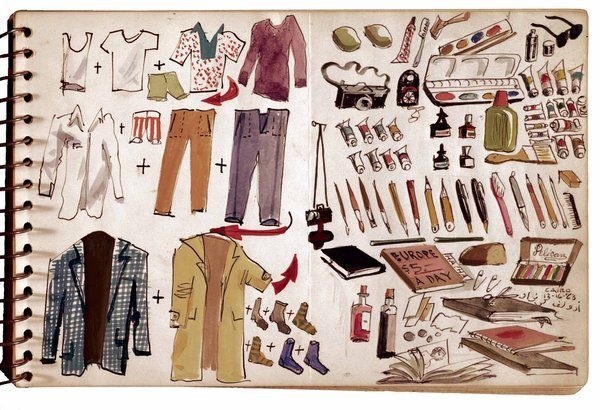
An illustrated packing list from a notebook by the artist Adolf Konrad, Dec. 16, 1963.
via ‘Lists,’ Exhibition at Morgan Library & Museum – NYTimes.com
Envy works upon what is close at hand, and things that are far off we are more free to admire.
Bike messenger, gallery assistant, office temp. I took these jobs to make money, but there was also an aspect of penance to them. I don’t know exactly for what sin I was repenting. Maybe the sin of having gone to graduate school for writing. On some level, I saw these jobs as a kind of Karma insurance. It was a way of testing myself: You want to be a writer? Can you handle this? How about this?
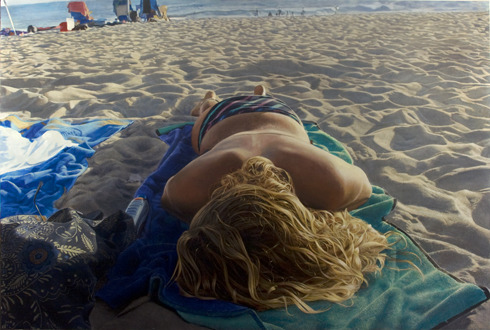
Back by Mary Henderson. The great majority of photorealistic painting leaves me cold, but that skin and sand… (via this month’s Harper’s)
Life will follow the path it started upon, and will neither reverse nor check its course; it will make no noise, it will not remind you of its swiftness. Silent it will glide on; it will not prolong itself at the command of a king, or at the applause of the populace. Just as it was started on its first day, so it will run; nowhere will it turn aside, nowhere will it delay.
Radiohead – Staircase (live From the Basement). New song. Self-recommending, as they say.

127 Hours. This was the perfect movie to watch while trapped in the middle of a 10-hour plane ride. Well done. We need more 90-minute movies.
 Mark Larson