Deadfall. There’s some good northern winter noir here and there, but it’s not consistent. I wonder if a different, shorter edit would have worked better for me. The Place Beyond the Pines is a better exploration of family relationships + law enforcement. The Grey is a better snowbound film where the odds are stacked from the beginning. I should re-watch both of those.
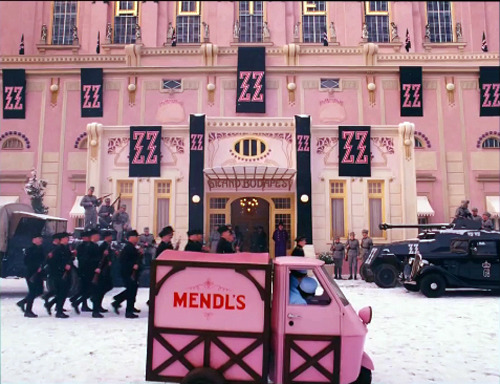
The Grand Budapest Hotel. I dig it. It’s got the usual fussy-awesome art direction and some technically interesting camera stuff, but what I really liked here: a good heart. Didn’t have much of the rooted dysfunction or cynicism or weariness that made some of his previous movies kind of a drag for me at times. I think I’ll call this my favorite of the Wes Anderson movies I’ve seen.
Kickboxer. Another childhood favorite revisited. This has not aged well. If you need ‘80s Van Damme, you will be much, much happier with Bloodsport. This one does have that classic dance scene, though.
Interesting villain-in-prison cliché to see popping up recently. Practical for shooting movies (nothing blocking your view), but then again, these days you can put a camera anywhere. Pairs nicely with a more paranoid, surveillance-oriented approach to war and policing. Can’t fight what you can’t constantly observe, or so they say.
It’s real, and it’s easy to get stuck in it. You start to think, “I’ve got my breakfast tacos, my sunshine, my BBQ, and my food trucks. I’m just going to sit here and do my thing.”
Demo of Beat It composed using only Michael Jackson’s voice
As Jackson couldn’t fluently play any instruments, he would sing and beatbox out how he wanted his songs to sound by himself on tape, layering the vocals, harmonies and rhythm before having instrumentalists come in to complete the songs.
One of his engineers Robmix on how Jackson worked: “One morning MJ came in with a new song he had written overnight. We called in a guitar player, and Michael sang every note of every chord to him. “here’s the first chord first note, second note, third note. Here’s the second chord first note, second note, third note”, etc., etc. We then witnessed him giving the most heartfelt and profound vocal performance, live in the control room through an SM57. He would sing us an entire string arrangement, every part. Steve Porcaro once told me he witnessed MJ doing that with the string section in the room. Had it all in his head, harmony and everything. Not just little eight bar loop ideas. he would actually sing the entire arrangement into a micro-cassette recorder complete with stops and fills.”
Reasons why I laugh when people say he wasn’t a real musician.
The first time I instagrammed a container car, it was because I was waiting on my commuter train to show up, and I was bored to death.
(click for superfluous historical facts!)
The second time, I was curious about the word “Maersk”.
(click again!)
The third time… yeah, in all honesty, I was just kinda trolling my friends.
(etc!)
But at least a handful of other folks saw the same appeal. I kept seeing the containers, and the each time I did a little more on-the-spot research, I learned how old and/or humongous these companies are.
Kinda cool that there’s a whole other part of the economy that’s just been chugging along, making the rest of it work a little more smoothly.
And there’s the novelty, like birding. I’ve seen, in passing, a bunch of other containers that I haven’t snapped or read about yet.
It’s not sexy at all, but there’s something compelling here. Some things are born interesting. Some things, given time or attention, become interesting.
Within the first 40 or 45 pages of The Sisters Brothers there’s a lethal spider bite, tough mercenaries marveling at the wonders of a toothbrush, a gyspy-witch, and a bear attack. The next 250 are just about as strong. It’s splendid.
The two lead characters–who aren’t really good people, by the way–are brothers, and there were plenty of family dynamics here that made me think of my own (“Our blood is the same, we just use it differently.”). And our narrator is smart and self-aware, and is constantly tossing out little observations and musings, like:
I could not sleep without proper covering and instead spent the night rewriting lost arguments from my past, altering history so that I emerged victorious.
And here, on booze:
When a man is properly drunk it is as though he is in a room by himself.
And here, on making a bozo move when he’s trying to get his flirt on:
My chest swelled like an aching bruise and I thought, I am a perfect ass.
And here, on waking up:
I thought, Why did I bring up God so soon after waking?
Funny, thoughtful, twisted, must-read. Thanks to Austin for the suggestion!
In Grand Budapest Hotel we move from the present, more or less, to events in the 1980s, then the 1960s, and eventually the 1930s, which constitute the central episodes.
Anderson has shot the frame stories in different aspect ratios. It’s 1.85 for the near present and the 1980s, when the Author recounts meeting the hotel owner. That meeting, set in the 1960s, is shown in 2.40, the anamorphic aspect ratio. The central story, taking place in the 1930s, is presented in classic 1.37, or 4:3 imagery. With typical Anderson butterfly-collector wit, each era gets a ratio that could have been used in a movie at the time. It’s remarkable that Anderson could persuade Fox Searchlight to let him do this, but it’s also a gift of digital projection: This play with ratios wouldn’t have been possible on film.
I knew something was up, I just couldn’t put my finger on it.
Almost always there is considerable tension between chronology and theme, and chronology traditionally wins. The narrative wants to move from point to point through time, while topics that have arisen now and again across someone’s life cry out to be collected.
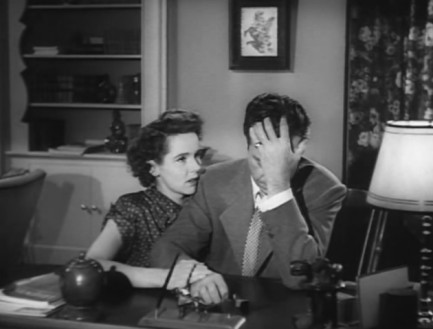
Pitfall. Aw, man. I watched this at the end of last month, so now everything is out of order. Anyway, really dug this one. A guy does some really dumb things while on the job, and the universe exacts its toll. Raymond Burr is so awesome – always loved him since watching Perry Mason as a kid. Reminds me of a portly cross between Kirk Douglas and Philip Seymour Hoffman. What a perfect weaselly creepy charmer.
Let’s pause for a moment, in fact, to notice that this kind of story almost always imagines a future world that’s far simpler than the one we currently live in, one in which all the stuff and clutter of our lives – the screens, the gizmos, the cars, the noise – has evaporated. As David Mamet once put it, every fear hides a wish.
A person can only have so much expertise, but if you can sell your ignorance and ability to root out answers, you’ll be employable forever, understood frequently, and relatable always.
The Broken Circle Breakdown. Heartbreaking. Cf. my thoughts on Blue Valentine. More like Bluegrass Valentine, amirite? Our relationships hinge on our ability to adapt not just to change itself, but also to how we accept/support/deny/undermine the effect on those we care about. I was pleasantly surprised by how much of this movie revolved around parenthood as much as romance. I was hoping for a bit more music. Took a quote-unquote “European” turn for a bit at the end.
Percentage wise, it is 100% easier not to do things than to do them, and so much fun not to do them—especially when you were supposed to do them. In terms of instant relief, canceling plans is like heroin.






 Mark Larson