Why Do Harvard Kids Head to Wall Street? « The Baseline Scenario

Very interesting article. One good bit:

The typical Harvard undergraduate is someone who: (a) is very good at school; (b) has been very successful by conventional standards for his entire life; © has little or no experience of the “real world” outside of school or school-like settings; (d) feels either the ambition or the duty to have a positive impact on the world (not well defined); and (e) is driven more by fear of not being a success than by a concrete desire to do anything in particular. (Yes, I know this is a stereotype; that’s why I said “typical.”) Their (our) decisions are motivated by two main decision rules: (1) close down as few options as possible; and (2) only do things that increase the possibility of future overachievement.

And another one:

You internalize the rationalizations for the work you are doing. It’s easier to think that underwriting new debt offerings really is saving the world than to think that you are underwriting new debt offerings, because of the money, instead of saving the world. And this goes for many walks of life. It’s easier for college professors to think that, by training the next generation of young minds (or, even more improbably, writing papers on esoteric subjects), they are changing the world than to think that they are teaching and researching instead of changing the world.

Why Do Harvard Kids Head to Wall Street? « The Baseline Scenario

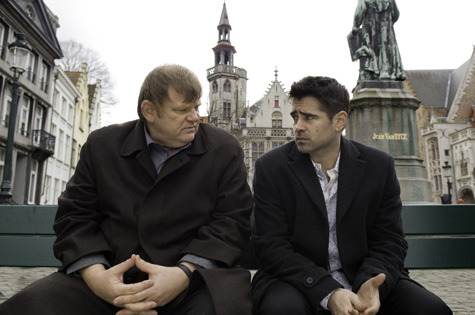
In Bruges

In Bruges. Plenty of dark humor presented in a carefree manner. You’re never too far from a laugh, but the pace isn’t manic. There’s a willingness to draw a scene out, let a situation linger. I liked it a lot.

It seems to me that making escapist films might be a better service to people than making intellectual ones and making films that deal with issues. It might be better to just make escapist comedies that don’t touch on any issues. The people just get a cool lemonade, and then they go out refreshed, they enjoy themselves, they forget how awful things are and it helps them—it strengthens them to get through the day. So I feel humor is important for those two reasons: that it is a little bit of refreshment like music, and that women have told me over the years that it is very, very important to them.

thingsiatethatilove:

AllHipHop.com: With “Shooters,” did you hear the original version by Robin Thicke and just wanted to redo it?
Lil’ Wayne: Yeah, hell yeah. I heard it years ago, on his album.
AllHipHop.com: Do you think that would surprise people, like, “Weezy listens to Thicke?”
Lil’ Wayne: Fuck people.

(via Leon)

Though it’s unlikely you’ll write something nobody has ever heard of, the way you have a chance to compete is in the way you say it.

Amy Hempel (via meaghano) (via austinkleon)

The Atlanta malaise

I needed this laugh today:

You know how it’s been around here – no one has jobs, certain people didn’t win certain elected offices so we have to treat them as private citizens, baby animals are dropping dead left and right and the AJC won’t let Mark Davis cover this so we don’t even know how to feel about the whole thing, not a single DJ in Atlanta will play Jermaine Stewart when we ask for it, we had to ride home on buses marked with red Xs a couple of weeks ago, and all the gourmet popsicles in the world can’t make us feel excited about summer because we didn’t even have time to get over spring’s runny allergy eyes before the humidity kicked in.

The Atlanta malaise

College and the Art of Life – David Salesin, Convocation Address, 28 September 2003

College is such an amazing time of freedom. For many of you, this is the first time in your life when it’s completely up to you, and you alone, to decide what you study, what activities you engage in, and how you structure your day. One idea I came up with as an undergrad was to try to maintain balance by making sure I engaged in four different types of activities every single day. These were:

-something intellectual (not so difficult at school);
-something physical (like running, biking, a team sport);
-something creative (like music, art, or writing); and
-something social (like lunch with a friend).

College and the Art of Life – David Salesin, Convocation Address, 28 September 2003

Colin Marshall: Openearedness

I went to City Skies Electronic Music Festival again last night and it reminded me of Colin Marshall’s post:

Take heed, experimental music-loathers: it’s not that us enthusiasts possess (or believe ourselves to possess) some higher discernment that allows us to draw infinitely more pleasure from the same sound waves you can’t stand. It’s that we enjoy the culture surrounding it.

Or at least I do; it’s the one live music “scene” whose adherents don’t irk me in some distinctive way. The experimental crowd lacks the pious immortal-worship of jazz fandom, the dried-out shushery of the classical set or the pro forma disenchantment/enchantment of young rockdom, replacing it with a relaxed yet eager openmindedness. Or openearedness. Whatever. The point is that they’re willing to listen seriously and see what sort of an art experience results, pretty much no matter what.

Colin Marshall: Openearedness

The Fifty Twentieth-century Works Most Cited in the Arts & Humanities Citation Index

“In Essays of an Information Scientist (Vol. 10, 1987), Eugene Garfield reported the findings of a quantitative analysis of cited works in the Arts & Humanities index.” See also Most-cited authors of books in the humanities, 2007, which summarizes my ambivalence nicely: “What this says of modern scholarship is for the reader to decide – and it is imagined that judgments will vary from admiration to despair, depending on one’s view.” My nerd side is excited to see lists like this, my mildly-cynical/skeptical-about-academia side isn’t so sure.

The Fifty Twentieth-century Works Most Cited in the Arts & Humanities Citation Index