I haven’t yet summoned the courage to tackle Beowulf in one of those authoritative translations yet, but I figured a graphic novel could do the trick. I tried Gareth Hinds’ graphic adaptation of Beowulf. The text is in a fresh translation, so it’s an easy read, but still has a noble, epic quality. I really wanted to like this one, but things didn’t work out. Some weird inconsistencies threw off the whole package for me.
It seemed like the art direction and illustrations took on a couple different styles over the course of the book. Some parts look hand-drawn and colored on computer, other parts look wholly of ink and watercolor. I think the paneling was a bit ad-lib, jagged, frantic–too excited for its own good. Especially in the early portions of the book, the poem is broken up into large chunks that are interspersed throughout the narrative. So, you end up with a couple of wordy pages and then a bunch of pages of pure illustration. I was a bit bothered that the action scenes were completely silent—I’m not looking for “POW” and “AARRRGGH” and “KER-THWAM”… I’m just not sure if the silence is because the original text glosses over the battles, or if it was the artist’s discretion. I have to admit that one very nice touch is the latter portion of the book, dealing with Beowulf’s final years. That final section is in a washed-out palette of grays, and the story has a sense of inevitability and confidence that I didn’t find in the rest of the book.
Category: comics
Plastic Man: Rubber Bandits (review: 5/5)
Kyle Baker’s Plastic Man: Rubber Bandits is absolutely hilarious. Pure entertainment, like watching a good Saturday morning cartoon (as in the Fox Kids era of Eek the Cat, the Tick, X-Men, Tiny Toons, Terrible Thunder Lizards, Batman: The Animated Series, etc.). This book, along with Baker’s other one, Plastic Man: On the Lam, has some of the best comedic writing I’ve seen. Plenty of sight gags—it seems like every panel has a little something extra. I love the snappy dialogue and self-aware parody: “Blast you, Trapper! My complex personal ethics force me to allow you to endanger the very fabric of reality to save a single human life!” Interestingly, although the silliness of the characters lend themselves to over-the-top illustration, most of the paneling maintains fairly traditional layouts with hard frames. It’s admirable restraint, allowing the colorful, sharp drawings and great characters to keep things exciting. This one and On the Lam are definitely worth a purchase. I just love it.
“Oaxaca. Filming a street demonstration during the teachersÄô strike down there. Twice in the chest. Never made it to the hospital. He filmed his own assassination.” The print version of the article in VQR also features illustrations from Peter Kuper‘s Oaxaca Sketchbook.
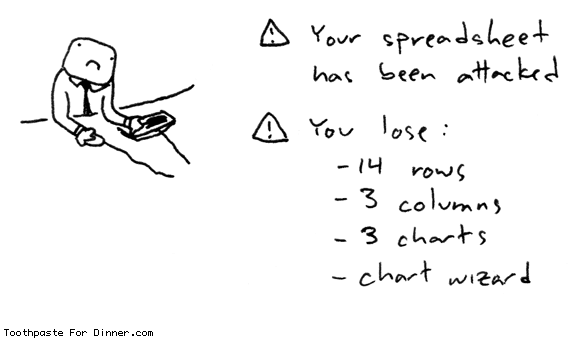
Your spreadsheet has been attacked. Modern office life can be a little like The Oregon Trail.
An open letter to Subway regarding cheese placement. Couldn’t agree more.
On Flickr, Milo Manara‘s very graphic cartoon timeline of mankind.
A choose-your-own-adventure story artfully stenciled on the sidewalks of San Francisco. I’d love to see illustrated comics on this kind of scale. I’m imagining entire sidewalk squares as panels wending around some plaza or across town. [via torrez]
An interview with Chris Ware. “I think storytelling is one of comics’ aesthetic hurdles at the moment, which was the novelist’s problem 150 years ago: namely, to take comics from storytelling into that of “writing,” the major distinction between the two to me being that the former gives one the facts, but the latter tries to recreate the sensation and complexities of life within the fluidity of consciousness and experience.”
Fun facts about the OCLC Top 1000 books owned by library systems worldwide. “How far down the list do you have to go to get to a live author? Jim Davis’ Garfield is number 15 on the list. (Four of the 5 top works by living authors are cartoons!)”
An interview with Scott McCloud.
One of the eternal tensions of comics might be this dual aspiration that we have, on the one hand, to ensure that words and pictures are integrated. That they feel as if they were drawn by the same hand, feel as if they belong togetherÄîthat theyÄôre flip sides to the same coin. And, on the other hand, to take advantage of the unique potential of words, and the unique potential of pictures, which often sends them in opposite directions.
In the course of the interview, he also mentions Dylan Horrock’s critical essay “Inventing Comics,” which is worth a read.
Batman: Year 100 (review: 2/5)
So in Batman: Year 100 we have the typical gritty Gotham set in a climate of heavy-hand police state dystopia, etc etc. The year is 2039. Not too distant, but plenty of time for the world to go to crap. Enough time for the old Batman to die off and a new one to take his place. Or maybe it’s the same man…? The mystery of the new Dark Knight is unfortunately one that never gets resolved. He just sort of is, and does the usual foiling of nefarious plots. On the upside, there’s interesting artwork from Paul Pope and Jose Villarrubia, and I liked seeing Batman as a bit more of a ramshackle outsider, coming across as unexperienced and a bit clumsy and improvisational.
One of the better surprises was the little mini-comic stashed in the back of the book: Berlin Batman. This one revolves around the (true) story of Ludwig von Mises, a brilliant and outspoken economist who fled the Nazis at the cost of having his home ransacked and all his papers confiscated. Batman tries to stop it. It’s a cool little yarn, with a hilariously bourgeois/bohemian Bruce Wayne. It was great to see two of my personal thrills (Batman and Austrian economics) collide so unexpectedly.
I think the anthology of Missed Connection Comics could be pretty cool. The concept is to take a missed connection post from Craigslist and comic-ize it. You’ll find some samples here.
The political cartoons of Dr. Seuss, who created around 400 editorial cartoons during the first part of World War II. See also the book Dr. Seuss Goes to War, which shows about half the collection.
The Surrogates (review: 4/5)
There are a couple little perks that made me like this book right off the bat. The Surrogates is set in Atlanta. It was written by a local named Robert Venditti, and it’s published in nearby Marietta over at Top Shelf Productions. Cool. AND it’s a really cool story. I haven’t seen a lot of sci-fi comics, but this one makes up for the absence.
The Surrogates is set about 50 years from now. Technology has advanced such that humans can stay home safe and sound, while remotely controlling their electronic replacements, their surrogates, to take care of work… and play. Some folks don’t like it. So there’s some terrorism, some politics, and a good bit of gumshoe detective work. Luckily, Venditti’s writing doesn’t dwell too much on the heavyhanded dystopian riff, and the best meditative moments come out naturally in the characters’ conversations and interactions. Mixed between the chapters are Watchmen-like interludes, “primary documents” that help to flesh out the story, including sales brochures, editorials, news articles, and television transcripts.
I love Brett Weldele’s artwork in this book. Besides the sensitive work the the lettering, speech bubbles, and very spare sound effects, the coloring is especially good. It reminded me a bit of Dean Motter’s book, Batman: Nine Lives, with its restrained palette. One great set of panels show a crime scene inside a major industry lab. The lights have been tampered with, so the lab is drawn in a wash of a dark blue and grey, except for flashlight glare as the investigation goes on. A couple dozen panels later, the lights have gotten fixed, and the wash turns to a warm yellow. It’s a simple, but very cool effect. I read it all the way through the first time I started it. I predict that will happen again and again.
Last October in London the Detour Exhibition was held to showcase how creatives use their Moleskine notebooks. There’s more than 70 videos flipping through the work of illustrators, designers, architects, writers, and other Moleskine afficionados.
An interview with Jeff Smith, part one. Part two is coming soon, I hope. Smith is known best for his epic series of Bone comics:
Part of the plan was that I was going to reprint the collection in books, to always keep the story available. I always wanted to do the big one volume edition, too. One of the things that I wanted to do was change the model of comics and make them restockable, instead of comics just being up on stands for a month and then coming down and going back into the longbox, after getting marked up a bit.
Scans of some absurdly complicated musical scores. Those bring back memories of a few marimba solos I’ve attempted. Composers can get a little carried away sometimes.
 Mark Larson