The secret is that the shit is fun to me. Finding a new groove to make a new song, that shit is fun. When you get the beat right and then the hooks and the bridges and the lyrics and it all comes together it’s like this feeling that you get like you hit the jackpot. I can only describe it as trying to unlock the combination to a safe. Once you get inside it, boom.
Tag: work
Festina lente – Wikipedia, the free encyclopedia
A classical adage and oxymoron meaning “make haste slowly” or “more haste, less speed”. It has been used as the motto of many people including the emperors Augustus and Titus, the Medicis and the Onslows.
Slow is smooth; smooth is fast. (via)
Study Hacks » Blog Archive » The Joys and Sorrows of Deep Work
The very type of deep work that provides the nutriment for remarkable results also defies all our instincts for how a productive day should feel. I don’t have a specific set of strategies to suggest here. Instead, I just want to point out that when it comes to our understanding of how to build towards something important in our working life, there is a lot that our current conversation about work — which focuses on themes like courage, passion and productivity — seems to be missing.
Study Hacks » Blog Archive » The Joys and Sorrows of Deep Work
Love Like Cosima – The Barnes & Noble Review
I didn’t realize that Jessa Crispin had an advice column! @CosimaWagner is one of my favorite Twitter accounts.
The Sad Secular Monks | First Things
Just like the driven twenty-somethings of Rosin’s article, monks and nuns have made a commitment so total that it precludes marriage. But in the case of vowed religious, the form of their service is meant to be elevating, not just useful.
In-Use: FF Quadraat in ‘The Shape of Design’ – An interview with Frank Chimero
We forget that doing the work makes us better, and being better makes us dislike the work that made us that way.
In-Use: FF Quadraat in ‘The Shape of Design’ – An interview with Frank Chimero
The Believer – Beat Boutique
On library music and the idea of “selling out”.
“Are you OK with making compromises with your art, or is it just better off for you to have your big compromise be walking into an office every day and getting to do whatever you want?” she says, without a fleck of judgment in her voice. “I think there’s arguments to be made for both.”
The Service Patch – NYTimes.com
Many people today find it easy to use the vocabulary of entrepreneurialism, whether they are in business or social entrepreneurs. This is a utilitarian vocabulary. How can I serve the greatest number? How can I most productively apply my talents to the problems of the world? It’s about resource allocation.
People are less good at using the vocabulary of moral evaluation, which is less about what sort of career path you choose than what sort of person you are.
In whatever field you go into, you will face greed, frustration and failure. You may find your life challenged by depression, alcoholism, infidelity, your own stupidity and self-indulgence. So how should you structure your soul to prepare for this? Simply working at Amnesty International instead of McKinsey is not necessarily going to help you with these primal character tests.
[…] It’s worth noting that you can devote your life to community service and be a total schmuck. You can spend your life on Wall Street and be a hero. Understanding heroism and schmuckdom requires fewer Excel spreadsheets, more Dostoyevsky and the Book of Job.
I missed this last month, so many thanks @davidbhayes for the post!
Whatever it is you have never done before in your life and have no interest in doing, that’s probably what you’ll need to learn in order to keep your business running. Accounting, sales, inventory management. These are all things I’ve had to take on. These are also things that I would rather not do for the rest of my life. And while I’ll never be a crack accountant or a star salesman, it’s better to be mediocre than incompetent.
Lessons from a craft beer startup. My buddy Jonathan and his two co-founders Jeff and Joel make the best beer in Atlanta.
Why do you always sit in the same place in meetings? – Barking up the wrong tree
People exhibit territorial behavior when they take seats in public places, limiting themselves to small areas so they don’t have to “renegotiate” seating arrangements with other people, researchers say. In one study by Marco Costa of the University of Bologna in Italy, university students showed strong attachments to specific areas of a lecture hall; on average, each student made use of just 2.4% to 2.7% of the seating area.
Confession: at college back in the day and at work currently, I’m that jerk that, every so often, likes to take the seat where other people always sit. Always stirrin’ shit up.
Why do you always sit in the same place in meetings? – Barking up the wrong tree
Many people think that in the 1960s I quit my job in an advertising company to write my first novel. Not at all: I just quit so I could go to the movies every afternoon.
Don DeLillo. (via) Echoing the Paris Review interview:
I wish I had started earlier, but evidently I wasn’t ready. First, I lacked ambition. I may have had novels in my head but very little on paper and no personal goals, no burning desire to achieve some end. Second, I didn’t have a sense of what it takes to be a serious writer. It took me a long time to develop this. Even when I was well into my first novel I didn’t have a system for working, a dependable routine. I worked haphazardly, sometimes late at night, sometimes in the afternoon. I spent too much time doing other things or nothing at all.
Making a choice and trying it is an important career skill. And choosing something practical, that people get paid well for, is an important life skill.
People who are smart and energetic are often angry. Not at each other, usually. Rather, they’re angry that we’re “not there yet,” i.e. that they have to solve X when they should be working on some greater problem Y.
Blake Masters: Peter Thiel’s CS183: Startup – Class 5 Notes Essay
Stephen Cohen on learning:
We tend to massively underestimate the compounding returns of intelligence. As humans, we need to solve big problems. If you graduate Stanford at 22 and Google recruits you, you’ll work a 9-to-5. It’s probably more like an 11-to-3 in terms of hard work. They’ll pay well. It’s relaxing. But what they are actually doing is paying you to accept a much lower intellectual growth rate. When you recognize that intelligence is compounding, the cost of that missing long-term compounding is enormous. They’re not giving you the best opportunity of your life. Then a scary thing can happen: You might realize one day that you’ve lost your competitive edge. You won’t be the best anymore. You won’t be able to fall in love with new stuff. Things are cushy where you are. You get complacent and stall. So, run your prospective engineering hires through that narrative. Then show them the alternative: working at your startup.
Working at a startup is an alternative rather than the alternative, but the career principle is the same: learning’s good and it’s wise to choose it over just about everything else. Cf. Penelope Trunk, Annie Clark, Charlie Munger, etc.
Blake Masters: Peter Thiel’s CS183: Startup – Class 5 Notes Essay
How to Avoid Burnout: Marissa Mayer – Businessweek
I have a theory that burnout is about resentment. And you beat it by knowing what it is you’re giving up that makes you resentful.
That’s so incisive. It’s not about the work, it’s about what you’re giving up that you’d rather not. I love when I find ideas that take things up one level of thinking, like a psychological heuristic. Burnout is about resentment, boredom indicates a gap between your interests and your current environment; unrealistic expecations have their roots in denial; when you talk to someone, you’re talking to their agent, etc.
Your biggest career decision is who you marry | Penelope Trunk Blog
You have to be really clear on what you are not willing to give up—because you’ll probably be giving up everything else.
Your biggest career decision is who you marry | Penelope Trunk Blog
The Top Idea in Your Mind
I’ve found there are two types of thoughts especially worth avoiding—thoughts like the Nile Perch in the way they push out more interesting ideas. One I’ve already mentioned: thoughts about money. Getting money is almost by definition an attention sink. The other is disputes. These too are engaging in the wrong way: they have the same velcro-like shape as genuinely interesting ideas, but without the substance. So avoid disputes if you want to get real work done. Corollary: Avoid becoming an administrator, or your job will consist of dealing with money and disputes.
When to leave grad school off your resume | Penelope Trunk Blog
People who have excitement about deciding for themselves what to read and what to learn are people who stop going to school and join the workforce. The workplace, done right, is a place for self-directed learning.
When to leave grad school off your resume | Penelope Trunk Blog
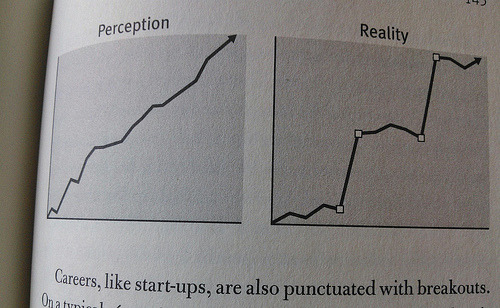
Perception vs. Reality. An excerpt from The Start-up of You.
Are You As Busy As You Think? – WSJ.com
Claiming to be busy relieves us of the burden of choice. But if you’re working 50 hours a week, and sleeping eight hours a night (56 per week) that leaves 62 hours for other things. That’s plenty of hours for a family life and a personal life — exercising, volunteering, sitting on the porch with the paper, plus watching TV if you like.
 Mark Larson