
An image of a page from The Hitchhiker’s Guide To The Galaxy, describing The Hitchhiker’s Guide To The Galaxy, on an e-reader that resembles The Hitchhiker’s Guide To The Galaxy.
This is the future, guys.
An image of a page from The Hitchhiker’s Guide To The Galaxy, describing The Hitchhiker’s Guide To The Galaxy, on an e-reader that resembles The Hitchhiker’s Guide To The Galaxy.
This is the future, guys.
I think people who want to read more but don’t, or people who don’t like to read, are sometimes just putting too much pressure on themselves. And perhaps not being smart or creative enough about it. Here are ways around reading a book that are still kinda reading a book:
And as I finish this brain dump I remember that Ryan Holiday has said many of the same things already.
Focusing all experiences through the lens of the Internet is an example of not being able to see history through the eyes of others, to be so enamored of one’s present time that one cannot see that the world was once elsewise and was not about you.
Literature is Eucharistic. You take somebody else’s suffering into your body and you’re changed by it, you’re made larger by their pain.
Everybody talks about the writer’s feeling and the writer’s expression and the writer’s experience, and, you know, I don’t give a fuck how the writer feels. I want a fucking book that I can be in love with. I want a book that I’ll reread seventeen times. That’s what I want.
Like my year in music, my reading was also a little down this year, especially over late summer and fall. I think I did pretty well on fiction this time around, though. I’ll stick to a couple picks for each month:
January
Extra Lives. Why video games are awesome and why they make you feel guilty and ashamed. And more! (reviewed)
Runner-up: The Art of Fielding. A tale of baseball and friendship that’s much, much better than it sounds. (reviewed)
February
Steal Like an Artist. Obviously. But you don’t have to take my word for it.
Runner-up: Hark! A Vagrant. I wish this was my high school history textbook.
March
Distrust That Particular Flavor. Twenty years of work from a great mind. I tumbled a bunch of quotes.
Runner-up: Dreamtigers. Only giving this one second place because I’ve read some of the stories before. Borges is still a champ.
April
The Gift of Fear. A fascinating look at the psychology of trust. (reviewed)
Runner-up: Philosophy Bites, for thoughtful variety that, like the podcast of the same name, doesn’t waste your time.
May
Religion for Atheists, for its thoughtful, inquisitive look at something many of us are already decided about. One of my favorites this year. (reviewed)
Runner-up: Macbeth, for being short and sweeping and brilliant. (tumbled)
Second runner-up: Mindless Eating, for its friendly, simple, super-practical approach to habits you might want to change. (reviewed)
June
{sound of crickets}
July
An Economist Gets Lunch, for Tyler Cowen’s typically counter-intuitive, omnivorous openness to experience. I’m a huge fan.
Runner-up: Imaginary Magnitude. A collection of introductions to fictional books covering, among other things, x-ray pornograms, computer-generated literature, and a biography of a sentient, moody super-computer. If you like the Borges above, or Borges in general, or strange science fiction, or strange conceptual writing in general, this is absolutely a book for you.
August, September, October
{embarrassed silence}
November
Mr. Penumbra’s 24-Hour Bookstore. This is tied with The Art of Fielding for the “How did he make that book so page-turnable?” award. A light, bright, fun adventure. Robin Sloan is next-level.
December
A Visit from the Goon Squad. Growing up in a music-heavy world. I like that every chapter has a different voice, perspective, and structure.
Runner-up: The First Four Notes, for its wide-ranging history of philosophy and aesthetics that uses Beethoven’s music as the pivot point.
In an odd way, the fact that no one else knows has made me more competitive, not less. I’m sure serious runners are familiar with this seeming paradox. Maybe nobody else knows that you shaved 1.2 seconds off your personal best time for the mile, but you know — and that knowledge, plus the fact that your achievement has brought you no external reward, gives you a perverse sense of satisfaction. Or no, let’s be honest about this: it gives you a perverse sense of superiority.
This is what RSS is for, these days: you set a snare, leave it, and trap for yourself the words you want to read most.

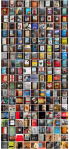
What I Read, 2007-2012. Amazing how it all adds up. Six years, 400-something books and counting. (Sometimes I write about them.)
As with any long-term journaling, what’s especially fun is the bigger picture you get from looking back. I see the individual books, yes, and my passing topical interests and ongoing obsessions, but I also see who I was hanging out with, who I was influenced by, and an incidental history of where I was living.
Going back to the 19th century makes you realize that a phenomenon we tend to blame on digitization actually happened a century earlier. Once you can throw it away, the value of books comes to reside in the words they contain rather than their potential for reuse.
Secret Reading Lives, Revealed – The Chronicle Review – The Chronicle of Higher Education
A case can be made that people who read a preposterous number of books are not playing with a full deck. I prefer to think of us as dissatisfied customers.
Summer Reading… and Programming.
I guess you could say this is a book review written… in JavaScript?
If you’re the kind of reader who doesn’t intend to give up on a Great Big Important Novel no matter how inhumanely it treats you, then there’s a sense in which Joyce or Pynchon or Gaddis (or whoever your captor happens to be) owns you for the duration of that captivity. In order to maintain your sanity, you may end up being disproportionately grateful for the parts where they don’t threaten to bore you to death, where there seems to be some genuine empathic connection between reader and writer.
Forms, styles, structures–whatever word you prefer–should change like skirt lengths. They have to; otherwise we make a rule, a religion of one form; we say, “This form here, this is what reality is like,” and it pleases us to say that (…) because it means we don’t have to read anymore, or think, or feel.
On the other side of the class and educational divide (…) it’s easy to forget what it’s like not to know.
The novels we know best have an architecture. Not only a door going in and another leading out, but rooms, hallways, stairs, little gardens front and back, trapdoors, hidden passageways, et cetera. It’s a fortunate rereader who knows half a dozen novels this way in their lifetime. I know one, Pnin, having read it half a dozen times. When you enter a beloved novel many times, you can come to feel that you possess it, that nobody else has ever lived there. You try not to notice the party of impatient tourists trooping through the kitchen (Pnin a minor scenic attraction en route to the canyon Lolita), or that shuffling academic army, moving in perfect phalanx, as they stalk a squirrel around the backyard (or a series of squirrels, depending on their methodology). Even the architect’s claim on his creation seems secondary to your wonderful way of living in it.
Justin Wehr on how Community is awesome and so is TV but…
I don’t mean to be another pretentious I’m-above-TV guy, because I’m not. TV is above me. It dominates me, it makes me want to do nothing but sit in front of its glowing glory. In a real way, it scares me, because it shows me how powerless I am. […] The danger of TV and of passive entertainment more generally is not just that it takes time away from better things. The real danger is that it makes better things seem harder.
A couple months ago I set aside Sunday mornings as a sacred, no-interference-allowed time for books and nerdery. It’s a guaranteed 3-5 hours of learning. No regrets whatsoever. And then on Sunday afternoons I watch/play sports because that’s what you do.
Rereading, an operation contrary to the commercial and ideological habits of our society, which would have us “throw away” the story once it has been consumed (“devoured”), so that we can then move on to another story, buy another book, and which is tolerated only in certain marginal categories (children, old people, and professors), rereading is here suggested at the outset, for it alone saves the text from repetition (those who fail to reread are obliged to read the same story everywhere) …
See also: William Ball and Mills Baker writing about Robin Sloan’s app, Fish: a tap essay, discussing things like stock and flow and David Cole’s personal canon.
Books. Books. Books. People have been doing [whatever it is your deciding about] for a while now. They’ve been moving West, leaving school, investing their savings, getting dumped or filing for divorce, starting businesses, quitting their jobs, fighting, dying and fucking for thousands of years. This is all written down, often in the first person. Read it. Stop pretending you’re breaking new ground.
 Mark Larson