The more seriously I took everything, and how serious life was in general, the better laughs I got.
Buster Keaton. (via)
The more seriously I took everything, and how serious life was in general, the better laughs I got.
It’s a very odd thing with Hollywood, where you do stand-up, you’re good at it, then they go, “How would you like to be a horrible actor?” Then you say, “All right, that sounds good. I’ll do that.” So I’m fucking excited about not having to pretend to know what I’m doing with acting.
Also:
I love abandoning shit, because I don’t like doing shit over and over and over. I’ve thrown so many jokes away. First of all, I’m not a good enough performer to pretend that “I just thought of this,” that kind of shit. It’s saying the same word over and over again, it loses its fucking meaning. Also, generally I don’t like traveling around saying the exact same thing. I don’t think that’s a very good thing to do with your life.
And also:
I don’t really care about success or money or shit. I could give a fuck. I hate fame. I hate being recognized, because I don’t know how to talk to people. I see Sandler, man, and I’m like fuck, goddamn, I don’t know how he does it, those people are fucking everywhere he walks. If you’re walking with him, all you hear behind is people whispering. It’s almost like being fucking stoned, or a paranoid schizophrenic or something, where you think people are talking about you, but they actually are talking about you. It’s fucking surreal.
Peter Gabriel – Solsbury Hill. If I were Peter Gabriel you could be damn sure I’d ride a bike around the stage.
What you want to do is build the people up. You start ‘em off and you give them this first half, and their feet, and next thing they got their heads goin’, and the next thing they got their mouths open and they’re yellin’ and they’re screamin’. It’s a great feeling when you can have your audience get involved with you […] where everyone can jump in and have a real good time. “What’d I Say” is my last song onstage. When I do “What’d I Say,” you don’t have to worry about it — that’s the end of me. There ain’t no encore, no nothin’. I’m finished!
I just love musicians. They’re not all super-happy all the time, but when they’re playing they’re happy, and it’s such a beautiful thing. I also like them because they sleep late in the morning; they’re more like children.
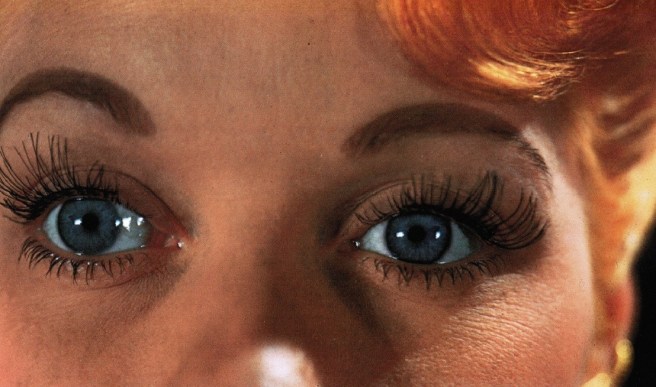
“I am not funny. My writers were funny. My directors were funny. The situations were funny…What I am is brave. I have never been scared. Not when I did movies, certainly not when I was a model, and not when I did I Love Lucy.”
–Lucille Ball (Rolling Stone, June 23, 1983) (photo by Walt Sanders for LIFE, 1943, click to enlarge)
http://videos.nymag.com/embed/player/?content=KWN4D022280LSM25&widget_type_cid=svp&title_height=24
Acting School With Will Arnett: His Video Tips for Playing an Arrogant Idiot. The Mickey Rourke look-away is brilliant.

Who is the Greatest Diva of the Last 25 Years? – The Awl. “While Aretha pretty much broke every song she ever performed, leaving it smoking on the stage, never to be touched again, Whitney broke our goddamn National Anthem.” (via)
1-Bit Symphony. “1-Bit Symphony is not a recording in the traditional sense; it literally "performs” its music live when turned on.“ This is brilliant. (via)
1. If you can be yourself on stage nobody else can be you and you have the law of supply and demand covered.
If you are feeling nervous, nervous is good. All right? It makes us stop thinking about things. It makes us ready to play. If you’re nervous, that’s fine. Feel nervous.
It sometimes feels like there’s not a ton of synergy between the persona and the (generally really good!) songs — I put on the music and enjoy it a lot, but I’m nagged by the feeling that I could engage with Gaga-world a lot more fully by turning the stereo off and logging on to the internet.
The best way to describe it is I’m like this energy-gathering dynamo. I suck in the energy from the crowd and right at the point they’re drained, ready to slump over and fall over and pass out, I bring it to a crescendo and [expletive] shoot it all back at ‘em. And then I’m [expletive] slumped over and ready to pass out and they’re energized and ready for the next artist or end of the party or whatever.
The crisis in performance is, I believe, based on one simple fact. When it started, rock n roll was dance music. One day we stopped dancing to it and started listening to it and it’s been downhill ever since. We had a purpose, had a specific goal, an intention, a mandate, we made people dance or we did not work, we didn’t not get paid, we were fired, we were homeless. That requires a very different energy. To compel people to get out of their chairs and dance, it’s a working-class energy, not an artistic, intellectual, waiting-around-for-inspiration energy. It’s a get-up, go-to-work-and-kill energy. Rip it up, or die trying.
We have to start the concert at 8:00 and we have to stop sometime because the halls are rented for a certain time but the music goes on in your mind before and after you play. It’s really just an agreement you make to stop at a certain time. On record, it goes for 40 minutes because an album has these dimensions. It’s just an agreement. But really the music goes on.
This is very interesting.
Think instead of a short story written with playback in mind. Written for playback. Typing speed and rhythm are part of the experience. Dramatic deletions are part of the story. The text at 2:20 tells you something about the text at 11:13, and vice versa. What appear at first to be tiny, tentative revisions turn out to be precisely-engineered signals. At 5:15 and paragraph five, the author switches a character’s gender, triggering a chain reaction of edits in the preceding grafs, some of which have interesting (and pre-planned?) side effects.
Brian Sacawa on playing unfettered, taking classical music out of the grand halls and into alternative venues. A lot of the talk focuses on music groups reaching new audiences, but like he says, it can be great for the performers, too. It’s liberating.
 Mark Larson