Anthony Bourdain, unreserved – chicagotribune.com

An excellent interview in many respects. I like this bit:

How do you avoid cliche when you’ve already done so many shows?

We try to undermine whatever it was that worked last week. We deliberately set up difficult things to do. Using new lenses, constantly experimenting with new equipment to give it a more cinematic look — letterboxes, widescreen, gyros, cheap do-it-yourself kind of innovation. The editing styles. We think about movies that we loved that have been shot in this area that we might try to rip off. In the case in Rome, we’re going to do the whole thing in black and white, and in letterbox. Can we do really gorgeous food porn in black and white? It’s never been done.

Anthony Bourdain, unreserved – chicagotribune.com

Interview with Carol Kaye | WMLB 1690 | The Voice of The Arts.

Scott Glazer speaks with one of music’s most prolific bass players, Carol Kaye. Kaye has played on over 10,000 recordings in her career including her work with the Beach Boys, Frank Zappa and as Phil Spector’s go-to bass player. Scott and Carol talk about her history in recorded music, how it all started and how an accidental session with Sam Cooke changed her life forever.

You can afford to expose yourself to uncertainties in art that you wouldn’t allow yourself in real life. You can allow yourself to get into situations where you are completely lost, and where you are disoriented. You don’t know what’s going on, and you can actually not only allow yourself to do that, you can enjoy it.

What writers have is a license and also the freedom to sit—to sit, clench their fists, and make themselves be excruciatingly aware of the stuff that we’re mostly aware of only on a certain level. And if the writer does his job right, what he basically does is remind the reader of how smart the reader is. Wake the reader up to stuff that the reader’s been aware of all the time.

David Foster Wallace quoted in The Howling Fantods Q&A with David Lipsky. Like I said, I wish Wallace had done stand-up comedy, too, because this attitude seems perfect for it. Isn’t that what many great comedians do? A voice in the wilderness kind of thing, standing apart or going deep and observing and noticing more than you, and pointing out these things in a way that makes you happy.

Q&A: David Lipsky | Mark Athitakis’ American Fiction Notes

From an interview with David Lipsky (via), here’s David Foster Wallace on the philosophical depth of country music:

Because that’s like pretty much all there is, when you’re tired of listening to Green Day on the one college station. And these country musics that are just so—you know, “Baby since you’ve left I can’t live, I’m drinking all the time.” And I remember just being real impatient with it. Until I’d been living here about a year. And all of a sudden I realized, what if you just imagined that this absent lover they’re singing to is just a metaphor? And what they’re really singing to is themselves, or to God, you know? “Since you’ve left I’m so empty I can’t live, my life has no meaning.” That in a weird way, they’re incredibly existentialist songs. That have the patina of the absent, of the romantic shit on it, just to make it salable… But that if you cock your ear and listen real close—that it’s deep, you know?… That we find, that art finds a way to take care of you, and take part. Kind of despite itself.

Q&A: David Lipsky | Mark Athitakis’ American Fiction Notes

My Year Of Everything: My Year Of Everything Q&A: With Kevin Murphy, Author of “A Year At The Movies”

Personally and emotionally it surprised me that I could actually stay committed to something so consuming without ruining my life. It’s almost axiomatic that people in the arts have to be willing to jettison their friends, marriages, loves, in order to really push through and break out. That is a hefty quantity of bullshit, and is an excuse for not living a full life and integrating work into it. This more than anything was the most positive outcome for me.

My Year Of Everything: My Year Of Everything Q&A: With Kevin Murphy, Author of “A Year At The Movies”

What you have to find is your own niche that will allow you to keep feeding and clothing and sheltering yourself without getting downtown. (Laughs.) Because that’s death. That’s really where death is.

Interview with Nora Watson in Studs Terkel’s Working.

People say you teach during the day and you’re free at so-and-so, but there’s a certain energy that goes into teaching people, it seems to me… and if you don’t give them that energy, then you’re immoral. And if you do give them that energy, then you’re wiped out. Because there’s only so much energy anyone has. So I’d rather drive a cab – I had a good time driving the cab, I wasn’t invested in it, you know what I mean? I could think about music, I could bug the cab, I could take time off to play a show – it really fit me. And I was making more money than most assistant professors too!

Steve Reich on resisting academia and driving a cab back in the early days.

A couple of other things that you might not have heard yet, because they’re not available: There’s a fantastic compilation of music that was recorded and released originally on 78s, and it’s called Black Mirror: Reflections In Global Musics. I would recommend it to anybody. But anyway, on that album there’s a song, and when I first heard that song, it just completely blew me away, because all the sudden I had heard the greatest note that I’d ever heard anybody make up to that point. The song is called “Smyrneiko Minore,” and it was sung by Marika Papagika, a young woman who emigrated from Greece to the United States, and she recorded it in 1919 in New York. When you listen to that song, you’re totally unprepared. At least I was. I was totally unprepared for her entrance. When she comes in, that first note, it’s unbelievable, the sense of human sorrow and the feeling of that note.

The best way to describe it is I’m like this energy-gathering dynamo. I suck in the energy from the crowd and right at the point they’re drained, ready to slump over and fall over and pass out, I bring it to a crescendo and [expletive] shoot it all back at ‘em. And then I’m [expletive] slumped over and ready to pass out and they’re energized and ready for the next artist or end of the party or whatever.

Interview with Coolio, describing what it’s like to perform.

Craig Schuftan: Hey! Nietzsche! Leave Them Kids Alone

fuckyeahphilosophy:

“Who knew Lord Byron had something in common with My Chemical Romance? Armed with an encyclopaedic knowledge of pop culture, Craig Schuftan traces the history of romanticism in rock and roll, drawing comparisons between 19th century poetic giants and the heroes of indie, glam and emo music. In this talk with Zan Rowe, Schuftan explores the links between music, philosophy and literature and why nobody wants to own up to being emo.”

Craig Schuftan: Hey! Nietzsche! Leave Them Kids Alone

I volunteered to serve food to the workers at Ground Zero after 9/11. There were dogs trained to find living people. The people who worked with the dogs became worried because the day after day of not finding anyone was beginning to depress the animals. So the people took turns hiding in the rubble so that every now and then a dog could find one of them to be able to carry on.

We have to start the concert at 8:00 and we have to stop sometime because the halls are rented for a certain time but the music goes on in your mind before and after you play. It’s really just an agreement you make to stop at a certain time. On record, it goes for 40 minutes because an album has these dimensions. It’s just an agreement. But really the music goes on.

Interview with Kraftwerk. Ralf Hütter and Florian Schneider talking with Synapse Magazine. September, 1976. On a side note, Ralf und Florian is a fantastic album.

I ended up in the Southwest because I knew that nobody had ever written about it. Besides Coca-Cola, the other thing that is universally known is cowboys and Indians. You can go to a mountain village in Mongolia and they’ll know about cowboys. But nobody had taken it seriously, not in 200 years. I thought, here’s a good subject. And it was.

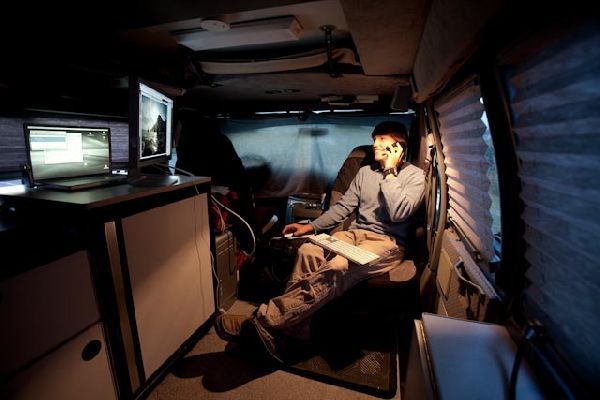
Trevor Clark (@trevorclark), a guy I knew back in the old high school days of yore, recently did a two-part interview about his life as an adventure photographer.

The main thing I need for any deadline is a fast and reliable Internet source. Working away from my van, I just make sure I have a plan and if all else fails, I do the old-fashioned journalistic thing and find Internet, no matter what.

One time I even ended up in a couple’s bedroom (absolute strangers) at midnight, fixing their router so that I could use their internet to upload a set of images that needed to be ready for Italian distribution within the hour.

Badass.

Q. Does President Obama make for a good Auto-Tune?

A. You know, what was great from Obama was the campaign speeches. His campaign speeches were excellent, because he was sort of using that almost gospel-preacher rhetorical style.

Since he’s been president, he’s been so relaxed and sort of so laid back and cerebral and sort of intellectual. He’s not been quite as excellent for Auto-Tuning because there’s a lot more of a mumbly tone about him. A lot less of the “Yes we can!” and a lot more of the “Weeeeell, as we see …”

Interview with the Gregory Brothers of “Auto-Tune the News” fame.

Some wisdom before school starts

davidfosterwallace:

nickzed:

Q:

“How do you remember Amherst? What are the experiences—in and out of the classroom—that shape those memories? Similarly, what aspects of your Amherst education served you best? And what are the things about Amherst that, in hindsight, disappoint you?”

A:

“I don’t know that many would remember me at all… I was cripplingly shy at Amherst. I wasn’t in a fraternity and didn’t go to parties and didn’t have much to do with the life of the College. I had a few very close friends and that was it. I studied all the time. I mean literally all the time…

So ‘the things about Amherst that, in hindsight, disappoint [me]’ are things not about Amherst but about who I was when I was there. I let almost no one know me, and I lost the chance to know and learn from most of my peers. It took years after I’d graduated from Amherst to realize that people were actually far more complicated and interesting than books, that almost everyone else suffered the same secret fears and inadequacies as I, and that feeling alone and inferior was actually the great valent bond between us all. I wish I’d been smart enough to understand that when I was an adolescent.”

— David Foster Wallace interviewed by Amherst magazine