Birds on the Wires on Vimeo. This is fantastic. Messiaen would be proud. (via waxy)
(Source: https://player.vimeo.com/)
Birds on the Wires on Vimeo. This is fantastic. Messiaen would be proud. (via waxy)

The first movement of Bach’s Violin Sonata No. 1 in G minor (BWV 1001). Listen.
Art Tatum goofs around with Dvorak’s Humoresque No. 7 in G flat major. Here’s a more traditional version. (via @danlevitin)
Pachelbel Rant, about being bored out of your mind on cello + the chord progression showing up everywhere.

via alex ross
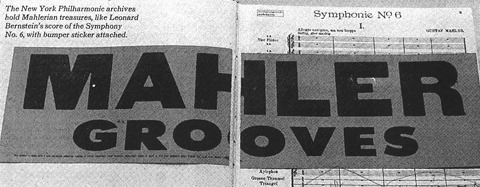
Mahler Grooves [via alex ross]
They skipped a few minutes’ worth of the opening toccata section, but man, how cool. That footwork! (via kottke)
I’m wondering what someone could do if they spent their life practicing an instrument like this one. Or what could a group of players (dancers?) make of it? One of the things that can make percussion ensembles (or say, a drummer in a band) more interesting than other chamber groups is all the movement. It can be really visual and just plain fun to watch, which you don’t always get from a pianist or string quartet or whatever.
a late-night-style infomercial for an imaginary compilation of Twelve-Tone Greatest Hits
Steve Reich: City Life – Part 1 “Check it out”.
One of my favorite bits of music in any genre, period. All 5 parts are worth a listen.
My homeboy Steve Reich won a Pulitzer. So did Atlanta author Douglas Blackmon, for his awesome book (judging by what I read when I borrowed it from Mom between holiday meals last winter), Slavery by Another Name. Need to move that one back on the list.
I love this post about measuring whether an artist is under- or over-valued. The method is pretty cool, basically comparing the Human Accomplishment ranking and the available Amazon music inventory, and making a rough P/E ratio. This post focuses on notable composers and it looks like Medieval, Renaissance, and Baroque composers get shorted, while late Romantics (especially opera dudes) get more hype than they deserve. And you see the same sort of bias in the season programming of most major orchestras.
Anyway, two cool things this brings to mind. One, I like this idea of bubbles in culture. Reminds me of the vast difference in New York Times coverage of conflicts in Darfur vs. the Congo, though one area has been about 10 times as deadly. There are all kinds of interesting feedback loops that affect how we perceive and respond to our world. And two, realizing that there’s so much rough-and-ready data out there that we’ve unwittingly created, just waiting to be mined.
A collection of tweet-length opera synopses. A few favorites:
The Flying Dutchman: “Any port in a storm. Tall dark and mysterious wants my daughter. She wants to save him, but can she be faithful? Splashy splashy.”
Salome: “Out of control teen uses stepdad to get back at would-be boyfriend, learns some confusing lessons about love”
I can’t believe that people really prefer to go to the concert hall under intellectually trying, socially trying, physically trying conditions, unable to repeat something they have missed, when they can sit home under the most comfortable and stimulating circumstances and hear it as they want to hear it. I can’t imagine what would happen to literature today if one were obliged to congregate in an unpleasant hall and read novels projected on a screen.

Igor Stravinsky (↑, one of my favorite composers) is probably best known for his collaboration with Serge Diaghilev on the The Rite of Spring ballet and its scandalous premiere. But a few years after that, with Diaghilev’s prodding, he brought out another ballet score with older, more conservative roots, Pulcinella.
What made Pulcinella different was that Stravinsky took most of the music from lesser-known classical-era composers like Pergolesi, Gallo, Monza, et al. “It was a backward glance, of course, but it was a look in the mirror, too.” Stravinsky took whole melodies and bass lines from the old stuff, and within that framework he rejiggered the harmonies, rhythms, and orchestration.
I began by composing on the Pergolesi manuscripts themselves, as though I were correcting an old work of my own. I knew that I could not produce a ‘forgery’ of Pergolesi because my motor habits are so different; at best, I could repeat him in my own accent.
The reception of the new work wasn’t all positive…
I was… attacked for being a pasticheur, chided for composing ‘simple’ music, blamed for deserting ‘modernism,’ accused of renouncing my ‘true Russian heritage.’ People who had never heard of, or cared about, the originals cried ‘sacrilege’: “The classics are ours. Leave the classics alone.”
… but he had his reasons…
To them all my answer was and is the same: You “respect,” but I love.
About a dozen years ago, Bj??rk interviewed composer Arvo P?§rt. P?§rt has written a number of things I like… Spiegel im Spiegel; Silouans Song; Credo; F?ºr Alina, etc. [via atlanta composers]
The twelve composers of Christmas. I love the Stravinsky and Beethoven bits. [via mmmusing]

Doctor Atomic is a new-ish opera about Dr. Oppenheimer, his team, and the first test of the atomic bomb at Los Alamos. I saw the Atlanta Symphony Orchestra’s semi-staged version on Friday night. It was all played and sung well enough. Parts of it were good. Some parts were outstanding—Oppenheimer’s aria on John Donne’s Batter my heart, three-person’d God was an incredible piece of music, if not storytelling (here’s a recording and a video of the solo). And the gut-wrenching countdown carried by the orchestra in the second act was a ton of fun. What suspense!
But some parts on the journey were just dreadfully boring. People sing about the weather and scientific devices and stand around and smoke. There’s no real look inside their head and they don’t seem to have motivations. The final seconds of the ending—recorded voices of a victim asking for help coupled with the image of a Japanese mother and child projected against the backdrop—just seemed plain old tacky and self-congratulatory in a dangerous way. When you omit the few weeks that happened between the first test and the first bombings, the ambiguity and the wonderful moral dilemma of the time gets washed out.
Awesome? No. Worth seeing? Mostly. Read Greg Sandow’s comments on Doctor Atomic and Ron Rosenbaum on why he walked out.
To celebrate its 120th anniversary, the Royal Concertgebouw Orchestra is giving away a symphony every day. Yes, please. Here’s the selection:
Franz Schubert – Symphony no. 8 ‘Unfinished’
Ludwig van Beethoven – Symphony no. 2
Felix Mendelssohn – Symphony no. 4 ‘Italian’
C?©sar Franck – Symphony in D minor
Gustav Mahler – Symphony no. 1
Anton??n Dvo?ô?°k – Symphony no. 8
Camille Saint-Sa?´ns – Symphony no. 3 ‘Organ’
Jean Sibelius – Symphony no. 2
Anton Bruckner – Symphony no. 8
Johannes Brahms – Symphony no. 2
What a nice surprise. Since you asked my opinion, I’d download the Schubert, the Dvo?ô?°k, and definitely grab the Sibelius—one of my favorites, period. Mahler, Bruckner, and Saint-Sa?´ns would be next if I had to choose. And if you get 6, you might as well get the rest… [via classical convert]
Remembering the genius whom Stanley Kubrick stole music from, a nice remembrance of the life and music of Gy??rgy Ligeti. Ligeti is well-known for Po?®me Symphonique For 100 Metronomes and his piano etudes like Devil’s Staircase. And lots of other good stuff. I also came across an interesting video of a visual listening score for Artikulation, one of Ligeti’s electronic works.
 Mark Larson