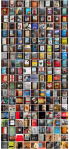
Favorite books of 2012

Like my year in music, my reading was also a little down this year, especially over late summer and fall. I think I did pretty well on fiction this time around, though. I’ll stick to a couple picks for each month:

January
Extra Lives. Why video games are awesome and why they make you feel guilty and ashamed. And more! (reviewed)

Runner-up: The Art of Fielding. A tale of baseball and friendship that’s much, much better than it sounds. (reviewed)

February
Steal Like an Artist. Obviously. But you don’t have to take my word for it.

Runner-up: Hark! A Vagrant. I wish this was my high school history textbook.

March
Distrust That Particular Flavor. Twenty years of work from a great mind. I tumbled a bunch of quotes.

Runner-up: Dreamtigers. Only giving this one second place because I’ve read some of the stories before. Borges is still a champ.

April
The Gift of Fear. A fascinating look at the psychology of trust. (reviewed)

Runner-up: Philosophy Bites, for thoughtful variety that, like the podcast of the same name, doesn’t waste your time.

May
Religion for Atheists, for its thoughtful, inquisitive look at something many of us are already decided about. One of my favorites this year. (reviewed)

Runner-up: Macbeth, for being short and sweeping and brilliant. (tumbled)

Second runner-up: Mindless Eating, for its friendly, simple, super-practical approach to habits you might want to change. (reviewed)

June
{sound of crickets}

July
An Economist Gets Lunch, for Tyler Cowen’s typically counter-intuitive, omnivorous openness to experience. I’m a huge fan.

Runner-up: Imaginary Magnitude. A collection of introductions to fictional books covering, among other things, x-ray pornograms, computer-generated literature, and a biography of a sentient, moody super-computer. If you like the Borges above, or Borges in general, or strange science fiction, or strange conceptual writing in general, this is absolutely a book for you.

August, September, October
{embarrassed silence}

November
Mr. Penumbra’s 24-Hour Bookstore. This is tied with The Art of Fielding for the “How did he make that book so page-turnable?” award. A light, bright, fun adventure. Robin Sloan is next-level.

December
A Visit from the Goon Squad. Growing up in a music-heavy world. I like that every chapter has a different voice, perspective, and structure.

Runner-up: The First Four Notes, for its wide-ranging history of philosophy and aesthetics that uses Beethoven’s music as the pivot point.

The Millions : My New Year’s Resolution: Read Fewer Books

In an odd way, the fact that no one else knows has made me more competitive, not less. I’m sure serious runners are familiar with this seeming paradox. Maybe nobody else knows that you shaved 1.2 seconds off your personal best time for the mile, but you know — and that knowledge, plus the fact that your achievement has brought you no external reward, gives you a perverse sense of satisfaction. Or no, let’s be honest about this: it gives you a perverse sense of superiority.

The Millions : My New Year’s Resolution: Read Fewer Books

What I Read, 2007-2012. Amazing how it all adds up. Six years, 400-something books and counting. (Sometimes I write about them.)

As with any long-term journaling, what’s especially fun is the bigger picture you get from looking back. I see the individual books, yes, and my passing topical interests and ongoing obsessions, but I also see who I was hanging out with, who I was influenced by, and an incidental history of where I was living.

Random! Postmodern Bio Blurbs » 3:AM Magazine

Gone are the golden days when an author’s bio blurb read like an obituary. Date and place of birth, occupation, current abode, names and dates of publications, year of death (if applicable): this was, apparently, all an educated public really needed to know about their writers to be able to ‘place’ their work. And as staid and conventional as that may now seem, there’s a lot to be said for this approach.

Random! Postmodern Bio Blurbs » 3:AM Magazine

The Millions: The Stockholm Syndrome Theory of Long Novels

If you’re the kind of reader who doesn’t intend to give up on a Great Big Important Novel no matter how inhumanely it treats you, then there’s a sense in which Joyce or Pynchon or Gaddis (or whoever your captor happens to be) owns you for the duration of that captivity. In order to maintain your sanity, you may end up being disproportionately grateful for the parts where they don’t threaten to bore you to death, where there seems to be some genuine empathic connection between reader and writer.

The Millions: The Stockholm Syndrome Theory of Long Novels

The novels we know best have an architecture. Not only a door going in and another leading out, but rooms, hallways, stairs, little gardens front and back, trapdoors, hidden passageways, et cetera. It’s a fortunate rereader who knows half a dozen novels this way in their lifetime. I know one, Pnin, having read it half a dozen times. When you enter a beloved novel many times, you can come to feel that you possess it, that nobody else has ever lived there. You try not to notice the party of impatient tourists trooping through the kitchen (Pnin a minor scenic attraction en route to the canyon Lolita), or that shuffling academic army, moving in perfect phalanx, as they stalk a squirrel around the backyard (or a series of squirrels, depending on their methodology). Even the architect’s claim on his creation seems secondary to your wonderful way of living in it.

Zadie Smith, opening an essay on two opposing philosophies of the reader-writer relationship, pitting Barthes vs. Nabokov. Collected in Changing My Mind, which I recommend. I’ll probably post some more quotes from this book in the near future.

Religion for Atheists (review)

Religion for Atheists
Alain de Botton’s Religion for Atheists has a simple, reasonable, open-minded premise: whether or not you believe in God/Jesus/Heaven/afterlife/salvation/etc., religions can still be interesting, useful, and consoling. The idea here is to explore function rather than truth. Religious institutions are some of the most successful, influential, widespread, long-lived things that humans have ever done, so there’s a lot to learn.

There’s the idea of community, for one. “Religions know a great deal about loneliness” de Botton writes. And if you’ve been to mass with any frequency, you know how often things like poverty, sadness, failure, and loss come up—because the church “sees the ill, frail of mind, desperate, and elderly as aspects of humanity and ourselves that we’re tempted to deny.” But acknowledging these things can bring us closer, or at least make us more humble.

De Botton talks about this sort of groundedness again later. There’s an earthly pessimism that comes with some religious belief. Hopes are ascribed to the next life, not this one. For this one you just try to do right, be generous, and get by as best you can. This pessimism deflates our hopes a bit, but helps to balance those needy, absorptive, consuming, ever-optimistic desires that come in everyday life. Christianity is sober, where perhaps the secular world is too optimistic, or maybe too cowardly, to face life’s hard facts. I like this line where de Botton summarizes all secular arguments:

Why can’t you be more perfect?

Luckily, “sermons by their very nature assume that their audiences are in important ways lost.” We need teaching, and religion’s insistence on that is pretty useful.

Christianity concerns itself with the inner confused side of us, declaring that none of us are born knowing how to live; we are fragile, capricious, unempathetic, and beset by fantasies of omnipotence.

The ever-seeking nature of secularism can also lead to lack of gratitude. Religions bring us back to the basics. A prayer of gratitude before you eat. Marking the passing of the hours with prayer or the seasons or harvests with celebrations. We need reminders of the transcendent, of our smallness. We need rituals and practices that put us in our place.

Art could do this, perhaps—“We need art because we are so forgetful”. De Botton has a great section on the opportunities that modern museum culture misses out on.

We tend to enter galleries with grave, though by necessity discreet doubts about what we are meant to do in them. […] It would take a brave soul to raise a hand.

Museums have a hard time explaining why they’re valuable. Education, sure. They’re not made for prayer or worship, really. We end up with buildings about history of art-ness. But what about something more ambitious? There’s an opportunity to meet our own psychological, emotional needs. We see placards on the walls about style and era and medium and influence. But just like churches aren’t made to teach us about the history of theology, necessarily, museums need not teach us about art history (exclusively). Why don’t we see an exhibition about Death? Or Parenting? Loss? Courage?

De Botton makes similar arguments about secular education, which is fairly impractical. Things like accounting and psychology are useful, yes, but where are the classes about tensions in marriage, or dying gracefully, or the struggles of friendship? (Of course, a philosopher would argue for these things, of course.)

Topics aside, there’s also the structure and etiquette of the modern class to consider. Lector, desks, students, whiteboard. Boring. Contrast with a vibrant church where the attendees are shouting “Amen” and “Preach on!” and “Thank you, Jesus.” You can’t underestimate the value of rapture and assent and an active audience. Teaching is a kind of performance, too.

What purpose can possibly be served by the academy’s primness? How much more expansive the scope of meaning in Montaigne’s essays would seem if a 100-strong and transported chorus were to voice its approval after ever sentence.

There’s also the idea that religious education isn’t, well… it’s not all that new. But the lack of novelty is a blessing in its own way. It makes room for reflection. The church hasn’t had big discoveries or breakthroughs. But it does a fantastic job for structure, schedules, repetition, and reinforcement of its long-held ideas.

A Catholic lectionary, for example, outlines everything you’ll be reading over the course of three years, with readings matched to season and occasion in the church calendar. If you’re devout and interested, there’s a plan there for you to follow. Even if you’re a casual but regular churchgoer, you’re going to cover a lot of material, and it’ll be appropriate to the season. But what’s the best way and context for me to revisit Marcus Aurelius’ Meditations? Is there a good calendar for reflecting on Leaves of Grass, if that’s your thing? How can you carve out a space for secular reflection in your life? It’s not just a scheduling thing. It’s knowing what to do when the time comes. Church attendance is a kind of rehearsal for life outside its doors, and inside its doors you know exactly what’s going to happen.

Another favorite passage:

An absence of religious belief in no way invalidates a continuing need for “patron saints” of qualities like Courage, Friendship, Fidelity, Patience, Confidence, or Skepticism. We can still profit from moments when we give space to voices of the more balanced, brave, generous–and through whom we may reconnect with our most dignified and serious possibilities.

Again, whether or not Mary gave virgin birth, or whether or not Jesus was also God, or whether or not Saint So-and-so really bled from her hands and levitated? Make your own call. The truth is secondary to De Botton’s argument. The function of these beliefs is to get you to be a better person.

This is one of the best books I’ve read in 2012 so far. Very highly recommended.

Wehr in the World: 30+ hours of TV later…

Justin Wehr on how Community is awesome and so is TV but…

I don’t mean to be another pretentious I’m-above-TV guy, because I’m not. TV is above me. It dominates me, it makes me want to do nothing but sit in front of its glowing glory. In a real way, it scares me, because it shows me how powerless I am. […] The danger of TV and of passive entertainment more generally is not just that it takes time away from better things. The real danger is that it makes better things seem harder.

A couple months ago I set aside Sunday mornings as a sacred, no-interference-allowed time for books and nerdery. It’s a guaranteed 3-5 hours of learning. No regrets whatsoever. And then on Sunday afternoons I watch/play sports because that’s what you do.

Wehr in the World: 30+ hours of TV later…

How Do You Make Life-Changing Decisions? | RyanHoliday.net

Books. Books. Books. People have been doing [whatever it is your deciding about] for a while now. They’ve been moving West, leaving school, investing their savings, getting dumped or filing for divorce, starting businesses, quitting their jobs, fighting, dying and fucking for thousands of years. This is all written down, often in the first person. Read it. Stop pretending you’re breaking new ground.

How Do You Make Life-Changing Decisions? | RyanHoliday.net

God with magnificent irony / gives me at once both books and night.

Jorge Luis Borges, in Poem About Gifts. Disclaimer: translated, paraphrased. He almost certainly has blindness in mind when referring to night, but it reminded me of me complaining on Twitter:

Every night the same fruitless bedtime prayer: “Dear God, please let me stop getting sleepy so I can read more. Amen.”

n 1: Listening to Books

The essayist Sven Birkerts claims that all good reading involves self-mediation, effort, “collaboration” between the reader and the book, whereas audio books “determine” everything—“pace, timbre, inflection”—for the “captive listener.” The blogger and critic Scott Esposito is less careful to mask his snobbery: “Don’t go pretending like you’re some kind of big-time reader because you consumed the complete works of Balzac via mp3. No, you’re some guy who listened to an iPod while cooking dinner.” And when a New York Times reporter asked Harold Bloom a couple of years ago what he thought of audio books, the great Yale humanist told her that “deep reading really demands the inner ear as well as the outer ear.” It requires, he continued, the use of “that part of you which is open to wisdom. You need the text in front of you.” This sounds to me somewhat peculiar, but a lot of people basically agree with it. They believe that whatever part of you is “open to wisdom” is a part that can be activated only through the eyes.

Unless, of course, you are blind. In which case everything is obviously completely totally different.

n 1: Listening to Books