What I’ve been reading, vol. ii

I’m back for a second reading round-up (previously). With these out of the way, I can turn to a nice stack of fiction, and after that, I’m going to do a little overhaul and start prioritizing some of the recommendations I’ve gathered. As for these, I’d say #5, #6, and #8 were the best of the bunch:
1. The Jazz Ear. Ben Ratliff met with jazz musicians and listened to music with them. It sounds like such a great idea, but I think it fails in that people who play music aren’t always good at talking about it. (I should mention that I generally like Ratliff’s writing for the New York Times.) I thought the most interesting bit on creativity came from the interview with Maria Schneider, who uses one art to understand another:

When she composes, she often plays a sequence into a tape recorder, then gets up to play it back, and moves around the room to the phrases of the music, seeing how it feels when danced. “It helps me figure out where things are, and what needs to be longer.”

2. The Maltese Falcon. I loved the movie. I found the book didn’t have the snappy pace I was hoping for. Good story, though.

3. The Year of Living Biblically. Good ol’ DNF. I realized I wasn’t that interested, but I hear good things.

4. But Beautiful. Author Geoff Dyer calls it “imaginative criticism”. It’s a creative sort of nonfiction where he imagines vignettes based on the facts of some famous jazz people’s lives. More about the personalities and trials than the music. I couldn’t get in to it.

5. Blues & Chaos: The Music Writing of Robert Palmer. This is a good collection that’s particularly strong in the blues, but covers a really wide range. Many of the pieces are short ones written for newspaper, so you’ll find it easy to flip through. I liked it.

6. How Markets Fail: The Logic of Economic Calamities. The best part, which I do recommend checking out, is the first 1/3, which reviews the historic of economic thought with a special focus on theories of market efficiency and failure (e.g. Smith, Keynes, Hayek, Walras, Pareto, Fama, Arrow, etc). The rest of the book explores some recent thinkers and our current crisis/recession thing. I didn’t find it nearly as interesting as the first part, but maybe that’s because I’ve read so much about the crisis already.

7. Riders of the Purple Sage. DNF. Didn’t read enough to speak for it. I’m still interested in reading some westerns.

8. The Greek Poets: Homer to the Present. This was nice to read just before bedtime. Sleepiness and inattention kept me from diving into the longer ones, but I bookmarked a bunch of the shorter ones that I liked. Generally, I liked the ancient stuff much more than the old and the modern. Here are a few:

Written by Anacreon, translated by Barbara Hughes Fowler:

I boxed with a harsh opponent,
but now I look up, I raise my head,
and owe great thanks that I
have escaped in every respect
the bonds of Love
Aphrodite made tough.
Let someone bring me wine in a jar
and water that bubbles.

Written by Menander, translated by Philip Vellacott:

By Athene, gentlemen, I can’t find a metaphor
To illustrate what has happened—what’s demolishing me
All in a moment. I turn things over in my mind.
A tornado, now: the time it takes to wind itself up,
Get nearer, hit you, then tear off—why, it takes an age.
Or a gale at sea; but there, you’ve breathing-space to shout
“Zeus save us!” or “Hang on to those ropes!” or to wait
For the second monster wave, and then the third, or try
To get hold of a bit of wreckage. But with me—oh, no!
One touch, one single kiss—I’d had it, I was sunk.

Written by Callimachus, translated by Frank Nisetich:

There’s something hidden here, yes, by Pan,
   by Dionysos, there’s fire under this ash.
Careful, now: don’t get too close! Often a river
   eats away at a wall, bit by bit, invisibly.
Even so, Menexenos, I fear you’ll slip
   under my skin and topple me into love.

I also liked several from Palladas. One translated by Edmund Keeley:

This is all the life there is.
It is good enough for me.
Worry won’t make another.
Or make this one last longer.
The flesh of man wastes in time.
Today there’s wine and dancing.
Today there’s flowers and women.
We might as well enjoy them.
Tomorrow—nobody knows.

Another from Palladas translated by Dudley Fitts:

Praise, of course, is best: plain speech breeds hate.
But, ah, the Attic honey
Of telling a man exactly what you think of him!

And one last one from Christophoros of Mytilene, translated by Peter Constantine:

How much better if an ox were to sit on your tongue
than for your poems to plod like oxen over fields.

9. Drive: The Surprising Truth About What Motivates Us. This was okay. It is hard to write a great business book.

10. The Adventures of Johnny Bunko: The Last Career Guide You’ll Ever Need. I like the efficiency of this one. It’s a nice kick in the pants/attitude adjustment. It doesn’t do much more than get a basic, broad message across in 20 or so minutes, and it that sense, probably is the last career guide you’ll need.
Vocabulary and the reading diet

Justin Wehr’s recent post about vocabulary highlighted four reasons why vocabulary matters. The final reason:

Linguistic vocabulary is synonymous with thinking vocabulary.

Sort of obvious and also sort of mind-blowing. It also reminded me of a couple things:

1. Some of the funniest/best storytellers I know are funny because, in part, they employ their vocabulary really well. Maybe I just respond well to wordplay because I am a word nerd, but still, I think there’s relationship between knowing how to describe things well, and making the sometimes oddball verbal connections and metaphors, that’s essential to the funny.

2. That fourth reason also reminded me of one of my favorite Phrases To Live By:

If you write like porridge you will think like it, and the other way around.

That’s from Don Watson in his book, Death Sentences. I read it a few years ago and haven’t forgotten that little bit. It’s also an important reminder about the words (read: ideas) I consume.

I had the—honestly, pretty disturbing—realization the other day that too much of my reading lately has been a bit content-thin. Not enough for my brain to chew on. My reading diet needs more raw, organic roughage, less HFCS. So to speak. I don’t mean it in a snobby way, or to fetishize difficulty for difficulty’s sake, but I could do a lot better. And it’s not that the stuff I’m reading isn’t interesting—just that sometimes entertaining ≠ illuminating, delightful ≠ insightful in a long-lasting way. It goes beyond books, too. I’m trying to be more picky about the magazines, essays, blog posts I invest my time in as well.

Some final reminders to myself:

  • Primary sources are often awesome.
  • The classic texts stick around because they are often awesome.
  • The author’s iconic essay is often better than the subsequent book.
  • I live minutes away from a kick-ass academic library.
  • More intentional book-choosing is good. Aimless browsing for serendipitous library finds doesn’t always work.
  • I would do well to curate from like-minded people more often than I do. Ignore recommendations from smart people at my own peril.

The Unlikely Disciple (review: 4/5)

The Unlikely Disciple
The Unlikely Disciple chronicles Kevin Roose’s semester “abroad”–he transfers colleges for a semester, from Brown University to Jerry Falwell’s Liberty University. This is exactly the kind of nonfiction I like: adventurous, curious, open-minded, respectful. You get a sense of his attitude in the Acknowledgements section, where Roose’s final thank-you is to the students, faculty and administration at Liberty: “By experiencing your warmth, your vigorous generosity of spirit, and your deep complexity, I was ultimately convinced—not that you were right, necessarily, but that I had been wrong.” I love that attitude. LOVE.

Why did he do it? Unfamiliarity, mostly:

One recent study showed that 51 percent of Americans don’t know any evangelical Christians, even casually. And until I visited Thomas Road, that was me. My social circle at Brown included atheists, agnostics, lapsed Catholics, Buddhists, Wiccans, and more non-observant Jews than you can shake a shofar at, but exactly zero born-again Christians. The evangelical world, in my mind, was a cloistered, slightly frightening community whose values and customs I wasn’t supposed to understand. So I ignored it.

I’m in the half that knows quite a few evangelicals, so it was really refreshing to see them treated sympathetically. It is so easy to dismiss crowds you might not agree with, or that you only know by association with FOX News (shudder). Roose offers a bunch of anthropological observations, which I found to be the best part, because many of them ring so true:

Outside of Jane Austen novels, nowhere is marriage a more frequent topic of conversation than at Christian college.

He also talks a bit about how, even at an evangelical college, everybody doubts… There’s a sort of paranoia about yourself and a concern for others that animates social life. What he first perceives as prying (“Are you saved?”) is actually an expression of genuine concern. And at the same time, this paranoia is balanced with a kind of self-help/empowerment vibe. Sin and salvation are two sides of the same coin:

Of all the people I expected to have a moral awakening this semester, Joey was at the bottom of the list. Liberty does this to you, though. It tempts you with the constant possibility of personal realignment.

Later in the book he joins a group for a spring break evangelism trip, down at the wild, sinful beaches of Florida. No success. Part of what cripples this crowd is a language barrier:

Claire’s other problem is total linguistic isolation. She, like many other Liberty students, speaks in long, flowery strings of opaque Christian speak. When a twenty-something guy named Rick tells Claire he doesn’t believe in God, Claire sighs and says, “Listen, Rick. There’s a man named Jesus Christ, and he came into my heart and changed me radically. And there is a God who loves you, and who sent his son to die on the cross for you, to take away your sins and my sins, and God shows himself to me every day. When I don’t have hope for tomorrow, Jesus never fails. His love is never ending.”

It’s no surprise that language is one thing that separates particular communities, but I’d never thought about it in a religious context before. Later in the book, when he’s talking about conversion, he echoes the bit about language and community:

Maybe the transition isn’t so smooth when the foreign experiences deal with God. The anthropologist Susan Harding defines a religious conversion as the acquisition of a form of religious language, which happens the same way we acquire any other language–through exposure and repetition. In other words, we don’t necessarily know when we’ve crossed the line into belief.

If there’s a weakness in this book, it’s that I would have liked to read more about the culture that is Liberty University. He says he peppers other people about their history, beliefs, reasons for being at Liberty, etc. (sometimes to the point of raising suspicions of his true purpose there), but it’s mostly about his own experience. This is a fair approach, but there’s still a voyeuristic side of me that would like to dig more into the sociology of the college itself. Anyway, great book. Recommended.

Finishing books vs. finishing movies

Over these past few months I’ve been watching more movies than ever before, and Peter’s tweet got me thinking about movie-patience. I DNF books all the time. Movies, I almost always finish. Why is this? A couple theories:

  • Movies last a specific amount of time. Knowing that I will be done with a mediocre movie in 86 minutes makes it easier to bear. Ambiguity around the time investment works against books.
  • Movies require less attention, so I can do other things while I (kinda sorta) watch. Eating, light conversation, light internetting, intermittent texting, etc.
  • Because there are fewer produced, movies make better conversation topics. They have better cultural currency. More people are more likely to have seen or at least be familiar with a given movie. So there’s a higher social cost for not being familiar with it.
  • Movies have a better entertainment/time ratio.
  • My priorities are out of whack.
  • I am subconsciously addressing an innate human need for stories. Most of my reading is nonfiction, so I’m using cinema-fiction to make up for the lack of text-fiction.
  • Eye candy.
  • Movies involve more people, more money, more compromises, more constraints on time and budget, and thus they are less likely to have nonessential bloat. Though I can easily see this argument going the other way, too.

Other possibilities?

Up in the Air (review: 3/5)

Up in the Air
I saw the movie, liked it a lot, heard good things about the book and figured I might as well. I liked this one just fine. I don’t think it’s quite great enough to recommend, but most good fiction has some oh-yes-that’s-just-like-real-life moments and general snippets of good writing worth sharing. Surely everyone knows a couple like this:

Her husband makes it all possible, a software writer flush with some of the fastest money ever generated by our economy. He hangs pleasantly in the background of Kara’s life, demanding nothing, offering everything. They’re a bountiful, gracious people, here to help, who seem to have sealed some deal with the Creator to spread his balm in return for perfect sanity.

A nice bit of airline paranoia:

I turn on my HandStar and dial up Great West’s customer information site, according to which our flight is still on time. How do they keep their lies straight in this business? They must use deception software, some suite of programs that synchronizes their falsehoods system-wide.

After a disagreement with his sister during a road-side stop, she walks away and he philosophizes on male-female argument dynamics:

My sister is dwindling. It’s flat and vast here and it takes time to dwindle, but she’s managing to and soon I’ll have to catch her. There are rules for when women desert your car and walk. The man should allow them to dwindle, as is their right, but not beyond the point where if they turn the car is just a speck to them.

On childish yet important body-language politics during a business lunch:

He chooses a two-setting table on a platform and takes the wall seat. From his perspective, I’ll blend with the lunch crowd behind me, but from mine he’s all there is, a looming individual. Fine, I’ll play jujitsu. I angle my chair so as to show him the slimmest, one-eyed profile. The look in my other eye he’ll have to guess at.

On Denver and arts scenes:

I’ve been told my old city possesses a “thriving arts scene,” whatever that is; personally, I think artists should lie low and stick to their work, not line-dance through the parks.

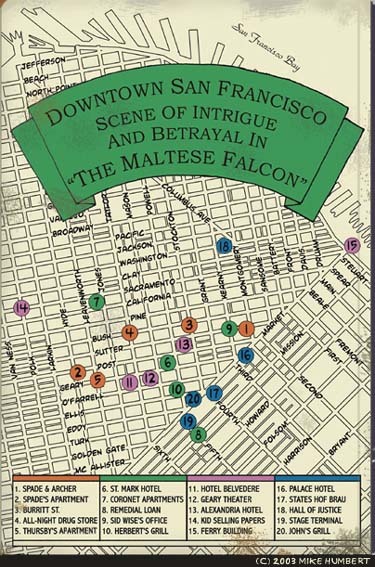
Watching The Maltese Falcon last month inspired me to read the original. It’s cool to see the names of streets and places I recognize. When I visited SF last year, my hotel was right in the thick of it.

What I’ve been reading

Just like it says on the label. I’m going to say a few things about what I read more often. I’ll keep the longer book reviews for the ones I have a bit more to share from or say about.
1. Too Big to Fail. This a great, great book that offers a minute-to-minute, blow-by-blow account of the financial crisis: meetings, phone calls, petty rivalries, bullying, groveling, panic. It’s to be expected that the people at highest levels of any industry will be fairly well-connected to each other. It’s also a little terrifying.

2. We’ll Always Have Paris. I think I need to give up on Ray Bradbury. I really liked Something Wicked This Way Comes and loved The Illustrated Man back in the day. Dandelion Wine and The Martian Chronicles were good, too. But nothing has hit the spot since.

3. Pride and Prejudice. Quite simply one of the best books I’ve ever read. One thing I appreciated was the characterization. When a new character comes in, they usually get some description, a good bit of dialogue to get the shape of their personality, and then the rest of the story assumes you remember that. Like that windbag Mr. Collins. You see his flowery speeches early, but later it’s summarized that Collins praised this and commended that. For all the 19th-century wordiness, it’s a pretty efficient little story. And it’s got all that suspense and miscommunication and false assumptions.

4. The Big Sleep. I expected to enjoy this one a lot, and I did indeed. I didn’t expect Chandler to be such a colorful writer. But there didn’t seem to be many wasted words. It’s all of a certain mood, a certain tone, a certain tightness. Great story.

5. Self-Made Man. Author Norah Vincent spent a year dressing as a man–dating, working, socializing, etc.–and reports on here experience. It’s pretty insightful. Here’s a great bit from when she meets some new guys, on the awesomeness of handshakes:

As he extended his arm to shake my hand, I extended mine, too, in a sweeping motion. Our palms met with a soft pop, and I squeezed assertively the way I’d seen men do at parties when they gathered in someone’s living room to watch a football game. From outside, this ritual had always seemed overdone to me. Why all the macho ceremony? But from the inside it was completely different. There was something so warm and bonded in this handshake. Receiving it was a rush, an instant inclusion in a camaraderie that felt very old and practiced.

Though some of her chosen research venues (bowling team, strip joints, monastery, high-pressure sales team, male retreat) are a little fringe, it’s a pretty sensitive account.

  • “If women are trapped by the whore/Madonna complex, men are equally trapped by this warrior/minstrel complex.”
  • “Every man’s armor is borrowed and ten sizes too big, and beneath it, he’s naked and insecure and hoping you won’t see.”
  • “After he told me the raw story, I said, ‘Ivan, how many women have you slept with?’
    ‘Seventy-four,’ he said without hesitation.
    Again, probably a giant lie, but who knew? Ivan also claimed to have an IQ of 180 and a nine-inch dick. But don’t they all, at least to each other.”

And she’s still plenty aware of the issues of sympathizing with The Man. Very thoughtful.

The Happiness Project (review: 3/5)

The Happiness Project
I felt pretty torn about this one. I’d been following Gretchen Rubin’s blog about the Happiness Project for a while and wondered what extra stuff would be in the book. I got it from the library, so I’m not sure that it matters as the only cost to me was time. Luckily she’s a really fluid writer and it’s a quick read, so it’s not in the “waste of time” category. Good parts:

If there’s a downside, it’s that I wish she’d shared more of the studies she read up on (surely a ton), and less of the personal anecdotes of how she applied them. But then again, I wonder if I’d say the opposite if the reverse were true? Either way, you can probably get the most bang for your buck by ripping through the best-of section over on her site. Tyler Cowen says “On net, Gretchen’s tips will enhance your happiness.” I suspect this is true.

Bicycle Diaries (review: 3/5)

Bicycle Diaries
I like David Byrne, but I feel really ambivalent about this book. On the one hand, there are some great gems and little thought-bits that come out of a curious mind. On the other hand, as the title so clearly points out, it’s diaristic. There’s a good amount of day-to-day humdrum “this is what I did here, this is what I did there” stuff to wade through. With that said, here are some parts I especially liked:

On the meta-ness of ringtones:

Ring tones are “signs” for “real” music. This is music not meant to be actually listened to as music, but to remind you of and refer to other, real music… A modern symphony of music that is not music but asks that you remember music.

Although he praises Europe’s cultivated, park-like landscape, in particular the “manicured” blend of man and nature in Berlin, he finds it

a bit sad, I think, that my visual reference for an unmediated forest derives from images in fiction and movies. Sad too that the forest in this preserved area was once quite common, but now lives on mainly in our collective imaginations.

Early in the book he talks about a number of American cities in brief. On the town of Sweetwater, Texas:

I enjoy not being in New York. I am under no illusion that my world is in any better than this world, but still I wonder at how some of the Puritanical restrictions have lingered—the encouragement to go to bed early and the injunction against enjoying a drink with one’s meal. I suspect that drinking, even a glass of wine or two with dinner, is, like drug use, probably considered a sign of moral weakness. The assumption is that there lurks within us a secret desire for pure, sensuous, all-hell-breaking-loose pleasure, which is something to be nipped in the bud, for pragmatic reasons.

And I liked this back-of-the-envelope theory on mating and signaling in Los Angeles:

I don’t know what the male-female balance is in L.A., but I suspect that because people in that town come into close contact with one another relatively infrequently—they are usually physicall isolated at work, at home, or in their cars—they have to make an immediate and profound impression on the opposite sex and on their rivals whenever a chance presents itself. Subtlety will get you nowhere in this context.

This applies particularly in L.A. but also in much of the United States, where chances and opportunities to be seen and noticed by the oppsite sex sometimes occur not just infrequently but also at some distance—across a parking lot, as one walks from car to building, or in a crowded mall. Therefore the signal that I am sexy, powerful, and desirable has to be broadcast at a slightly “louder” volume than in other towns where people actually come into closer contact and don’t need to “shout”. In L.A. one has to be one’s own billboard.

Consequently in L.A. the women, on the face of it, must feel a greater need to get physically augmented, tanned, and have flowing manes of hair that can be seen from a considerable distance.

Summarizing a conversation he had about the creative impulse:

People tend to think that creative work is an expression of a preexisting desire or passion, a feeling made manifest, and in a way it is. As if an overwhelming anger, love, pain, or longing fills the artist or composer, as it might with any of us—the difference being that the creative artist then has no choice but to express those feelings through his or her given creative medium. I proposed that more often the work is a kind of tool that discovers and brings to light that emotional muck. Singers (and possibly listeners of music too) when they write or perform a song don’t so much bring to the work already formed emotions, ideas, and feelings as much as they use the act of singing as a device that reproduces and dredges them up.

In a later part, in the London section, he talks about a new wave of appreciation for the late artist Alice Neel, and touches on the convoluted ways we evaluate and reflect on creative works new and old:

Maybe the work looks prescient? Maybe it looks prescient every decade or so, whenever a slew of younger artists do work that is vaguely similar to hers? In that way maybe she’s being used to validate the present, and in turn the present is being used to validate the past?

And lastly, on PowerPoint:

A slide talk, the context in which this software is used, is a form of contemporary theater—a kind of ritual theater that has developed in boardrooms and academia rather than on the Broadway stage. No one can deny that a talk is a performance, but again there is a pervasive myth of objectivity and neutrality to deal with. There is an unspoken prejudice at work in those corporate and academic “performance spaces”—that performing is acting and therefore it’s not “real”. Acknowledging a talk as a performance is therefore anathema.