Who needs a plain old crime now? Crimes need endorsement, distribution, crowds.

Masha Tupitsyn on Steubenville | berfrois. Reminds me of William Gibson on terrorism:

You’re a small group with no reputation, and you start covertly blowing up or murdering the people of a big group, like a government or a nation-state or a whole race. And you can’t just do it and then go and do the next one. You have to do it, and then go and do your PR. “We just bombed your mall. It was us.”

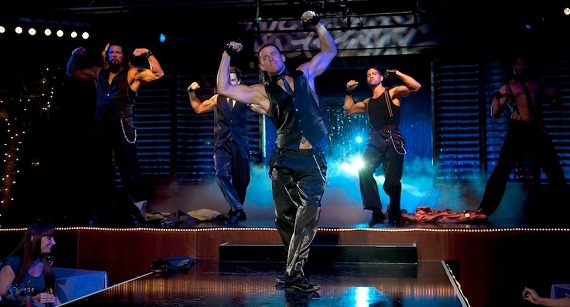
Magic Mike

Magic Mike. Soderbergh! Best movie ever about the economy and strippers. I’d rank this one behind only Haywire and Out of Sight. You’ve got Tatum’s stripper-slash-roofer-slash-artisan muddling through, but it’s hard to change course when he’s great at something he doesn’t love that’s still addicting in its own way. You’ve got Pettyfer’s teenage socially-tone-deaf bro drifter who’s having a great time being showered with money and attention–at long last! You’ve got McConaughey’s (too?) serious entrepreneur-impresario-emperor. There’s the promise of Miami as the great mythical somewhere else where things are different, some future day. Just a few more nights and then…? Contrast these three with Horn, who takes a more cautious, realist, rooted approach to every day’s compromise. She’s awake in daylight, she works and reads and goes out to dinner and enjoys a glass of wine at home. Hard and boring is okay. Pairs well with Spring Breakers.

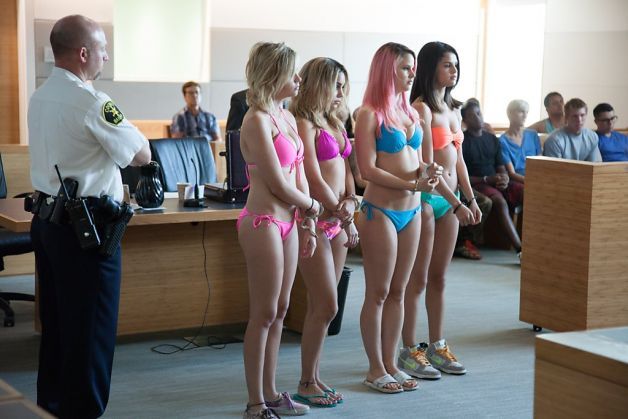
Spring Breakers

Spring Breakers. Great movie. Surface appeal is dangerous, no? It feels a little exploitative sometimes, but then again our protagonists have such undeniable agency that you wonder whose fantasy(-ies) you’re watching. So now what creeps you out? The movie repeats itself over and over. It’s the promise of spring break and sunshine and fun and release and anything but this, but looping to exhaustion. Interesting also that the movie borrows a contemporary sun-drenched/lens flare/desaturated/neon/present-tense-nostalgia fun aesthetic to undermine itself. Some dialogue I didn’t love, but maybe it was better for efficiency’s sake. Franco’s Alien and Gomez’s Faith are great. I watched this as a belated double feature with Magic Mike. Florida: Where the American Dream Confronts Itself!

The Barbed Gift of Leisure – The Chronicle Review – The Chronicle of Higher Education

We have always sensed that free time, time not dedicated to a specific purpose, is dangerous because it implicitly raises the question of what to do with it, and that in turn opens the door to the greatest of life mysteries: why we do anything at all. Thorstein Veblen was right to see, in The Theory of the Leisure Class, not only that leisure time offered the perfect status demonstration of not having to work, that ultimate nonmaterial luxury good in a world filled with things, but also that, in thus joining leisure to conspicuous consumption of other luxuries, a person with free time and money could endlessly trapeze above the yawning abyss of existential reflection. With the alchemy of competitive social position governing one’s leisure, there is no need ever to look beyond the art collection, the fashion parade, the ostentatious sitting about in luxe cafes and restaurants, no need to confront one’s mortality or the fleeting banality of one’s experience thereof. Even if many of us today would cry foul at being considered a leisure class in Veblen’s sense, there is still a pervasive energy of avoidance in our so-called leisure activities.

Also:

Work hones skills, challenges cognition, and, at its best, serves noble ends. It also makes the experience of genuine idling, in contrast to frenzied leisure time, even more valuable. Here, with only our own ends and desires to contemplate—what shall we do with this free time?—we come face to face with life’s ultimate question. To ask what is worth doing when nobody is telling us what to do, to wonder about how to spend our time, is to ask why are we here in the first place.

Previously in Mark Kingwell tumbles.

The Barbed Gift of Leisure – The Chronicle Review – The Chronicle of Higher Education

ransomcenter:

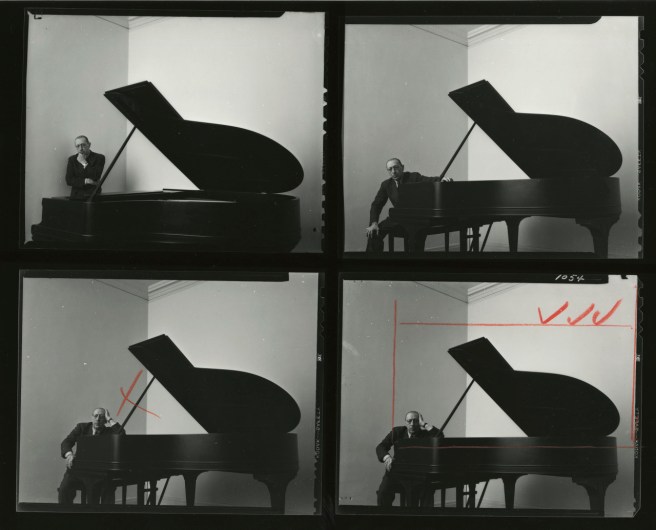
“There’s a reason so many of Newman’s portraits have become the iconic images of artists such as Stravinsky and Picasso. Entering their space, Newman managed to capture something of these artists’ inner lives.” 

Read the Austin American-Statesman’s review of “Arnold Newman: Masterclass.”

Caption: Arnold Newman, Igor Stravinsky, 1945. Contact sheet of four negatives with Newman’s marks and cropping lines.

TFS Essentials: Dirty Dancing, feminism and the female gaze – Toronto Film Scene.

It’s no wonder that Dirty Dancing inspires near-mythic allegiance among women of a certain age. It may be the only film we’ve ever seen in which the male love interest is the one placed squarely in the centre of the frame to be admired for his physical prowess. Ostensibly, films in the romance genre are always “for women” but it’s rare that the male lead is objectified in the way Swayze is here. […] Baby has a great experience with a caring lover, and then at the end of the summer she goes on with her awesomely ambitious life. She doesn’t change her plans to be with her man or cry bitter tears at having to leave him. It’s impossible to overstate how rare a role model like Baby is in films aimed at teenage girls and young women.

atlurbanist:

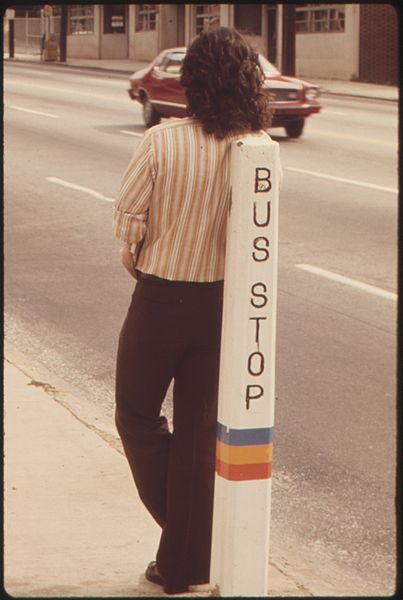
Waiting for a MARTA bus in 1974

Cool dude waiting for a MARTA bus in Atlanta, 1974. This photo comes from Wiki Commons, with a note that there was a spike in ridership at this time because the fare was reduced from 40 cents to 15 cents. Also, new routes and buses had been recently added.

Current MARTA fare for buses and trains is $2.50, with an increase possible later this year if budgeting measures (and proposed privatization) are unsuccessful at alleviating financial woes at the agency.

I really like these old bus stop obelisks.