Tangerine

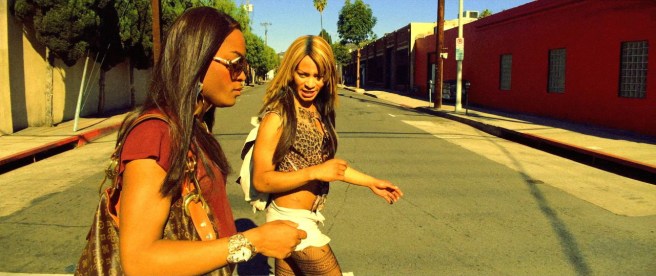
Tangerine. It kicks your feet out from under you with all this zany energy. I wish it could have sustained it all the way through. The scene at the end where all the threads come together is a bit of a too-long jumble. And some parts are, ah, problematic because the tone feels a bit off. But man, such a fresh and fiery start. I love how they work in the soundtrack, and let the visuals and the music guide you every now and then.

The Assassin

The Assassin. Not going to pretend that I understood the plot in its finest details, but it’s pretty great. We have a heroine who’s had her life planned for her, and now she is wrestling with a choice. Love how the soundtrack often sticks to almost silence, except for a slow drum strike every few seconds. There’s one long scene that’s we watch – just barely, sometimes – through these gauzy curtains that drift back and forth as the camera pans from A to B and back. It’s one of those moments that gets me fired up about what you can do with movies with a little patience. Rare to see something so reflective yet so lively.

Essentialism: The Disciplined Pursuit of Less

I read Greg McKeown’s Essentialism: The Disciplined Pursuit of Less, and I got some good ideas out of it.I suppose at it’s heart it’s about making decisions. “Less but better”. It’s a tough one to pull quotes from. Some of the best parts were a few graphics here and there. This was important:

Routine is one of the most powerful tools for removing obstacles.

I also like this idea of an “essential intent”. That is, some idea that’s both somewhat inspirational but also concrete. It gets you motivated… and you also know when you’re done. “Done right, an essential intent is one decision that settles one thousand later decisions”.

Maybe the most immediately practical part was a section on sayning “no”, where appeared this lovely bit of conversational judo:

Use the words “You are welcome to X. I am willing to Y.” For example, “You are welcome to borow my car. I am willing to make sure the keys are here for you.” By this you are also saying, “I won’t be able to drive you.” You are saying what you will not do, but you are couching it in terms of what you are willing to do. This is a particularly good way to navigate a request you would like to support somewhat but cannot throw your full weight behind. I particularly like this construct because it also expresses a respect for the other person’s ability to choose, as well as your own. It reminds both parties of the choices they have.

And this section on sleeping:

The best asset we have for making a contribution to the world is ourselves. If we underinvest in ourselves, and by that I mean our minds, our bodies, an dour spirits, we damage the very tool we nee to make our highest contribution. One of the most common ways people – especially ambitious, successful people – damage this asset is through a lack of sleep. […] While there are clearly people who can survive on fewer hours of sleep, I’ve found that most of them are just so used to being tired they have forgotten what it really feels like to be fully rested.

Guilty as charged. Reminded me, I realized this over Christmas vacation recently, when my previously typical 6-6.5 hours of sleep each day ballooned to 10-11 when I didn’t have any constraints. I felt like a different human being and now I’m all about that 8hrs every day. Worth a read.
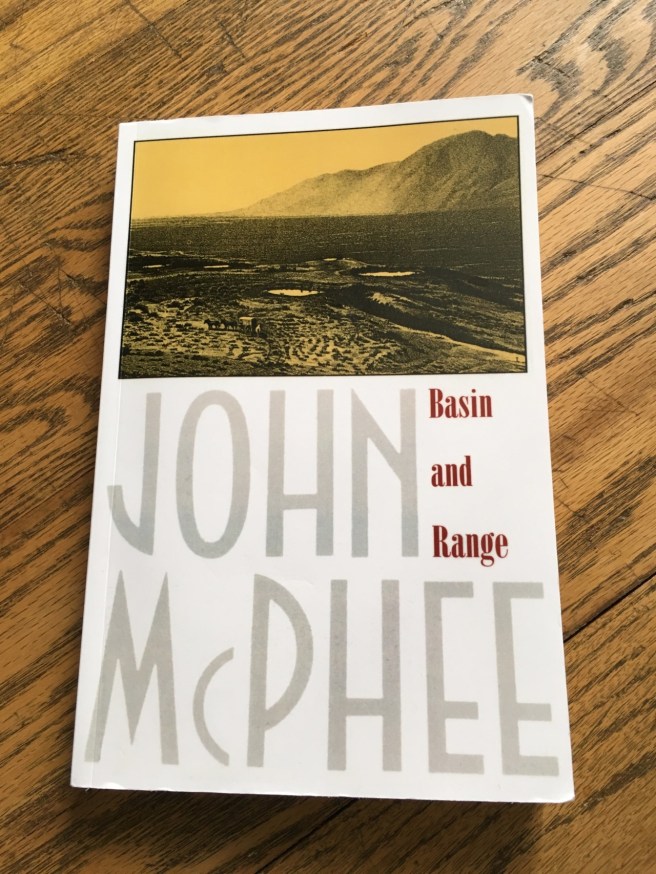
Basin and Range

I read John McPhee’s Basin and Range, and really liked it. He’s just a ridiculously great writer. Big chunks of the book tie in with a road trip he takes with a geologist named Deffeyes. They stop a lot and look at rocks.

Deffeyes said, “Let’s Richter the situation,” and he got out and crossed the road. With his hammer, he chipped at the rock, puzzled the cut. He scraped the rock and dropped acid on the scrapings. Tilted by the western breeze, the snow was dipping sixty degrees east. The bedding planes were dipping twenty degrees east; and the stripes of Deffeyes’ knitted cap were dipping fifty degrees north. The cap had a big tassel, and with his gray-wisped hair coming out from under in a curly mélange he looked like an exaggerated efl. He said he thought he knew what had cause “that big goober” in the rock, and it was almost certainly not a manifestation of some major tectonic event – merely local violence, a cashier shot in a grab raid, an item for an inside page.

There’s a lot of neat historical parallels, like how geology’s growing understanding of deep time put humanity in our place, just like over in biology, natural selection was having a similar effect. It’s 300 pages about rocks, y’all. This is one book of a four-part series collected in Annals of the Former World and I’m very, very tempted.

Filed under: John McPhee.

The Revenant

The Revenant. I still hold to my first reaction:

I wish THE REVENANT were wilder, of all things. Camera makes you feel not like you’re there, but like you’re on an Arctic ride on rails. Or a videogame cut scene? I liked it though. Looked like the most miserable filming experience one could ask for. Also, Tom Hardy has never lost a staring contest.

A bit of a slog. Doesn’t seem to be a whole lot of meat on those bones. Birdman also felt a bit stifling for me. Amazing that this thing got made, though. I wonder if all the PR talk about the filming conditions was sort of an admission/cover that they didn’t quite get what they wanted out of this one.

See also: The Grey and Grizzly Man.

Out Stealing Horses

I read the first 1/3 or so of Per Petterson’s Out Stealing Horses, but then I came to a chapter where I predicted what was going to happen within the first couple pages. When my prediction turned out to be right, I tried to press on but interest dwindled too quicky. Lovely writing about nature, though. I like this, too:

Time is important to me now, I tell myself. Not that it should pass quickly or slowly, but be only time, be something I live inside and fill with physical things and activities that I can divide it up by, so that it grows distinct to me and does not vanish when I am not looking.

Carol

Carol. I feel like there’s enough there for me to like it more than I do, but it wasn’t for me. I don’t regret watching Blanchett and Mara for a couple hours, though.

Spotlight

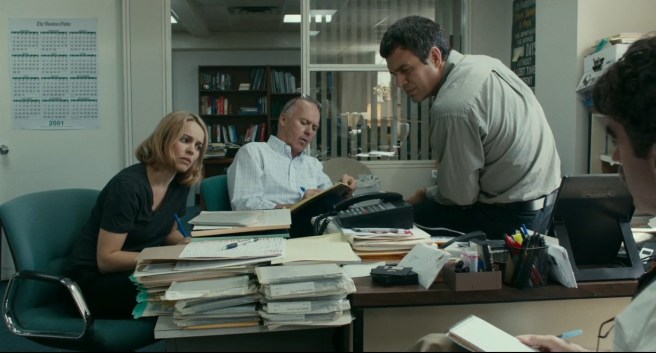
Spotlight. I loved it. Great writing and acting. Teamwork, thinking, putting pieces together. There is some conflict here and there, and most of it doesn’t seem too drummed up for drama, but just real people navigating messy institutions and practical realities. Love the costume design, too. Doesn’t just capture the era but the personalities, too. One of my faves of last year.

The Oxy Epidemic Shows What Happens When Addictive Drugs Are Easily Available | Mother Jones

It’s easy to favor drug legalization when you’re middle-class and well educated. Your social group probably doesn’t include many people who abuse drugs much in the first place. Moderate users can afford their habit. And when their use turns into addiction, they usually have a strong support network to help out. It’s a problem, but not a huge one. In poor communities, none of this is true. Drug addiction is financially ruinous. It often leads to petty crime. Support systems are nonexistent. The justice system is harsh. There are no rehab centers on the Malibu coast to help out. Drug epidemics — Oxy, meth, heroin, you name it — are devastating. It’s something to keep in mind when you consider both the costs and benefits of drug legalization. Ending the war on drugs would indeed be a huge benefit, but the costs might be higher than you think.

The Oxy Epidemic Shows What Happens When Addictive Drugs Are Easily Available | Mother Jones

Star Wars: The Force Awakens

Star Wars: The Force Awakens. I had fun, and quickly forgot it. It mostly felt good to be watching a Star Wars movie again. If you’re pretty sure you don’t care about Star Wars in general, this movie will not convince you otherwise. If you do, you will probably leave feeling satisfied, depending on how you like your ratio of pandering nostalgia vs. breaking new ground. The hat-tips and references to previous movies wore thin pretty quickly and for me slowed down what otherwise has some nice momentum. Definitely some groaners, though (for example, the snowy mountain Nazi castle…). I really like Ridley and Chiyoga as the new faces. Isaac is always reliable. I feel like in a few months or maybe not until VIII we’ll look back and admit “Hey, VII is pretty thin but it’s not a total trainwreck and that’s okay”. Ranking the best episode 7’s in 2015:

  1. Creed, by a landslide.
  2. Furious 7
  3. The Force Awakens

To discard the stuff we’ve acquired is to murder the version of ourselves we envision using it.

Laura Miller in Marie Kondo Will Help You Tidy Your House, Embrace Your Mortality. Cleaning up is hard to do, y’all.

The piles of stuff we might need someday are an argument that we will always be around to need them. The plans to revisit those photos and take up again that course of study, the books we fully intend to finally read assure us that there will be enough time to do so. Mementos presume the ongoing existence of a rememberer. Yes, all of that is a lie, but it’s a necessary lie. And all the joy in the world can’t really compensate for having to let that go.

Cf. “Our unlived lives…”

Star Wars Episode III: Revenge of the Sith

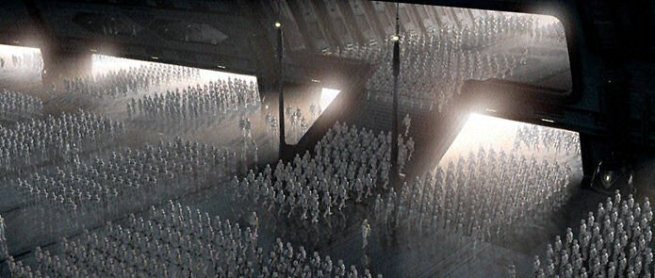
Star Wars Episode III: Revenge of the Sith. I don’t know how you could watch the prequels and pick anyone other than Obi-Wan Kenobi as the coolest guy in the galaxy. I also appreciate that it undercuts the Jedi a bit. They are powerful and try to do some good, but they mess up a lot. I really dig the psychological battles and manipulation in this one. Great stuff. While Christensen is not a good actor, I buy into his tortured melodrama because I believe in Darth Vader’s arc. You’ll forgive a lot if the story is worth believing in. Would have loved more of that. Meanwhile, who the hell is General Grievous? (Know what’s cooler than two light sabers? Four light sabers!) Yeesh. Better than the other two prequels, I think, and a good way to close things out.

Star Wars Episode II: Attack of the Clones

Star Wars Episode II: Attack of the Clones. One of my major complaints of the prequels is that everything looks so nice, and nothing really feels lived in. Very true in this one. I like that we get to hang out with Obi-Wan so much, doing private eye stuff, chasing down assassins. Overstuffed and scattered, though, and there’s just no way that Anakin & Padme fall in love. Teen Anakin is a nightmare. While I don’t see him in that relationship, I can start to feel for him here, just tragicomically buffeted by his emotions, absolutely at their mercy. The soundtrack is in peak form here, too.

Star Wars Episode I: The Phantom Menace

Star Wars Episode I: The Phantom Menace. Maybe it’s just that time has washed away the hurt and shattered expectations of 1999, but my thoughts after a second viewing:

If I learned anything from STAR WARS it’s to let go of hate and stuff and I realized episode 1 is kinda campy and charming on second watch?

The story is blah, the writing and acting is blah. But yet, I don’t regret watching it again. I love how every setting is packed with goofy species and local details, every cityscape is full of air traffic. If there is any saving grace, it is the soundtrack – the best part of all of the prequels.

You don’t realize how much of your sense of self is bound up in how you use your time until you have a lot of it.

Max Read in Milling Time.

New year, new you? Forget it

Behind the seductive lure of “New Year, New You” lies another kind of mistake, too: the idea that what we require, in order finally to change, is one last push of willpower. (Presumably, the hope is that the “January feeling” of fresh starts and clean slates will provide it.) The assumption is that you’re a bit like a heavy rock, poised on a hill above the Valley of Achievement, Productivity and Clean Eating. All you need is a concerted push to get you rolling.

Filed under: my really good resolutions tag.

New year, new you? Forget it

If you’re 30% through your life, you’re likely 90% through your best relationships. Some really great visuals in this one – how many books you might read, how many times you might go swimming – and then it comes to this:

I’ve been thinking about my parents, who are in their mid-60s. During my first 18 years, I spent some time with my parents during at least 90% of my days. But since heading off to college and then later moving out of Boston, I’ve probably seen them an average of only five times a year each, for an average of maybe two days each time. 10 days a year. About 3% of the days I spent with them each year of my childhood. Being in their mid-60s, let’s continue to be super optimistic and say I’m one of the incredibly lucky people to have both parents alive into my 60s. That would give us about 30 more years of coexistence. If the 10 days a year thing holds, that’s 300 days left to hang with mom and dad. Less time than I spent with them in any one of my 18 childhood years.

Damn.