About Costa Rica, Nicaragua, their mutual border, and Google | Ogle Earth. (via)

Nicaragua did not mistakenly enter Costa Rican territory because it relied on Google Maps. Ortega’s justification for Nicaragua’s actions appeal to documents from the 19th century; Pastora’s mention of Google Maps is just a taunt.

This whole thing, after going to Nicaragua last winter, makes me wonder:

Is there a (preferably German) word for the residual interest/affection you feel about places you’ve visited only for a short time?

“Nostalgia” is too yearn-y and past-oriented. It’s more like wanting to be in touch with the Now that you’re missing over there.

If you are dependent on borrowed money, you have to wake up every day worried about what the world thinks of you.

Warren Buffett. The context for this was the Bear Stearns meltdown, but it applies to so much more.

Not Your Parents’ Audiobook: David Byrne’s “Bicycle Diaries”

utnereader:

David Byrne’s successful book, Bicycle Diaries, probably would have sold just fine as a traditional audiobook, as well. However, never one for the status quo, Byrne wanted to do something a little more interesting than simply reading the book in silence and releasing it as a download or cd. Instead, he looked to other successful audio formats for inspiration, namely NPR shows that incorporate scene sounds and podcasts.

I was pretty ambivalent about the book, but maybe ambient sound would have kicked it up a notch, especially for a work so linked to its geography. Great idea. Download the intro and hear some samples.

Not Your Parents’ Audiobook: David Byrne’s “Bicycle Diaries”

maudnewton:

yama-bato:

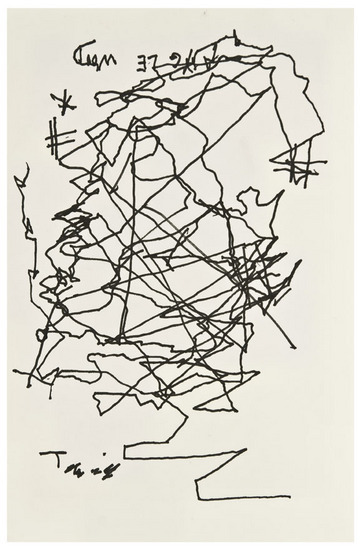
Jorge Luis BORGES (Argentinian, 1899 – 1986) Self-portrait. ink on paper
8 3/4 x 6 inches (225 x 150 mm)

http://ny.bloomsburyauctions.com/detail/NY034/61.0

When he drew this, because Burt Britton asked him to, Borges was blind.

Weirdly, Cormac McCarthy also did a self-portrait for Britton. Other writers in the collection: Joan Didion, Edward Gorey, Roald Dahl, Margaret Atwood, Saul Bellow, Norman Mailer, Maurice Sendak, John Updike, and Tom Wolfe.

The New Inquiry – SEO & the Disappearing Self

Social media structures communication between friends so that the responsibility for listening — inescapably built into earlier mediums that structured talk between friends as person-to-person — is modulated into a vaguer injunction to respond if and when you feel like it. Because status updates and the like are not addressed to anyone specific, they don’t generate an obligation in anyone specific to pay attention.

The New Inquiry – SEO & the Disappearing Self

The Book of Basketball (review: 5/5)

The Book of Basketball
It’s a great book, let’s get that out of the way before we proceed. Just know that Bill Simmons is a carefree, garrulous writer and it is obsessively focused on basketball. It might not be your thing. One of the best practices when I was reading this one was to keep the iPad nearby so I could do a little backgrounder on legendary players I’d never heard of, and, more importantly, keeping YouTube handy to look up amazing dunks, passes, etc. If you haven’t followed basketball, there is a learning curve. On the upside, like I told Justin, reading this book after the recent playoffs, finals, The Decision, etc. has me more interested in basketball than I’ve ever been.

The biggest parts of the book cover Larry Bird, Russell vs. Wilt, The Secret (e.g. TEAMWORK), ranking the best players ever, and ranking the best teams ever. All in obsessive detail. You can open a page anywhere in the book, and in short order stumble on a really good argument about something. In a 3-page section on Elvin Hayes, Simmons lists 5 reasons that Hayes stands out. In item #5, there’s a little mini-essay on the fall-away/turnaround shot:

My theory on the fall-away: it’s a passive-aggressive shot that says more about a player than you think. For instance, Jordan, McHale and Hakeem all had tremendous fall-aways—in fact, MJ developed the shot to save his body from undue punishment driving to the basket—but it was one piece of their offensive arsenal, a weapon used to complement the other weapons already in place. Well, five basketball stars in the past sixty years have been famous for either failing miserably in the clutch or lacking the ability to rise to the occasion: Wilt, Hayes, Malone, Ewing and Garnett. All five were famous for their fall-away/turnaround jumpers and took heat because their fall-aways pulled them out of rebounding position. If it missed, almost always it was a one-shot possession. On top of that, it never leads to free throws—either the shot falls or the other team gets it. Could you make the case that the fall-away, fundamentally, is a loser’s shot? For a big man, it’s the dumbest shot you can take—only one good thing can happen and that’s it—as well as a symbol of a larger problem, namely, that a team’s best big man would rather move away from the basket than toward it. […] So here’s my take: the fall-away says, “I’d rather stay out here.” It says, “I’m afraid to fail.” It says, “I want to win this game, but only on my terms.”

Woah, right? Coming up organically in a discussion about a specific player we get a really interesting observation on the game itself, couched in a super-fan/nerd’s historical mastery, with some speculative psychology delivered in the kind of friendly/authoritative tone you’d hear at a bar. A later section on Kobe Bryant looks at his career through the lens of Teen Wolf, vacillating between the team-player (Michael J. Fox) and the devastating ball hog/alpha dog (Wolf). Maybe the better movie analogy is thinking of Tim Duncan like Harrison Ford:

If you keep banging out first-class seasons with none standing out more than any other, who’s going to notice after a while? There’s a precedent: once upon a time, Harrison Ford pumped out monster hits for fifteen solid years before everyone suddenly noticed, “Wait a second—Harrison Ford is unquestionably the biggest movie star of his generation!” From 1977 to 1992, Ford starred in three Star Wars movies, three Indiana Jones movies, Blade Runner, Working Girl, Witness, Presumed Innocent and Patriot Games, but it wasn’t until he carried The Fugitive that everyone realized he was consistently more bankable than Stallone, Reynolds, Eastwood, Cruise, Costner, Schwarzenegger and every other peer. As with Duncan, we knew little about Ford outside of his work. As with Duncan, there wasn’t anything inherently compelling about him. Ford only worried about delivering the goods, and we eventually appreciated him for it. Will the same happen for Duncan one day?

If there is a weakness, it’s that the occasional jokey celeb-bashing comes up really lame and unnecessary. But that’s a small price to pay for 700+ quality pages and a comparable number of entertaining footnotes. Worth a read!

In which I ponder former selves

How much have I changed? Andy McKenzie and Ben Casnocha wrote recently about the wisdom of former selves. Their posts reminded me of a note I jotted down the other day:

Things that, while I was in college, I wish I’d had/made more time to learn about: film, psychology, business, economics.

Things that, since college, I’ve found myself learning more and more about, without applying any special focus: film, psychology, business, economics.

Which relates to another note-to-self from a few weeks ago:

Some careers I considered, ages 5-15: archaeologist, carpenter, National Geographic explorer, SWAT team, writer, conductor.

Plus ça change… I would, for the most part, still have interest in certain aspects of these (maybe even the whole thing). Discovery, craft, research, suspense, mastery, performance. And over the past few weeks I’ve spent some time re-reading my journals from previous long hikes and travel. It’s both amusing and a little frustrating that some of the same ideas that consume me now popped up 1, 3, 5, 10 years ago. Or some of the really funny and observant things I wrote could have been written yesterday. As Andy writes:

It’s harder to construct a personal narrative of growth when the sentences showing that you used to be just as sweet remain visible.

Just makes me wonder if I’m really changing that much (do I want to?), or if I’m just becoming more like me. The metaphor that comes to mind is like when you’re downloading a large image file, and it gradually becomes less and less pixelated. Same Mark, more data, more detail.

On Kindness (review: 4/5)

On Kindness
While it didn’t finish as awesomely as when I first tweeted my excitement half-way through, On Kindness still ended up being very good, and still among the top nonfiction of the year for me. The goal here is to figure out what happened to kindness: why we have an instinct for it, why religions encourage it, how the ideas of fellow-feeling and sympathy went from being a celebrated part of a well-balanced life to something we see as either suspicious or weak nowadays. Adam Phillips and Barbara Taylor put special focus on the experience of kindness as we move from childhood to adulthood. Rousseau (e.g. Émile) and of course Freud receive special attention. The idea of the “riskiness” of kindness was really, really novel for me. Here are some favorite quotes, starting with a good summary:

Acts of kindness demonstrate, in the clearest possible way, that we are vulnerable and dependent animals who have no better resource than each other. If kindness previously had to be legitimized by a God or by gods, or located in women and children, it is because it has had to be delegated—and sanctioned, and sacralized, and idealized, and sentimentalized—because it comes from the part of ourselves that we are most disturbed by; the part that knows how much assurance and (genuine) reassurance is required to sustain our sense of viability. Our resistance to kindness is our resistance to encountering what kindness meets in us, and what we meet in other people by being kind to them. And, of course, our resistance to seeing the limits of what kindness can do for us.

Real kindness is an exchange with essentially unpredictable consequences. It is a risk precisely because it mingles our needs and desires with the needs and desires of others, in a way that so-called self-interest never can.

Freud: We are never so defenseless against suffering as when we love.

Childhood has become the last bastion of kindness, the last place where we may find more love in the world than there appears to be. Indeed, the modern obsession with child-rearing may be no more and no less than an obsession about the possibility of kindness in a society that makes it harder and harder to believe in kindness. Talking about child development and about parenting may be one of the only ways we have now of talking about fellow feeling.

Growing up, if anything, is the imaginative elaboration of fellow feeling: the acknowledgment that other people have what we need and that their well-being matters to us.

When it comes to appetite, all exposure is experienced as overexposure.

If people are too kind–too thoughtful, too considerate, too sensitive–sex can be insufficiently exciting; if they are not kind enough, it can be too frightening too enjoy.

Kindness is a continual temptation in everyday life that we resist. Not a temptation to sacrifice ourselves, but to include ourselves with others. Not a temptation to renounce or ignore the aggressive aspects of ourselves, but to see kindness as being in solidarity with human need, and with the very paradoxical sense of powerlessness and power that human need induces. Acts of kindness involve us in different kinds of conversations; our resistance to these conversations suggest that we may be more interested in them, may in fact want much more from them, than we let ourselves know.