No pain here, no dull empty hours, no fear of the past, no fear of the future.
John Muir on Yosemite. (via)
No pain here, no dull empty hours, no fear of the past, no fear of the future.
A very good essay on how the twin ideas of the sublime and the frontier coalesced into the American environmental movement, and how the modern idea of wilderness sets a dangerous sort of man vs. nature dualism that we’re better off without. There’s also the class/race issues, of course, and how modern outdoor experience became not a way of life but a consumptive pastime. And ironically, “Frontier nostalgia became an important vehicle for expressing a peculiarly bourgeois form of antimodernism.” Good stuff.
The Trouble with Wilderness; or, Getting Back to the Wrong Nature – William Cronon
The line between the reality that is photographed because it seems beautiful to us and the reality that seems beautiful because it has been photographed is very narrow. […] The minute you start saying something, “Ah, how beautiful! We must photograph it!” you are already close to the view of the person who thinks that everything that is not photographed is lost, as if it had never existed, and that therefore, in order really to live, you must photograph as much as you can, and to photograph as much as you can you must either live in the most photographable way possible, or else consider photographable every moment of your life. The first course leads to stupidity; the second to madness.
Upon receipt of Maushart’s out-of-office email stating that she was no longer online, many of them assumed that she’d had a nervous breakdown.
A very good essay on how the twin ideas of the sublime and the frontier coalesced into the American environmental movement, and how the modern idea of wilderness sets a dangerous sort of man vs. nature dualism that we’re better off without. There’s also the class/race issues, of course, and how modern outdoor experience became not a way of life but a consumptive pastime. And ironically, “Frontier nostalgia became an important vehicle for expressing a peculiarly bourgeois form of antimodernism.” Good stuff.
The Trouble with Wilderness; or, Getting Back to the Wrong Nature – William Cronon
No pain here, no dull empty hours, no fear of the past, no fear of the future.
Upon receipt of Maushart’s out-of-office email stating that she was no longer online, many of them assumed that she’d had a nervous breakdown.
The line between the reality that is photographed because it seems beautiful to us and the reality that seems beautiful because it has been photographed is very narrow. […] The minute you start saying something, “Ah, how beautiful! We must photograph it!” you are already close to the view of the person who thinks that everything that is not photographed is lost, as if it had never existed, and that therefore, in order really to live, you must photograph as much as you can, and to photograph as much as you can you must either live in the most photographable way possible, or else consider photographable every moment of your life. The first course leads to stupidity; the second to madness.
We are all dying of miscellany.
Like many innovative artists, Monet, I believe, was unclear about what he had achieved. Or, to be more precise, he could not name his achievement. He could only recognize it intuitively, and then doubt it.
The enveloping air: Light and moment in Monet – By John Berger (Harper’s Magazine)
An alcoholic writes about AA and recovery. This is a fantastic essay. [$]
My own view-in-progress is that there is no such thing as alcoholism as a disease or an allergy or a condition, but that alcohol is a very effective and potentially addictive medication for a whole host of psychological and neurobiological problems. […]The problem with alcohol is not so much that it is an addictive medication; rather, it’s that, unlike other addictive medications–to which people will also grow or not grow addicted at varying speeds and in unpredictable ways–alcohol’s social function and accessibility obfuscate this reality. If you’re prone to overdoing it, the fact that you’re self-prescribing (and choosing your own dosage) doesn’t help.
And:
Like most alcoholics I prefer to be the center of attention. That’s one of the reasons drinking was fun. You’re the hero of every story.
And also:
When you keep hearing “Relapse is part of recovery, relapse is part of recovery” each night from a different person, sometimes two or three, and then you leave the meeting and see the neon beer signs of the bar on the other side of Main, well, those lights get a little sparklier. Elbows on the bar, squeezed in, the bartender smiles; that smell of the bar, the smell of self-acceptance, joy, and fellowship.
Help is out there, folks.
The drunk’s club: A.A., the cult that cures – By Clancy W. Martin (Harper’s Magazine)
Short version: you should buy How I Got Over, Watertown, White Light, Station to Station, and The Black Album. What follows are more highlights from my year, month by month. As in 2008 and 2009, the general rule here is I don’t care if it actually came out in 2010, it’s just that I happened to pay attention this year.
January

Brian Eno, Before And After Science. I *love* No One Receiving and By This River. In a similar vein, but not quite as good, were Fripp & Eno’s albums Evening Star and (No Pussyfooting).
Cocteau Twins, Victorialand and Head Over Heels. Twisting vocals and dark, driving Cure-ish soundscapes. These guys are great.
Ama Maïga, Une Fleche Malienne. Kora + Afro-pop. The first and last tracks are my favorites.
Linda Perhacs, Parallelograms. Think Joan Baez/Joni Mitchell-esque dreamy acoustic guitar with solid songwriting. This album’s vibe would echoed in October with one from Françoise Hardy…
Steve Roach, Structures from Silence. I’m not quite sure how to distinguish good ambient music from bad ambient music, aside from maintaining a general sort of peacefulness, but I liked this a lot.
February

Frank Sinatra, Watertown. This is my favorite one that wasn’t released this year. It’s another of his heartbreak concept albums, and it definitely holds its own against In The Wee Small Hours and Only the Lonely. I have no idea why this one is still underground.
Antônio Carlos Jobim, Wave. His most successful album. Stone Flower came out a few years later and is worth a listen, if only for Brazil.
Sayeeduddin Dagar, Lineage of Dhrupad. I hadn’t listened to much Indian vocal work before this year, but this album sold me on it, especially the old dhrupad stuff. The voice and breathe control is super-impressive. Lots more to come later in the year.
March

Young Jeezy, The Inspiration: Thug Motivation 102. Atlanta’s own. He’s not the best lyricist, but I love his voice/delivery and the steady, drenched sound you hear in most of the production. And he has good samples. Standout tunes are Hypnotize and The Inspiration (Diana Ross sample!). Great nighttime city-driving music.
Hariprasad Chaurasia, Charm of the Bamboo Flute. This might be my favorite Indian album this year.
Magdalena Kožená, performing a collection of French Arias. Charles Gounod’s O ma lyre immortelle from Sapho and Nuit resplendissante from Cinq-Mars are the best ones. Ambroise Thomas’ Connais-tu le pays from Mignon is a close third.
Crystal Tears is a solid Renaissance collection from Andreas Scholl singing with Julian Behr on the lute and the Concerto di Viole Basel. John Bennet’s Venus’ birds whose mournful tunes is a good one and John Dowland’s Go, crystal tears is a classic.
Flanders Fiamminghi Orchestra and conductor Rudolf Werthen put together the awesome An I Fiamminghi Collection. Highlights for me are Alan Hovhaness’ Prayer of St. Gregory and Henryk Górecki’s Pieces in the Olden Style.
Mariem Hassan, Deseos. This might be my favorite African album of the year. Sick desert blues riffs + powerful vocals. Check out Magat milkitna dulaa, or Sbar. Mariem Hassan con Leyoad is not quite as good.
April

Kraftwerk, Radio-Activity. A lot of it is pretty toned-down and spacey compared to the earlier stuff I loved so much last November.
Gundecha Brothers & Uday Bhawalkar, Timeless Dhrupads. Whoever is playing mridangam here is just killing it.
Duruflé: Requiem & Four Motets. Lovely recording. This one is a happy medium between the sleepy Fauré Requiem and Verdi’s ridiculous one.
Yeasayer, Odd Blood. This one took a while to grow on me, though I loved All Hour Cymbals. Mondegreen is the best song, followed by I Remember.
Glenn Gould recorded Brahms’ Ballades, Op. 10 and Rhapsodies, Op. 79. I don’t know if Gould is a good Brahms interpreter or not, but he helped me overcome my long-standing aversion to the guy. I like the Ballades in particular.
May

This was baroque month, apparently. While only two albums stood out, they were very, very good.
Rosso – Italian Baroque Arias, sung by Patricia Petibon with Andrea Marcon conducting the Venice Baroque Orchestra. Highlights for me: from Stradella’s San Giovanni Battista, Queste lagrime e sospiri; from Handel’s Giulio Cesare, Piangerò la sorte mia; and from Sartorio’s L’Orfeo, Orfeo, tu dormi. Dang, y’all.
I also enjoyed various Baroque Oboe Concertos with Marcel Ponseele on the oboe, with Ensemble Il Gardellino. One particular favorite is Bach’s Ich steh mit einem Fuß im Grabe, BWV 156.
May was odd in its uniformity. I’m not sure what connects Bach and Bowie, but they were both highlights for the next month…
June

David Bowie, Station to Station is a masterpiece, pure and simple. See: Golden Years, Stay, Wild Is the Wind, and everything else.
Collegium Vocale Ghent and conductor Philippe Herreweghe did some good work on Christus, der ist mein Leben: Bach Cantatas BWV 27, 84, 95, 161.
Olivier Latry played César Franck’s organ stuff on In Spiritum. Much of it is pretty mellow. The Pièce héroïque is wonderful, as is the Prelude, fugue and variations, Op. 18.
July

Devo’s Something For Everybody was surprisingly fun. It doesn’t seem very ambitious, just upbeat, tight, and it reaps major benefits from keeping the songs brief and to the point.
Sundrips, Slow Futures. More ambient. Everything I’ve heard from Sundrips has been pretty good.
Ramakant & Umakant Gundecha, Ancestral Voices. More dhrupad. There is something incredibly fulfilling about the pattern of slow, meditative, exploratory beginnings that build to rhythmic extravagance by the end. Sooltal of Raga Charukeshi is a favorite here, but it’s not as satisfying if you don’t listen to the opening.
August

The Roots, my friends. How I Got Over is my favorite album released this year. It’s a lovely piece of work. Writing, production, performances, variety. It’s all in there. Favorite track = Now or Never, followed closely by the title track.
This month actually kicked off with Beat Connection’s Surf Noir EP, which was available on their site and is probably easy to download somewhere else now. Sunburn followed by In the Water is one of the great album openings. Nice closer, too, with Same Damn Time.
M.I.A.’s Kala makes me wish I was on something. Paper Planes is one for the ages.
Like St. Vincent’s Actor last year, The Ruby Suns’ Fight Softly gets better as it goes along. It’s not as sharp as Annie Clark’s work (but what is?), but solid nonetheless. Two Humans is the one to hear.
September

Ash Ra Tempel, Inventions for Electric Guitar. Something like Steve Reich + Robert Fripp, maybe? Whatever the ingredients, it’s good space-trippy music.
Rilo Kiley, Under the Blacklight. How have I ignored this so long? The title track, Silver Lining, The Moneymaker, and Dejalo are stand-outs. The rest are really good.
Fire Beneath My Fingers is a sweet collection of recorder concertos. Like I said, Vivaldi’s Trio Sonata RV 86 is my jam.
Robert Johnson, King of the Delta Blues Singers, Slow Version. The speed change creates a whole different feel for a great body of work.
The Clientele, Minotaur. Like an updated version of The Byrds, tempered with a dash of Devendra Banhart or Iron & Wine or something.
Thione Seck, the Best of. I love the layers of drumming, big horns, funky guitar riffs. See Mane Mi Gnoul, Mass Ndiaye, and Yaye Boye.
October

This might have been the best month overall. The favorite was Darker Than Blue, Soul From Jamdown 1973-1980. Jamaican bands cover American funk. Win-win. Check out Freddie McGregor’s cover of Get Involved (George Soule’s original) and John Holt’s For the Love of You (Isley Brothers original).
The Clientele, Bonfires on the Heath. Another solid album.
Washed Out. The Life of Leisure EP came out late last year, but somehow I missed it. I can’t wait to see this dude for the third time in just a few weeks. I say this summer’s song, You and I, is a must-listen. Love that slow disco-stomp + sweet bass line.
As I did with Brahms, this year I also finally came to understand That Which Is Hendrix. Are You Experienced? did the job.
Françoise Hardy’s album La question kicks off with the breezy Viens, and sweeps through 11 more songs.
Charanjit Singh’s Ten Ragas to a Disco Beat is fantastic, and apparently preceded much of what we call dance/trance/electronic over here in the States. This is my new upbeat Getting Shit Done music.
The collection of Brahms Symphonies from Orchestre Révolutionnaire et Romantique and conductor John Eliot Gardiner helped me get Brahms. It’ll take a few more listens to settle in, but they are good recordings.
November

Gene Clark, White Light and Roadmaster are excellent 70’s country-rock albums. Check out The Virgin, Where My Love Lies Asleep, and 1975. I’d never heard Clark outside of The Byrds, and I was surprised these solo albums were so good. His later album No Other misses the mark a bit for me (though Some Misunderstanding is superb).
Heart is an amazing band. I knew some of the songs from the radio, but never heard Little Queen and Dreamboat Annie all the way through. I didn’t expect them to be so good. It’s like a female-dominant Led Zeppelin + Rush + Fleetwood Mac + something else. Favorites include Love Alive, Too Long a Time and Dreamboat Annie.
Xavier Cugat, Cugi’s Cocktails. A lot of latin albums drive me nuts, but this one really hit the spot. I want to have a party where I try to mix+serve+consume each song’s corresponding drink before the song ends. The frenzy! The fun! Small portions, naturally. Favorites are Zombie and, of course, the Old-Fashioned.
Bach. Boom. James Kibbie recorded all of Bach’s organ works and they’re free for download. !!!
December

Jay-Z, The Black Album. Holy shit, guys. I take it all back. Jay-Z’s voice used to drive me nuts, but his writing from this era is so good. This is a seriously once-in-a-lifetime album. The Blueprint is also worthwhile. I need to check out the rest. (His latest album, with the exception of What We Talkin’ About, blows).
Marvin Gaye & Tammi Terrell. Their three albums together are pretty priceless, e.g. Give A Little Love.
Nice selection. See also Carmody’s earlier Film History 101 and Matt Penniman’s SciFi Film History 101.
“Who needs the phone number of a restaurant when you could be enjoying stock photos of food?” (via) See also university websites.
This is a good idea.
My friend turns on their Kindle the morning of the day I select for the book to arrive. Their Kindle syncs with the Kindle cloud and — oh, look! A gift! The book is automatically downloaded. My personalized message — long or short — is displayed and kept as a part of that book. Furthermore, if I’ve opted to have my notes and highlights included with the book, those too, are downloaded.
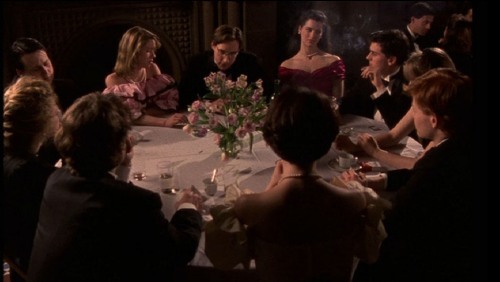
Metropolitan. I loved it. What we have is a modern-day drawing room film/comedy of manners, with upper-crusty Manhattanite teens inviting a misfit into their fold. They go back and forth from debutante balls to house parties, gossiping and verbally jousting all the while. It’s very dialogue-heavy (they almost all speak in long, precise sentences, processing their emotions and ideals and the failings of society) and very funny. I think you could compare it favorably to Annie Hall or Manhattan, but with a younger cast. Ebert says. Criterion essay.
 Mark Larson