I do not disagree with any of these. Food for thought!
You don’t get what you deserve, you get what you negotiate.
Jay-Z. Gotta say, I really liked his book. And it was only last December that I started paying decent attention to his music.
Decoded (review)

Jay-Z’s Decoded is a wonderful book. Read it. I’d love to read more nonfiction like this. So conversational, relaxed, super-smart. And it’s just a really beautiful book. Lots of photos, lyrics and footnoes, pull-quotes. I started off a little skeptical, just skimming for pictures and quotes and anecdotes, but then I just had to start over and read it straight through. Highly recommended. Here’s some favorite parts…
An important lesson from “Coming of Age”:
Ten thou’ or a hundred G keep yo’ shit the same
Next up is maybe my favorite line from the whole book. The context is the music business, but the wisdom applies well beyond. Emphasis mine:
In the streets there aren’t written contracts. Instead, you live by certain codes. There are no codes and ethics in music because there are lawyers. People can hide behind their lawyers and contracts and then rob you blind. A lot of street cats come into the music game and expect a certain kind of honor and ethics, even outside of contracts. But in business, like they say, you don’t get what you deserve, you get what you negotiate. So I mind my business and I don’t apologize for it.
Speaking of business, when he was just getting started, he knew to put the plans on paper…
We didn’t know the business yet, but we knew how to hustle. Like a lot of underground crews on a mission, we were on some real trunk-of-the-car shit. The difference with us was that we didn’t want to get stalled at low-level hustling. We had a plan. We did more than talk about it, we wrote it down. Coming up with a business plan was the first thing the three of us did. We made short and long-term projections, we kept it realistic, but the key thing is that we wrote it down, which is as important as visualization in realizing success.
I think this next bit is a pretty incisive take on poverty. Cuts right to the heart of it. Emphasis mine:
One of the reasons inequality gets so deep in this country is that everyone wants to be rich. That’s the American ideal. Poor people don’t like talking about poverty because even though they might live in the projects surrounded by other poor people and have, like, ten dollars in the bank, they don’t like to think of themselves as poor. It’s embarrassing. […] The burden of poverty isn’t just that you don’t always have the things you need, it’s the feeling of being embarrassed every day of your life, and you’d do anything to lift that burden.
Yep.
Later in the book he talks about the tension between being a ridiculously wealthy businessman with lingering remnants of street thug…
Having a devil on one shoulder and an angel on the other is the most common thing in the world. The real bullshit is when you act like you don’t have contradictions inside you, that you’re so dull and unimaginative that your mind never changes or wanders into strange, unexpected places.
Which reminds me of a quote I already tumbled:
I was on the streets for more than half of my life from the time I was thirteen years old. People sometimes say that now I’m so far away from that life—now that I’ve got businesses and Grammys and magazine covers—that I have no right to rap about it. But how distant is the story of your own life ever going to be?
I first read this bit in The Millions (thanks, Austin!). It’s about piecing together your influences:
The seventies were a strange time, especially in black America. The music was beautiful in part because it was keeping a kind of torch lit in a dark time. I feel like we–rappers, DJs, producers–were able to smuggle some of the magic of that dying civilization in our music and use it to build a new world. We were kids without fathers, so we found our fathers on wax and on the streets and in history, and in a way, that was a gift: We got to pick and choose the ancestors who would inspire the world we were going to make for ourselves. That was part of the ethos of that time and place, and it got built in to the culture we created. Rap took the remnants of a dying society and created something new. Our fathers were gone, usually because they just bounced, but we took their old records and used them to build something fresh.
And speaking of fathers, one of the wisest bits come in his footnotes for the song “Moment of Clarity”:
My father and I didn’t have a lot of deep conversations before he died, but we did have one important one. When I first reconnected with him, I hit him with questions and he came back with answers until I realized nothing he could ever say would satisfy me or make sense of all the feelings I’d had since he turned his back on us. In the end, he broke down and apologized. And, somewhat to my surprise, I forgave him. […] Although this verse starts off on a cold note–I seem indifferent and even smirking about his death–that’s only me being honest. I didn’t cry. I didn’t know him that well. But at the same time, it was so important that we did meet up before he died. It was important for me to hear him say he was sorry and for me to hear myself say, “I forgive you.” It changed my life, really. I wish every kid who grew up like me could have the same chance to confront the fathers who left them, not just so they can lay out their anger, but so they can, in the end, let that anger go.

Case Study | Building a Better Mixer – NYTimes.com. I spent an embarrassing number of hours peeling and juicing limes to start this cordial last night. This better pay off big. Early samples tell me I’m on the right track…
This continuous modification of man by his own technology stimulates him to find continuous means of modifying it; man thus becomes the sex organs of the machine world just as the bee is of the plant world, permitting it to reproduce and constantly evolve to higher forms. The machine world reciprocates man’s devotion by rewarding him with goods and services and bounty.
Days of Heaven
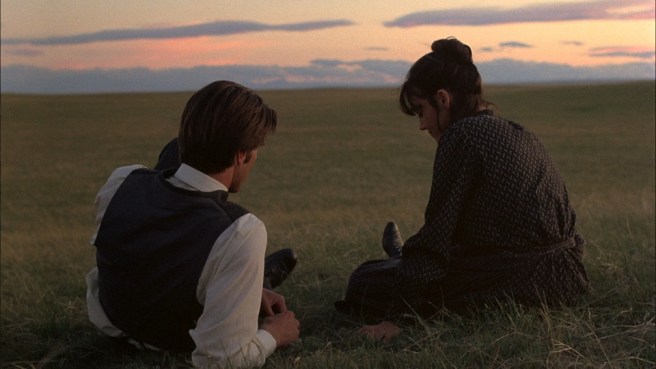
Days of Heaven. My first Malick film, and luckily an interesting, beautiful one. The story has scattershot narration by a young kid. Sometimes she has wise observations and sometimes she has immaterial asides. With this distance in age, we sort of see the characters in the central love triangle at a remove, a little more inscrutable. We see the drama and the tragedy but Malick’s not looking for your tears, I don’t think. The story’s too thin to bear it. The magic’s in the editing. The shots are elliptical, working by collage and juxtaposition and suggestion. Check out some lovely stills. Nice soundtrack from Mr. Morricone, to boot.
When we get better at expressiveness, we get better at understanding, better at sympathy, better at bullshit-detection, better at experiencing pleasure, better at true engagement (with others, with the world, with ourselves).
George Saunders. Which reminds me of one of my oft-quoted favorite Phrases to Live By: “If you write like porridge you will think like it, and the other way around.”
The Epidemic of Mental Illness: Why? by Marcia Angell | The New York Review of Books
Forgotten but Not Gone – Guernica
“On the fiftieth anniversary of Borges’s first visit to Texas, Eric Benson searches for traces of the fabulist in the Lone Star State.” (via)
Reading Borges isn’t like reading most fiction, it’s more like flipping through an encyclopedia: uncovering its most surprising truths requires whim and a wandering mind.
No Strings Attached

No Strings Attached. This is pretty terrible. Awful script. But Lake Bell’s character was wonderful.
God forbid we should wake up one day and know exactly what we’re doing.
The Kids Are All Right

The Kids Are All Right. It’s… alright. Not particularly funny nor dramatic. Breezy and halting in turns. Mostly a little awkward.
The better part of my work on media is actually somewhat like a safe-cracker’s. I don’t know what’s inside; maybe it’s nothing. I just sit down and start to work. I grope, I listen, I test, I accept and discard; I try out different sequences — until the tumblers fall and the doors spring open.
The concert hall is one of the few places where we become unreachable, where we can switch off our lifelines and surrender to a form that will not let us go for an hour or more.
<param name="movie" value="http://www.youtube.com/watch?v=ypar
Chris Rock: Job vs. Career. (via)
“Damn, I gotta come in early tomorrow and work on my project!” There ain’t enough time when you got a career. When you got a job, there’s too much time. You’re looking at your watch, like “Ah, shit. It’s 9:08.”
(Source: http://www.youtube.com/)
It’s hard to beat the entertainment value of people who deliberately misunderstand the world, people dying to be insulted, running around looking for a bullet to get in front of.
George Saunders: “Home” – The New Yorker
Find some way to bring me back.
There and Back Again: The Soul of the Commuter – The New Yorker
Last year, Midas, the muffler company, in honor of its fiftieth anniversary, gave an award for America’s longest commute to an engineer at Cisco Systems, in California, who travels three hundred and seventy-two miles—seven hours—a day, from the Sierra foothills to San Jose and back. “It’s actually exhilarating,” the man said of his morning drive.
There and Back Again: The Soul of the Commuter – The New Yorker
Most things are hideous at birth.
@nikastates. I don’t personally know the person that said this, but it got the @millsbaker/Mills retweet endorsement and it strikes me as very wise.

 Mark Larson