The impact of kitsch is limited to reminding the viewer of great works of art, deep emotions, or grand philosophic, religious, or patriotic sentiments.
People’s Champion: Behind the Battle
People’s Champion: Behind the Battle. I was bummed I missed the Atlanta premiere back in May, so I’m glad the first half of People’s Champion is now online. It’s a documentary going behind the scenes of the Eli Porter vs. Envy freestyle battle. They’re trying to Kickstarter the second half.
(Source: https://player.vimeo.com/)
Wehr in the World: New York frickin’ City
I love this. Reminds me that I forgot to do notes on Tokyo. Should have done that when it was still fresh.
The Zanskar Trek, I: Darcha to Padum
I just finished reading Chris Willett’s journals from the Indian Himalaya that I tumbled a while ago.
The purity of the alpine is not a reassuring quality. It is a fearful one, one that does not invite a person to linger or lounge. It is an abode that is best visited and not one to be domesticated, the living room of everything that is not the village, everything that is outside the bounds of settled, civil life.
But it is a place that one calls to some of us, bringing us to the hostile place to breathe the air and feel the sterility. It is a place, like the floor of Death Valley or, presumably, the ice floes of the Antarctic, that amplifies human existence. One does not feel insignificant in such places. Rather, one feels a sense of importance for no other reason that being alive.
It is not an importance born and cultivated to be ego satisfying or one that inspires arrogance. No, it is a sense that to be alive is an important quality and that to be alive is better than to be dead. Barren, lifeless places teach us this better than anything written, drawn, or recorded. And, besides, the alpine is a beautiful place to visit in fine weather.
We Must Be Superstars – New York Magazine
The music we spend our private time on, and use to build our identities, varies more wildly than ever from person to person. But there’s at least one kind of music that needs consensus to function, and that’s the stuff we dance, party, and strut around to. “The club” might be the last remaining space where strangers are all forced to pay attention to the same songs. And whether it’s an actual club or just a bedroom, it tends to be a space where people enjoy feeling fabulous.
Cf. Norman Lebrecht.
On Being Ill (review)
I don’t have much to say about On Being Ill other than it’s incredibly short and its meanderings in that space cover the spectrum from silly to sentimental. You will spend perhaps 30 minutes reading this book. I heard of it via Tyler Cowen’s breathless recommendation.
It’s hard to block quote such a short flowing text, but I like these next couple passages. Here’s one at the heart of the book: people don’t write about pain much. It’s overlooked by the great writers, and thus we have no words to steal or clichés to rely on:
The merest schoolgirl, when she falls in love, has Shakespeare or Keats to speak her mind for her; but let a sufferer try to describe a pain in his head to a doctor and language at once runs dry. There is nothing ready made for him. He is forced to coin words himself, and, taking his pain in one hand, and a lump of pure sound in the other (as perhaps the people of Babel did in the beginning), so to crush them together that a brand new word in the end drops out.
And I think most can relate to the the perverse sort of joy we take in being sick, reclining, casting off social graces, embracing our misery:
There is, let us confess it (and illness is the great confessional), a childish outspokenness in illness; things are said, truths blurted out, which the cautious respectability of health conceals. About sympathy for example—we can do without it. That illusion of a world so shaped that it echoes every groan, of human beings so tied together by common needs and fears that a twitch at one wrist jerks another, where however strange your experience other people have had it too, where however far you travel in your own mind someone has been there before you—is all an illusion. We do not know our own souls, let alone the souls of others. Human beings do not go hand in hand the whole stretch of the way. There is a virgin forest in each; a snowfield where even the print of birds’ feet is unknown. Here we go alone, and like it better so. Always to have sympathy, always to be accompanied, always to be understood would be intolerable. But in health the genial pretense must be kept up and the effort renewed—to communicate, to civilise, to share, to cultivate the desert, educate the native, to work together by day and by night to sport. In illness this make-believe ceases.
Americanisms: 50 of your most noted examples – BBC News
“The Magazine’s recent piece on Americanisms entering the language in the UK prompted thousands of you to e-mail examples.” Picky picky.
Most of my days involve four- and five-hour stretches of what I would characterize as dicking around on the Internet.
Jesse Thorn. (via)
Harry Potter and the Deathly Hallows – Part 2
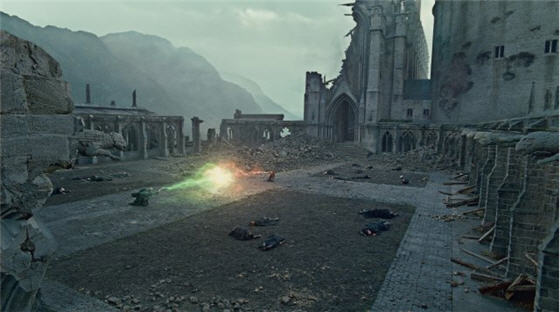
Harry Potter and the Deathly Hallows – Part 2. You know it’s serious when the skies are overcast for two hours straight. Setting aside the expected clichés of dim lighting, muted palettes, stormclouds, speeches, etc., I went in expecting to be highly entertained and I was not disappointed. Until the end. I see the last five minutes as a pretty serious failure given the ~15 hours of good work that came before. Seriously, just throw an Ewok party and call it a day. Don’t try to make 20-year-olds-who-look-like-teenagers look like 40-years-olds. Yep, I’m old and grumpy. One day I’ll be glad to watch these again with my kids.
Harry Potter and the Deathly Hallows – Part 1
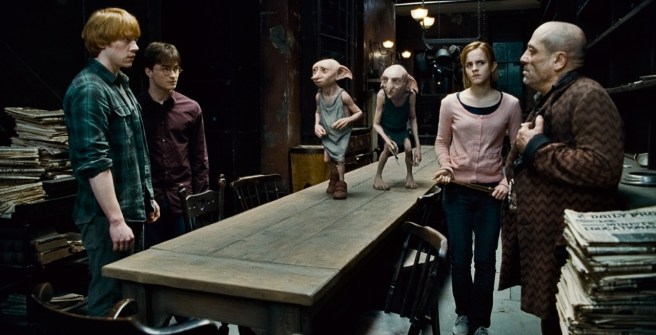
Harry Potter and the Deathly Hallows – Part 1. Honestly, I don’t remember this one well at all. My friends were talking a lot while it played. Whereas I’m not a superfan, and whereas I stopped reading the books after 2¼ books, it struck me as the same kind of chase-this, find-that sort of adventure I was expecting. Which is not at all a bad thing. It was fun. The best moment is Dobby unscrewing the chandelier.
The value of physical pain is that it is finite. It ends when the ailment ends. We can use this as an opportunity to push on through, with the safety net of knowing it will eventually be over. It is practice.
Ryan Holiday. Just this weekend I was talking about the value of exercise qua mild self-harm. This is more articulate than I was.
Son Of Strelka, Son Of God (Narrated by Obama) – A Free Audio Story
Bit by bit I’ve dissected Obama’s self-read autobiography into thousands of very short phrases, usually one to ten words or so, and have used these snippets to tell a completely different story from the original. I’ve then set the story to music. The story is called Son Of Strelka, Son Of God. Broadly speaking, it tells the story of an ugly dog-faced demigod who recreates the world after it is destroyed. It’s about thirty minutes long, and lies in some weird grey area between audiobook and electronic music.
Wow. More in Slate.
Son Of Strelka, Son Of God (Narrated by Obama) – A Free Audio Story
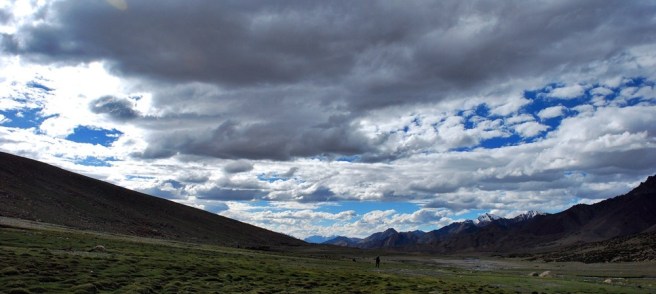
Trekking in the Indian Trans-Himalaya. Chris Willett’s journals from a July-August trip to Ladakh and Zanskar, India. I still agree with my claim that he has pretty much the best hiking journal on the internet when you consider the double-whammy of writing and photography. Usually pretty unvarnished. Sometimes travel is damn hard.
It was here that Tibetans fled when the Chinese liberated their country, and it was here that I was told Tibetan culture was still intact. Desert peaks leading to handing glaciers soared above irrigated valleys, with monasteries carved into the sides of mountains and an outdoor paradise, this was the objective for the summer. But as always seems to happen, my time was more an experience within myself, an experience that helped to bring clarity to my own life at a time of transition. I will not be back.
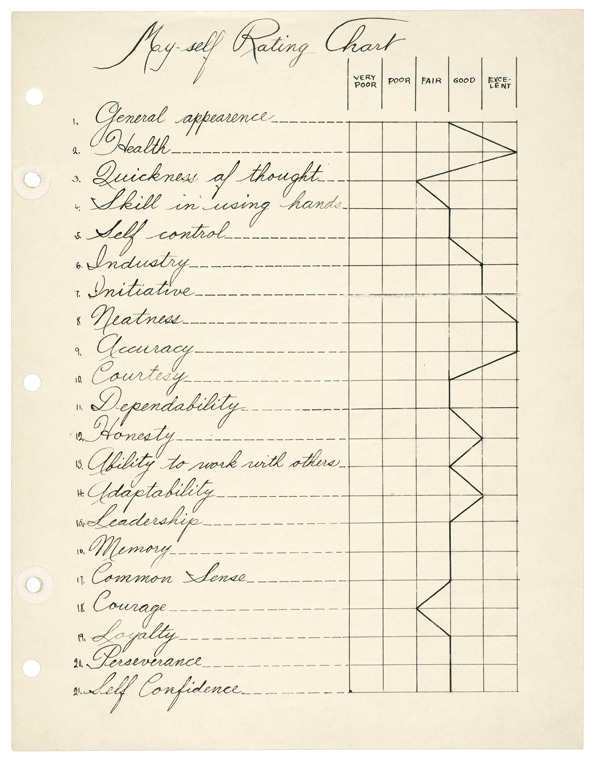
Harry Bertoia’s “My-self Rating Chart” school assignment. Harry Bertoia papers, 1917-1979.
The buyers of useless things are wiser than is commonly supposed – they buy little dreams.
Fernando Pessoa in The Book of Disquiet, which I haven’t read but got the quote from Tyler Cowen’s so-far excellent The Age of the Infovore. See also social objects.
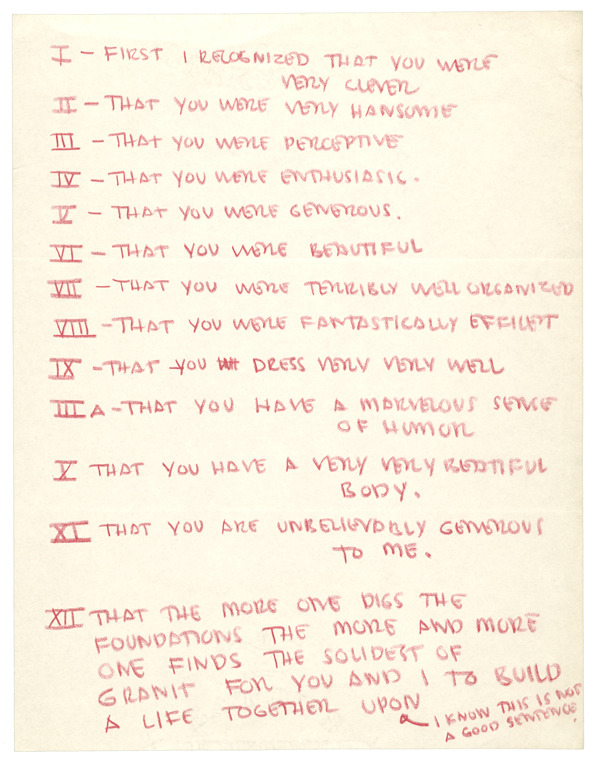
Eero Saarinen’s list of Aline Bernstein’s good qualities, ca. 1954. Aline and Eero Saarinen papers, 1857-1972. Featured in What we can learn from lists. This reminds me of Charles Darwin trying to decide whether or not to marry Emma Wedgewood. Sounds like a cool list-focused exhibition at the Morgan Library & Museum.
Overcoming Bias : Beware Morality Porn
Movies usually focus more on whether characters have the strength of will to do what is obviously right than on whether they have the wisdom to discern what is right. And movie characters rarely have to choose between the praise of associates and doing the right thing – key associates usually support doing the right thing.
There are few if any awkward silences on Facebook.
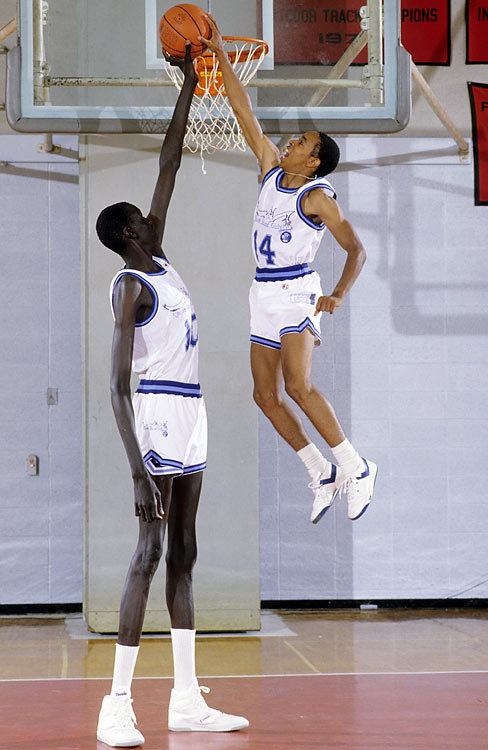
Manute Bol and Spud Webb – 1985. Photo by Manny Millan.
 Mark Larson