In the Mood for Love

In the Mood for Love. Gorgeous, seductive movie. One of the dilemmas here is, (how) can you get what you want if you don’t want to be the kind of person that would do what it takes to get it? When you’re watching it, it’s easy to sympathize with the protagonists, but afterward… don’t they seem a little, um, weird? I love the parallels in setting and architecture. They’re so hemmed in, so much kept inside. Thematically, it pairs well with David Lean’s Brief Encounter.

Man vs. Corpse

The postapocalyptic scenario—the future in which everyone’s a corpse (except you)—must be, at this point, one of the most thoroughly imagined fictions of the age.

Man vs. Corpse

An Interview With Steve Reich, Who Rewrote Radiohead

Steve Reich can talk a mile. The most amusing, Reich-splaining part of this interview is him talking about how, exactly, he was influenced by jazz.:

Yeah, sure, all jazz is improvisation. What I’m saying is what jazz is for me is yes, improvisation is a big part of it, I understand that and I’m just not a very good improviser and I’m not interested in improvisation at all, but I understand that it’s a very, very important part of music. What interests me in jazz is the feel of jazz, the tones of jazz, the gestures of jazz, the way John Coltrane sounds as opposed to some classical saxophone is like two different universes. I’ve had a tremendous influence where, when I was a kid I took piano lessons, but it wasn’t until the age of 14—when I was a kid before the age of 14 I never heard a note of music before 1750, I never heard a note of music after Wagner, and I never heard any real jazz, I heard you know, pop music and all kinds of Broadway shows and that kind of stuff. But at the age of 14 for the first time I heard the The Rite of Spring, the 5th Brandenburg Concerto, and Miles Davis, Charlie Parker, and the drummer Kenny Clarke and I decided I want to be Kenny Clarke and I started studying percussion at the age of 14. I studied with Roland Kohloff, who was the local great drummer and later became the timpanist with the New York Philharmonic, and I remained a drummer ever since. And so hence all the percussion in my group. And I went down to hear Miles Davis and Kenny Clarke and Thelonious Monk and Horace Silver and Art Blakey and the Jazz Messengers and all those groups started when I was 14 years old, on through high school, on through college when I got to Juilliard and continued doing it, and I started listening particularly to John Coltrane.

I got out to the West Coast and I was studying with Luciano Berio during the day, and every time he was in town I would go to hear John Coltrane at night. Now what was it I learned, improvisation? No, forget about it. What I learned was this: John Coltrane could play for half an hour on one harmony. Think of the album, or if you don’t think of it, go out and buy it or steal it whatever, called “Africa Brass”. Do you know it? “Africa Brass” is 17 minutes and it’s all on the low E of the double bass. So if you go to a jazz musician and say ‘hey man, what are the harmonic changes of “Africa Brass” – “This is E” “well what changes?”.”E for 17 minutes!” “Well that sounds strange, how are you going to play one harmony for 17 minutes?” Well I’ll tell you how: you have incredible melodic invention from Coltrane himself, who’s either playing gorgeous melodies or screaming noise through his horn, you have incredible timbral variety because he was working with another great jazz musician Eric Dolphy, who arranged all the brass in the “Africa Brass” and part of it was french horn, which sounded like elephants coming through the jungle. He also was working with Elvin Jones, who as you may know, is a drummer who sounds like he’s two or three or four drummers all at once. If you have rhythmic complexity, timbral variety and melodic invention, then you can stay put on a single harmony for half an hour, and it’s fascinating, it’s fantastic, it gives it more intensity because you’re focused on these other things. And in a funny way my piece “Drumming” doesn’t sound like “Africa Brass”. I didn’t even think about “Africa Brass”, but really it syncs the exact same way. There’s one slight change of key in the glock section, but basically it’s in six sharps for an hour. It doesn’t change. Because of the rhythmic complexity in the drums, the complete change of timbre into marimbas, and the rhythmic complexity and the melodic invention of the women’s voices and then the complete change of timbre into glockenspiel and the melodies in the flutes and piccolo and whistling, and then the complete change of timbre to all those instruments playing together you can listen to one key for an hour and enjoy it. So my interest in jazz is in gestures, the way Kenny Clarke could make an entire band sort of float in a magical way I never heard in any classical music, and the gesture of tones, the style of playing, THAT’S what I loved about jazz.

He also closes talking about his Radiohead piece and a great rant about artists getting expensed out of NYC. Filed under: Steve Reich.

An Interview With Steve Reich, Who Rewrote Radiohead

Mud

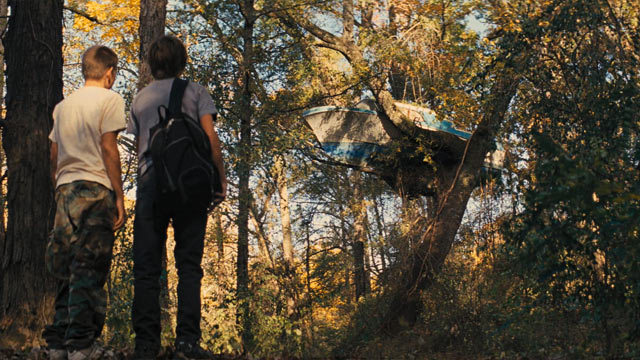
Mud. Best summarized in this review I stumbled upon where I lifted the still above: “Mud reminds us that the most special effect is compelling characters caught in a vexing situation.” Check and check. I loved this movie. Jeff Nichols is on a roll right now, after directing Shotgun Stories, and then Take Shelter, and then this. I’m excited for whatever is next.

A MARTA story in tweets from @lainshakespeare

So jealous of Lain Shakespeare’s Atlanta moment:

//platform.twitter.com/widgets.js

//platform.twitter.com/widgets.js

//platform.twitter.com/widgets.js

//platform.twitter.com/widgets.js

//platform.twitter.com/widgets.js

//platform.twitter.com/widgets.js

//platform.twitter.com/widgets.js

Saying Good-bye As the Braves Leave Atlanta for ‘Atlanta’ – Grantland.

Nothing in this message is a lie, or even exaggerated, once you realize who the audience is. This message isn’t directed toward the Atlanta city-dweller. The “you, our fans” is not targeted at a person who lives in the city of Atlanta. It’s targeted at everyone in that dark-red blot that lives in the city’s northern suburbs. If you’re a fan who lives in these suburban areas, today is a great day. It has long been a hassle to get to Turner Field — because it involves going all the way to Atlanta to see the Atlanta Braves.

ecantwell:

I have become a big fan of sunrises lately. Sunsets get all the credit, all the social media likes, all the romance. Sure, okay, more people are awake when the sun sets (especially these post-daylight-savings days), but I think there is also something lingering about a sunset that allows it to be mused over and loved and savored by its admirers. Sunrises, as I have come to observe, are often over very fast. The gorgeous part doesn’t hang around. It is there and then it is not.

It is there and then it is not and then it’s time to eat breakfast, to answer emails, to fight traffic, to stare at the clock, to spend money, to feel tired, to wish you were somewhere else. You can’t settle into a sunrise with a glass of wine and a nice book. You can’t use it as a chance to reflect on things. 

Sunrises are capricious and selfish. They are not interested in rewarding you. They are the kind of lover who leaves when the act is over. This is brave of them. They don’t want to cater to your needs. They don’t want to perform for you on cue. They take care of themselves, they are gorgeous when they want to be, they are not ashamed to become mundane again very quickly. 

And yet how can you wake up to this and not feel somehow more whole, more alive, more determined? Walk into it, walk through it. It will be gone too soon not to dive in like some holy Olympian. Take it by its stupid reins and ride it into the ground. You’re only awake like this for a minute.

Don’t waste it. 

gotemcoach:

LOOK AWAY: Steph Curry had a 3-on-1 break against the Clippers, so naturally he pulled up and shot a 3-pointer (and got fouled = 4-point play).  That’s not why I posted this GIF though.

Just look at the faces of the crushed Clippers fans in the stands who can do nothing but look away.

My Power Rankings:

  1. Brunette lady in blue Clippers jersey
  2. Guy who exhales, grabs Dodgers cap
  3. Older white guy shaking his head

#GotEmCoach

Alright, gotta get this out of my system. I took this photo a few weeks ago when I went back up to Dahlonega, the small town in north Georgia where I was born and spent the first half of my life. This is the first house we lived in. And, take my word for it, this is a flattering photo. The place has… seen better days. I keep pulling up this picture so I can hate-look at it. I hope that one day, if I ever buy a house, I will remember that it might have been where someone else grew up. My memories are still in pristine condition, so no harm there. And I have no idea of the circumstances of the people who live there now. But part of me is like… come on. Ah well. Gotta let it go.

The New Canon – The LARB Blog

Through this reliance on Netflix, I’ve seen a new television pantheon begin to take form: there’s what’s streaming on Netflix, and then there’s everything else.

When I ask a student what they’re watching, the answers are varied: Friday Night Lights, Scandal, It’s Always Sunny, The League, Breaking Bad, Luther, Downton Abbey, Sherlock, Arrested Development, The Walking Dead, Pretty Little Liars, Weeds, Freaks & Geeks, The L Word, Twin Peaks, Archer, Louie, Portlandia. What all these shows have in common, however, is that they’re all available, in full, on Netflix.

Things that they haven’t watched? The Wire. Deadwood. Veronica Mars, Rome, Six Feet Under, The Sopranos. Even Sex in the City.

It’s not that they don’t want to watch these shows — it’s that with so much out there, including so much so-called “quality” programs, such as Twin Peaks and Freaks & Geeks, to catch up on, why watch something that’s not on Netflix? Why work that hard when there’s something this easy — and arguably just as good or important — right in front of you?

Markets influence taste.

The New Canon – The LARB Blog