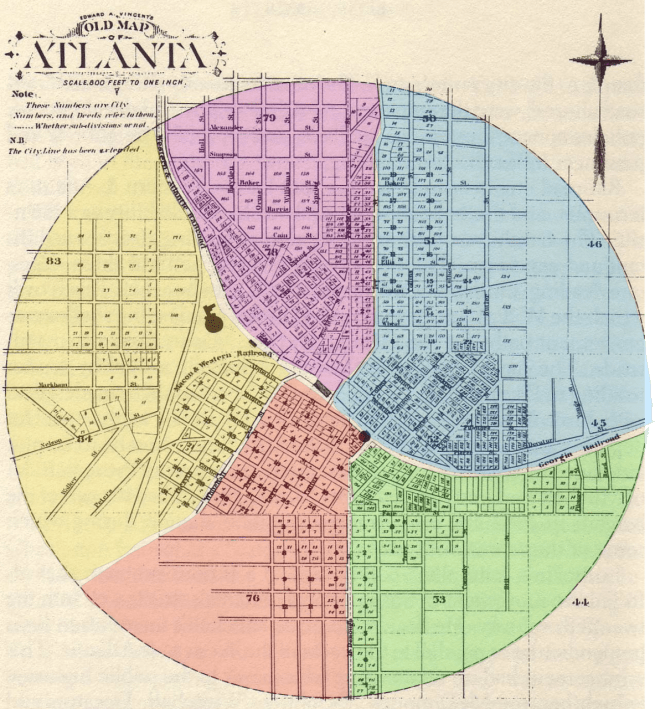
Map of the original 1854 Atlanta Ward System.
Map of the original 1854 Atlanta Ward System.
Really awesome background on two of Atlanta’s 19th-century sketchy neighborhoods: Snake Nation (now Castleberry Hill) and Murrell’s Row (in today’s Old Fourth Ward/Five Points area). I’d never heard of them before.
My loving homage to every breathless unboxing video ever made.
(via funkaoshi)
http://video.google.com/videoplay?docid=3147358394537366471
I saw my first Buster Keaton film yesterday: One Week, a 20-minute short on the joys of home ownership. It’s not always super ha-ha funny, but I love how the directing, acting, stunts, transitions, etc. are so tight and snappy. There are some genuine surprises in there, too.
You know how you scratch away at a lottery ticket to see if you’ve won? That’s what I’m doing when I begin a piece. I’m digging through everything to find something.
[…]
Scratching can look like borrowing or appropriating, but it’s an essential part of creativity. It’s primal, and very private. It’s a way of saying to the gods, “Oh, don’t mind me, I’ll just wander around in these back hallways…” and then grabbing that piece of fire and running like hell.

Louis Armstrong, takin’ care of business without a shirt. I wish I knew some background on this photo.
Balloon Land (1935) Ub Iwerks’ ComiColor cartoon. I remember seeing this exactly once, about 20 years ago, and it’s stuck with me ever since. So glad to stumble on it again today.
I like the idea that you let culture use you as its instrument. What gets in the way is being too clever, or worrying about how something is going to function, or where it’s going to be. When you start thinking of something as art, you’re fucked: you’re never going to advance.
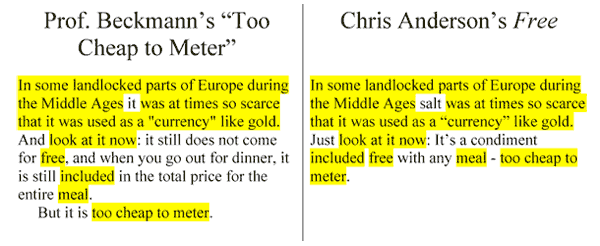
Chris Anderson’s Free Contains Apparent Plagiarism. Not sure what to make of the copying, but I like the presentation from the folks at VQR. Side-by-side comparison FTW!
Tyler Cowen summarizes some of the contents of his new book. Some bits I’m curious about:
2. A new vision for how “autistic cognitive strengths” are a major dynamic element in human history and that includes a revisionist view of the autism spectrum.
3. New ways of thinking about what you’re really good at (and not so good at).
4. A view of why education is much more than just signaling, but why you should be cynical about most education nonetheless.
7. Why the Sherlock Holmes stories are a lot more interesting than most people think.
10. The importance of neurology for unpacking debates about aesthetics, especially when it comes to music.
I finished his Discover Your Inner Economist last week, which was wide-ranging and breezy and smart, just like the blog he co-writes. Looking forward to this new book.
Marginal Revolution: *Create Your Own Economy*, standing on one foot
An economy that is more entrepreneurial, less managerial, would be less subject to the kind of distortions that occur when corporate managers’ compensation is tied to the short-term profit of distant shareholders. For most entrepreneurs, profit is at once a more capacious and a more concrete thing than this. It is a calculation in which the intrinsic satisfactions of work count.
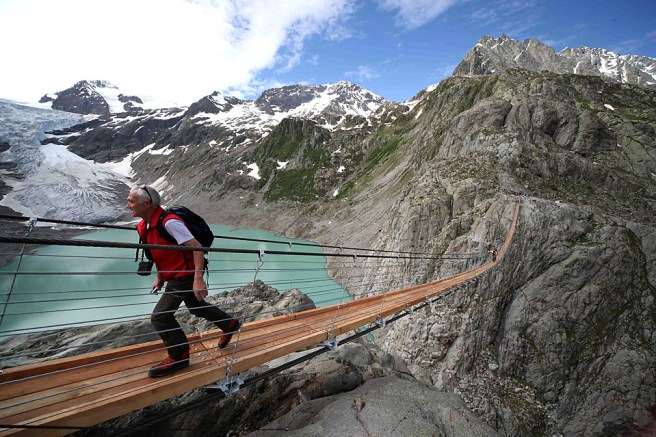
The Trift Bridge in Switzerland is the longest pedestrian suspension bridge in the world. 46°41’38"N 8°21’27"E. (via)
I’m not sure how big it got, but I know I missed this growing up in rural north Georgia. Apparently, for a time in the late ‘80s and early ’90s (as LPs and 45s were fading but before CDs made a big splash, way before our idyllic days of mp3 ubiquity), you could buy singles for $0.50-$1.50 or so, and have them recorded on a custom-labeled mixtape. (via retro thing)

I really want to see some Buster Keaton films after reading about him in Walter Kerr’s essay “The Keaton Quiet”. I haven’t been able to find it online, but it’s in Kerr’s book The Silent Clowns and in the movie critic anthology I’ve been reading. Here’s Rogert Ebert on Buster Keaton.
As if lugging around a book the size of a 2 br. 1¼ bath apartment isn’t enough, you may want to carry a notebook as well. You won’t always have the requisite Oxford English Dictionary within arm’s reach, you know.
I checked this out from the library a while ago. Unfortunately, some guy had it requested before I could break into triple-digit pages. Now that I’m armed with my very own shiny new copy, I’m ready to dive back in.
Just learned a new word: “Walla is a sound effect imitating the murmur of a crowd in the background.”

Oliver Sacks’ desk. I like this workspace: a few books, paper, pencil, some raw metals, and a few photos of friends. [via @thebookslut]
One of the tasks of the film critic of tomorrow – perhaps he will even be called a “television critic” – will be to rid the world of the comic figure the average film critic and film theorist of today represents: he lives from the glory of his memories like the seventy-year-old ex-court actresses, rummages about as they do in yellowing photographs, speaks of names that are long gone. He discusses films no one has been able to see for ten years or more (and about which they can therefore say everything and nothing) with people of his own ilk; he argues about montage like medieval scholars discussed the existence of God, believing all these things could still exist today. In the evening, he sits with rapt attention in the cinema, a critical art lover, as though we still lived in the days of Griffith, Stroheim, Murnau, and Eisenstein. He thinks he is seeing bad films instead of understanding that what he sees is no longer film at all.

97. Harpsichord. Plus ça change…

 Mark Larson