Success guide: 1. Cultivate risk tolerance. 2. Cultivate endurance.
Category: uncategorized
“If you pan & scan Lawrence of Arabia, you lose the desert.” (via kottke)
(Source: https://www.youtube.com/)
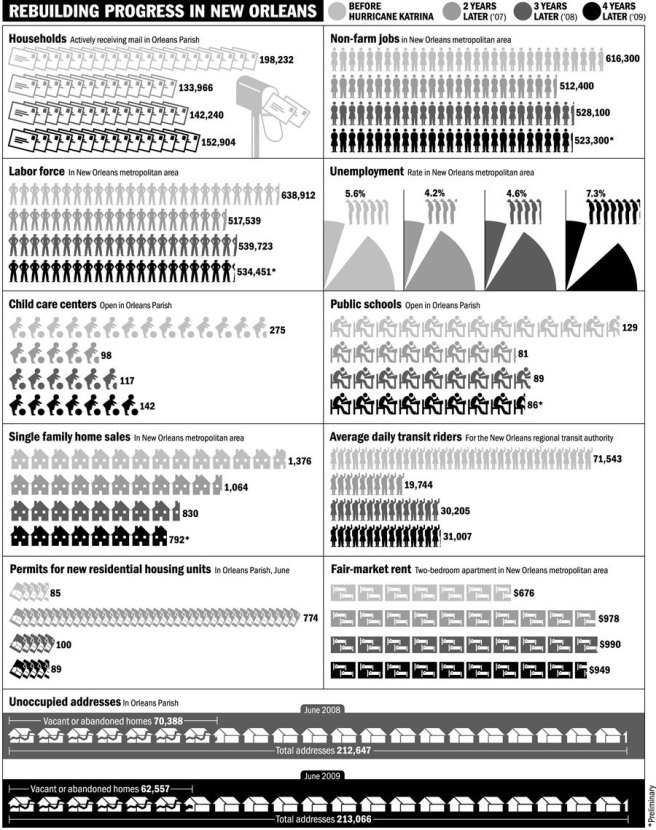
The State of New Orleans by Nigel Holmes for the New York Times.
Some wisdom before school starts
Q:
“How do you remember Amherst? What are the experiences—in and out of the classroom—that shape those memories? Similarly, what aspects of your Amherst education served you best? And what are the things about Amherst that, in hindsight, disappoint you?”
A:
“I don’t know that many would remember me at all… I was cripplingly shy at Amherst. I wasn’t in a fraternity and didn’t go to parties and didn’t have much to do with the life of the College. I had a few very close friends and that was it. I studied all the time. I mean literally all the time…
So ‘the things about Amherst that, in hindsight, disappoint [me]’ are things not about Amherst but about who I was when I was there. I let almost no one know me, and I lost the chance to know and learn from most of my peers. It took years after I’d graduated from Amherst to realize that people were actually far more complicated and interesting than books, that almost everyone else suffered the same secret fears and inadequacies as I, and that feeling alone and inferior was actually the great valent bond between us all. I wish I’d been smart enough to understand that when I was an adolescent.”
— David Foster Wallace interviewed by Amherst magazine


The first movement of Bach’s Violin Sonata No. 1 in G minor (BWV 1001). Listen.
http://video.ted.com/assets/player/swf/EmbedPlayer.swf
Dan Pink’s TED Talk about motivation and the ineffectiveness of extrinsic rewards and incentives in the workplace. Intrinsic is where it’s at.
(Source: http://video.ted.com/)
Edge: What makes people vote Republican?
Making the Clackity Noise
Reading through the histories of both jazz and rock, I am struck again and again by the fact that although women and girls were the primary consumers of popular styles, the critics were consistently male–and, more specifically, that they tended to be the sort of men who collected and discussed music rather than dancing to it. Again, that is not necessarily a bad thing (some of my best friends…), but it is relevant when one is trying to understand why they loved the music they loved and hated the music they hated.
Another selection from How the Beatles Destroyed Rock ‘n’ Roll. Over the past year or so, I find I’m more and more reluctant to condemn music I don’t like, maybe partly because I’m more willing to dance than I used to be.

Exclusive First Listen – Tim Buckley – NPR
Live at The Folklore Center, NYC. March 6, 1967.

Tickets for the Great Decatur Craft Beer Festival go on sale soon. I am glad to be within walking distance. (via decatur metro, my favorite neighborhood blog.)

Newsboys Strike of 1899, via one of the cool people I work with.

Dinner at El Bulli: The Greatest Restaurant in the World. I love the way photos and captions and videos are all blended together here, capturing a 30-course meal at El Bulli. It’s great storytelling + food porn.
Respect the dance floor because the dance floor never lies. The DJ is not the star.
Ben Watt, via one of my old PoliSci professors.
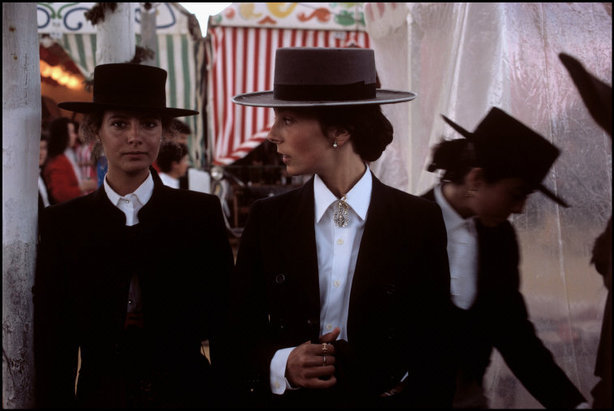
SEVILLE, Spain—Feria Festival, 1986. Kind of like that old cartoon I stumbled upon a while back, I hadn’t seen this photo in years, but I remember seeing it in an issue of National Geographic back in the ‘80s.
Kseniya Simonova – Sand Animation on Ukraine’s Got Talent. (via vqr).
(Source: https://www.youtube.com/)
Art Tatum goofs around with Dvorak’s Humoresque No. 7 in G flat major. Here’s a more traditional version. (via @danlevitin)
(Source: https://www.youtube.com/)
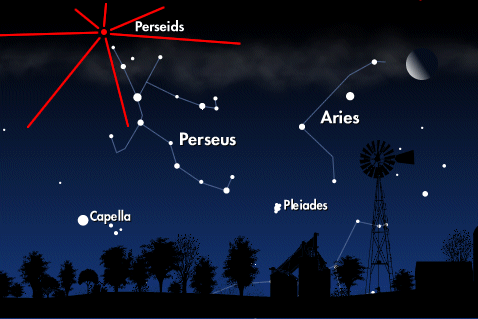
The Perseid Meteor Shower is gonna peak tonight/tomorrow. I’ve got fond memories of previous years, hope the moon doesn’t spoil things in 2009.
 Mark Larson