Murder, My Sweet

I don’t know which side anybody’s on. I don’t even know who’s playing today.

Murder, My Sweet. Not excellent, not bad. Every new character brings a new complication to the story. Plenty of the snappy writing that you’d expect from Raymond Chandler. (Other film noir I’ve watched.)

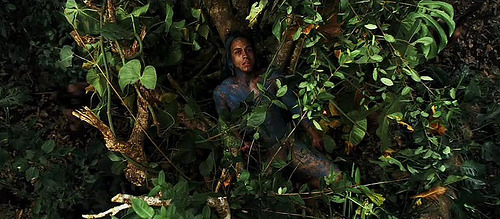
Apocalypto

Apocalypto. I got a kick out of this one. At its heart, it’s a chase movie, stripped down to loincloths. It did not at all feel like 140 minutes. Many thanks to the Battleship Pretension episode on Mel Gibson’s directing for spurring me to watch it.

If you’ve seen Braveheart or The Passion of the Christ, you’ll be prepared for the frequent, unsubtle graphic violence. I cringed a lot, but that’s okay. Actually, funny thing when I was watching, the violence actually got me curious about psychological health in ancient times. Given that levels of violence, trauma, and death were much higher than today, you have to wonder.

I’m not suggesting that this movie is historically accurate in any way. That’s very much beside the point, I think. Every movie set in the past gets something wrong. It’s just context, people. Not a documentary. I think that some folks have gotten up in arms about the depiction of the Mayans is actually kind of a bonus – it hasn’t really been explored on film, so they’d like to get it right. Understandable. The benefit for the viewer, accuracy aside, is that the novelty forces your attention. It’s all in Yucatec Maya language, so you have to keep your eyes on the screen for subtitles. Clothing and environment are novel. You probably don’t recognize any of the actors, so you can come to watch their performance without any expectations. When I watched Brief Encounter I had a similar reaction to an unknown-to-me cast:

One of the most enjoyable things about old/foreign movies is that I often don’t know the cast. It can feel more immediately immersive to see the characters as characters, rather than recognizing actors and trying to set aside that I know they’re portraying people. There’s no baggage, no expectations, no known quirks or ticks. It all feels very fresh.

Along the same lines, familiar scenes feel less loaded. There’s a slave-trading scene that’s somehow more touching because it’s Mayans selling Mayans, rather than whites selling blacks. Put a familiar, undeniable evil in a different cultural frame, and you feel it more powerfully, I think. You can’t bring your baggage as easily. I feel no hesitation in recommending this one.

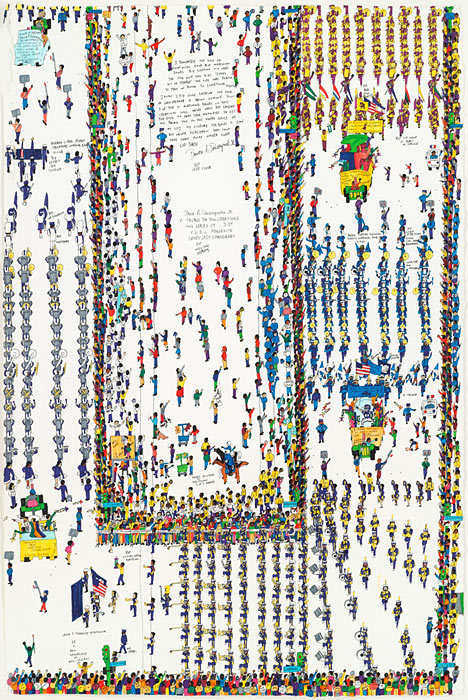
Martin Luther King Jr. National Memorial Opens in Washington – NYTimes.com

There is always an element of kitsch in monumental memorials, a built-in grandiosity that exaggerates the physical and spiritual statures of their human subjects. That is one of the purposes of turning flesh into imposing stone.

Via. See also Dennis Dutton on kitsch:

According to Tomas Kulka, the standard kitsch work must be instantly identifiable as depicting “an object or theme which is generally considered to be beautiful or highly charged with stock emotions.” Moreover, kitsch “does not substantially enrich our associations related to the depicted subject.” The impact of kitsch is limited to reminding the viewer of great works of art, deep emotions, or grand philosophic, religious, or patriotic sentiments.

Martin Luther King Jr. National Memorial Opens in Washington – NYTimes.com

The pretender: Dana Spiotta’s persuasive performances—By Jonathan Dee (Harper’s Magazine)

Part of the fascination rock stars, even those of the wannabe variety, hold for fiction writers must have to do with the degrees of mediation in an artist’s relationship to his or her audience. What would it be like to jump the gap between oneself and the presentation of one’s own art? In live performance the feedback is instant, for better or worse, and the artist’s presence as a conduit for his or her work is a precondition for that work’s existence.

I’ve tagged a lot of things with performance/audience.

The pretender: Dana Spiotta’s persuasive performances—By Jonathan Dee (Harper’s Magazine)

Only part of us is sane: only part of us loves pleasure and the longer day of happiness, wants to live to our nineties and die in peace, in a house that we built that shall shelter those who come after us. The other half of us is nearly mad. It prefers the disagreeable to the agreeable, loves pain and its darker night despair, and wants to die in a catastrophe that will set back life to its beginnings and leave nothing of our house save its blackened foundations.

A rural person expects to know every person in his world, and therefore thinks of every person as an individual. An urbanized person never expects to know the people he comes into contact with, and therefore rarely focuses on them as individuals. Stating the same thing in a different way, when you have more categories in your mind than people, you tend to see the categories as characteristics of the people. […] But once you have more people in your world than categories, you start to sort the people into categories.

Bill James in Popular Crime. Food for thought.

austinkleon:

A page from John Cage’s “Aria”

Cage wanted the piece to be singable by any male or female vocalist, and he wanted them to freely choose 10 different singing styles that could be rapidly alternated. Each style is represented by a different color and the shape of the squiggles indicates the general melodic contour.

Link: Scoring Outside the Lines – NYTimes.com

There are cases were poetry creates itself. […] Let us take the title of one of the most famous books in the world, El ingenioso hidalgo don Quijote de la Mancha. […] “De la Mancha” – now this sounds noble and Castilian to us, but when Cervantes wrote it down he intended the word to sound perhaps as if he wrote “Don Quixote of Kansas City” […]. You see how those words have changed, how they have been ennobled.

Jorge Luis Borges in “The Riddle of Poetry” segment of his Norton Lectures. File under Borges.