I love this taxonomy of logical fallacies. Learn those, and you’ll be well on your way to… something. Probably something good. [via tim walker]
Category: Politics
I was browsing through the Library of Congress website and came upon some cool posters from the Works Progress Administration. From that, I put together a little collection of library propaganda, lovely pro-literacy silkscreens and lithographs from our government.
Animal Farm (review: 0/5)
This was the second book I read on the Appalachian Trail this summer. Unfortunately it was the only book I had available at the time, but I pushed through it. I was surprised how bad this book was. I just loved 1984, and I for the most part I’ve enjoyed Orwell’s essays and stories… but wow, what a disappointment. I guess the storyline was a too much of a bludgeon for my tastes.
Videos of mass human choreography at the Arirang Festival in North Korea. Here’s the Children’s Parade. It would be kind of cool if it weren’t taking place in a hopelessly poor, totalitarian state.
I’m glad that someone has called out Oprah Winfrey for featuring The Secret on her show. I was pretty stunned that she’d pick a crap book like that.
Batman: Year 100 (review: 2/5)
So in Batman: Year 100 we have the typical gritty Gotham set in a climate of heavy-hand police state dystopia, etc etc. The year is 2039. Not too distant, but plenty of time for the world to go to crap. Enough time for the old Batman to die off and a new one to take his place. Or maybe it’s the same man…? The mystery of the new Dark Knight is unfortunately one that never gets resolved. He just sort of is, and does the usual foiling of nefarious plots. On the upside, there’s interesting artwork from Paul Pope and Jose Villarrubia, and I liked seeing Batman as a bit more of a ramshackle outsider, coming across as unexperienced and a bit clumsy and improvisational.
One of the better surprises was the little mini-comic stashed in the back of the book: Berlin Batman. This one revolves around the (true) story of Ludwig von Mises, a brilliant and outspoken economist who fled the Nazis at the cost of having his home ransacked and all his papers confiscated. Batman tries to stop it. It’s a cool little yarn, with a hilariously bourgeois/bohemian Bruce Wayne. It was great to see two of my personal thrills (Batman and Austrian economics) collide so unexpectedly.
An interview with Jonathan Lethem. He talks about copyright and some of the ideas in his Harper’s article a couple months ago.
Due out next month is The Politically Incorrect Guide to Capitalism, written by Robert Murphy. I think Murphy is pretty sharp. I liked his market-anarchist speculation/philosophizing in Chaos Theory. And he also wrote a study guide for Murray Rothbard’s 1400-page economics treatise Man, Economy, and State. I’m looking forward to this latest one—it could pair nicely with Economics for Real People for a sort of friendly intro to libertarianism. Save the Block and Hoppe for later.
Some interesting thoughts on the future of libertarianism from Virginia Postrel:
While the last centuryÄôs greatest threats to liberty, prosperity, and peace came from totalitarian nation-states, todayÄôs come from transnational organizationsÄîranging from imperialistic regulators (the European Union) to violent religious crusadersÄîand from Äúfailed statesÄù where warring gangs have superseded governments. Focusing on the nation-state as the source of all threats to liberty is anachronistic… Against these ideological and institutional challenges, liberal society will need the practical lessons of libertarian scholarship on decentralized order and knowledge sharing. It will need the cultural libertarianism that knows liberal society is not just familiar but good. And it will need the 18th-century wisdom that lets skepticism happily coexist with civility and reason. Surviving the 21st century with our sanity and civilization intact will require less Nietzsche and more Hume.
The political cartoons of Dr. Seuss, who created around 400 editorial cartoons during the first part of World War II. See also the book Dr. Seuss Goes to War, which shows about half the collection.
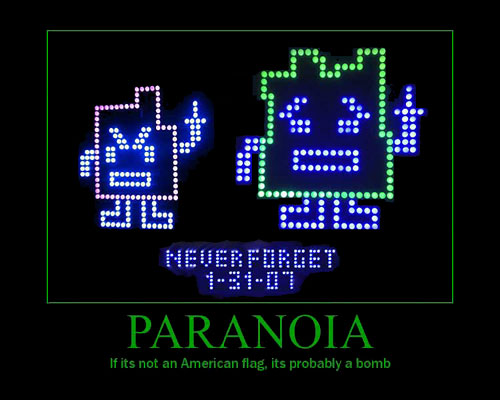
A fascinating story of pranking the 2007 Super Bowl half-time show. Sometimes security really is only theater. Hilarious and frightening.
Distorted maps of the earth, redrawn to be proportionate to wealth, disease, toy imports, war & death, etc. Plenty more over at Worldmapper.
Some cool infographics drawing on aspects of American culture, using pictures of 2 million prison uniforms, or 15 million sheets of paper, etc.
I love these renditions of the Republican elephant logo. I wonder if there are any good ones for the Democrat donkey, too?
This Godless Communism was a multi-issue comics series published by the Catholic Guild beginning in 1961. It even has a foreword by J. Edgar Hoover.
Economist Henry Hazlitt wrote an interesting critique of Marxist literary criticism: “There is in most of the new American “Marxist” critics a deplorable mental confusion, and this mental confusion, as I have hinted, is not necessarily connected with Marxism.” This essay came in one of his books from the 1930s when Marxism in academia was just catching on.
 Mark Larson