Une femme est une femme (A Woman Is a Woman)

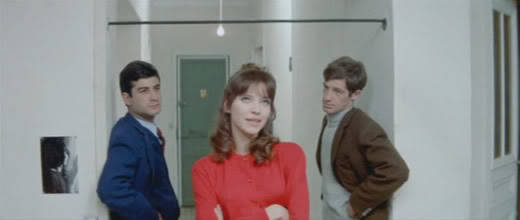
Une femme est une femme (A Woman Is a Woman). What a wacky movie. Anna Karina wants to get pregnant. Boyfriend Jean-Claude Brialy won’t help while buddy Jean-Paul Belmondo is all too willing. Lots of rich primary colors. Hints at the musical genre every so often, and sometimes it seems operatic, with bits of dialogue like recitative punctuated with responses or embellishments from the orchestra. It’s very self-aware, playing with the form, making no attempt to stay absolutely true-to-life, sometimes literally winking at the camera. It’s all good fun. I caught several references to other films, and it’s likely there are more clever ones that I didn’t notice. This is probably my favorite of the Godard movies I’ve seen so far.

Is this a tragedy or a comedy? With women you never know.

When I was younger I developed what I called the Baseball Theory of life. At that point the average life expectancy was something like 72 years. If you divide that by nine, it’s eight years an inning. Once you turn 32 you’re in the top of the fifth inning. At 36 you’re in the bottom of the fifth. It’s an official game at that point. You can’t mess around any more.

Restrepo

Restrepo. This is as depressing as you’d expect. It’s also some ballsy filming, tastefully done. I’m really glad the film kept its focus on the on-the-ground experience without straying into speechy political analyst territory. People who weren’t there don’t get to talk.

Should you pursue mastery? | Penelope Trunk’s Brazen Careerist

At some point, all first dates become the same. The beginnings of relationships are all the same, but deeper connections require understanding more and more about yourself to keep going. That’s what I think of mastery. […] It occurs to me that mastery is irrational. Pursuing it makes life more difficult and more interesting than people really need life to be. But people who are driven to mastery can’t stop. It’s either charming or boorish. I’m not sure which.

Should you pursue mastery? | Penelope Trunk’s Brazen Careerist

What you want to do is build the people up. You start ‘em off and you give them this first half, and their feet, and next thing they got their heads goin’, and the next thing they got their mouths open and they’re yellin’ and they’re screamin’. It’s a great feeling when you can have your audience get involved with you […] where everyone can jump in and have a real good time. “What’d I Say” is my last song onstage. When I do “What’d I Say,” you don’t have to worry about it — that’s the end of me. There ain’t no encore, no nothin’. I’m finished!

Force of Evil

Force of Evil. Very, very good. Everyone tries to justify their minor (and major) wrongdoings, but living in the gray areas rarely turns out well. Touches on ideas of business, family, loyalty, with some biblical overtones. “What do you mean ‘gangsters’? It’s business.”

Wine descriptors tell us more about a bottle’s price than its flavor. – By Coco Krumme – Slate Magazine

“Graphite. Black currant. Incense. And camphor?” This is a great read. You’ve probably read something similar about wine bullshit before, but this is probably better. Interesting that more expensive wines are described with more specific words.

When it comes to invoking elegance, foreign and complex words have a natural advantage. Cigars and truffle conjure up prestige and luxury. Meanwhile, a little-known berry or spice conveys the worldly sophistication of the critic, which the drinker can share. For a price.

Wine descriptors tell us more about a bottle’s price than its flavor. – By Coco Krumme – Slate Magazine

Via mhsteger, a few of Sydney Smith’s prescriptions for low spirits, from a February, 1820 letter to Lady Georgiana Morpeth:

6th. See as much as you can of those friends who respect and like you.

7th. And of those acquaintances who amuse you.

11th. Don’t expect too much from human life—a sorry business at the best.

14th. Be as much as you can in the open air without fatigue.

15th. Make the room where you commonly sit gay and pleasant.

17th. Don’t be too severe upon yourself, or underrate yourself, but do yourself justice.

18th. Keep good blazing fires.

Joan Rivers: A Piece of Work

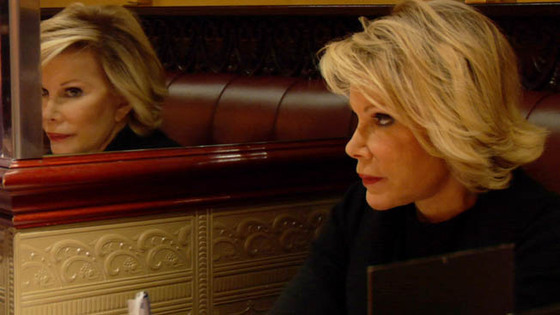
Joan Rivers: A Piece of Work. Rivers is awesome. This movie is not. Two things I would have especially liked: 1) longer scenes from her stand-up acts and 2) more of a plot or wrapper. It’s a “scenes from a year in the life of”-type documentary–hey let’s film famous people and see if anything interesting happens! It doesn’t always work. This one ends up more like reality TV. Which is fine, I guess, but I expect more from a feature-length. What I need is mysterious brilliance on a deadline, a story of redemption, a look into a specialized world, an insane challenge, or old-fashioned good vs evil. All that said, I am super-impressed with Rivers as a person, still going, still feisty in an absolutely brutal industry.

How to Behave in an Art Museum – Paper Monument

Intellectual conversations, as a woman I briefly dated once admonished me, are like public displays of affection—fun to be in, but mortifying to observe, and in a museum you know you’re being observed. But refusing to answer your friend’s questions is no solution either. You’re paralyzed. And you’re not even sure what you’re afraid of. You’re not sure whether your replies will make you look like a philistine or a snob. Which would be worse? Which are you more qualified to be?

How to Behave in an Art Museum – Paper Monument

The Baroque is that style which deliberately exhausts (or tries to exhaust) its possibilities and borders on its own caricature.

Brazil

Brazil. A daydreaming bureaucrat muddles through a dysfunctional future that seems crippled more by pervasive triplicate than any central evil. It’s not perfect, but it is absurd and entertaining. Jonathan Pryce is excellent.