
Emily Dickinson’s coconut cake recipe. See also Marilyn Monroe’s stuffing.

Blue Valentine. My first reaction: it’s a snuff film. My second reaction: it’s not entertainment. Which is right and wrong. Tragedy isn’t fun, but it is appealing in that train-wreck-in-slow-motion kind of way. The shifting back and forth in time lets you see, in parallel, their courtship (including a falling-in-love montage I will lazily/accurately describe as “cloyingly indie”) and their crumbling. Nice to see signals of their growing union fall into place (e.g., She starts wearing his jacket. One tune played is later revealed to be “their song” from back in the day. Etc.). Ebert observes wisely: “Dean thinks marriage is the station. Cindy thought it was the train.”
I got curious about this one after seeing Austin’s post. Good read. Author Viktor Frankl says:
What was really needed was a fundamental change in our attitude toward life. We had to learn ourselves and furthermore, we had to teach the despairing men, that it did not really matter what we expected from life, but rather what life expected from us. We needed to stop asking about the meaning of life, and instead to think of ourselves as those who were being questioned by life–daily and hourly. Our answer must consist, not in talk and meditation, but in right action and right conduct. Life ultimately means taking the responsibility to find the right answer to its problems and to fulfill the tasks which it constantly sets for each individual.
This reminds me of a favorite blog post I came across several years ago: You don’t need a plan, you need skills and a problem (original blog now defunct?).
Screw your plans. Work on your skills. Apply them to a problem that is biting you. Flush and repeat until people believe you had a plan.
I love the sense of *action* that Frankl gets at. Meaning doesn’t happen to you or arrive through talk or navel-gazing, it’s something you do. You have to scratch around a bit. It’s part of a process, which itself is part of the fun, if you’re doing it right: Things won are done; joy’s soul lies in the doing. Doesn’t mean it’s easy. Opportunity comes dressed in overalls, as they say. You’ll have to spend some time groping, listening, testing, accepting, discarding. And if you’re doing it right, it won’t feel good a lot of time: you can tell if it’s your own plan by how lost you feel.
Doesn’t mean you have to be super-choosy (although Family. Friends. Health. Work. Pick any three is helpful to keep in mind). Be careful what parts of yourself you give up on: “You can cut off a couple passions and only focus on one, but after a while, you’ll start to feel phantom limb pain.” And you have to keep in mind that, if you do ever succeed, having found your life’s purpose/calling/vocation/mission, it’s not going to extend your life and not necessarily make you *happy*. One year’s answer might not do for another. And by the way, “Don’t let yo’ happiness make somebody sad!”

Mystic River. Great movie. Dang. I was immediately convinced this one would be worth it. On the surface it’s a whodunnit crime thriller kind of thing, but by the end it’s beside the point. It’s about hurt and healing, history and fate. My respect for Clint Eastwood grows with every film I watch. My overall impression is that he just seems to use his time really well, which is not a small compliment. I also realized during the movie that the score was recognizably Eastwoodian–I hadn’t known he wrote it before I started watching, but it’s definitely got his touch there, too. And I can’t not mention the kickass cast that kicks ass like you think they would: Penn, Robbins, Bacon, Fishburne, Linney. Good stuff.
My updated rankings for Eastwood’s directing:
I think I’ve seen more movies directed by Eastwood than anyone except for Hitchcock (also 9 movies) and Spielberg (20-something!). Buster Keaton and Tim Burton come in at 6 and Martin Scorsese and Christopher Nolan at 5, if I’m remembering correctly. Can’t think of anyone else with more than 4 right now.
More and more, a psychiatrist is approached today by patients who confront him with human problems rather than neurotic symptoms. Some of the people who nowadays call on a psychiatrist would have seen a pastor, priest or rabbi in former days.
For a single person, thinking something through marks the end of the reasoning process; it becomes habit. But that gets the married (or life-partnered) person only halfway through at best.
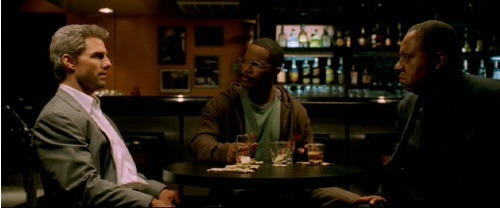
Collateral. Totally forgot Mark Ruffalo was in this. Fun, but moreso in memory than the second time around. I should have left this one alone.
I’m a big believer in boredom. Boredom allows one to indulge in curiosity, and out of curiosity comes everything.
The confidence that people have in their beliefs is not a measure of the quality of evidence, it is not a judgment of the quality of the evidence but it is a judgment of the coherence of the story that the mind has managed to construct.
New research finds we’re more likely to believe a piece of false information conveyed in a television drama after two weeks have passed.
Okay yeah yeah yeah you can find any number of things “a recent study” will tell you. But I like this because it makes me think of Tyler Cowen’s talk on being suspicious of stories, which I have listened to probably 6 or 7 times and will do so again starting… now. (via)
Misinformation in TV Drama Gains Credibility Over Time – Miller-McCune
Robin Hanson on Steve Jobs’ commencement speech:
Now notice: doing what you love, and never settling until you find it, is a costly signal of your career prospects. Since following this advice tends to go better for really capable people, they pay a smaller price for following it. So endorsing this strategy in a way that makes you more likely to follow it is a way to signal your status.
It sure feels good to tell people that you think it is important to “do what you love”; and doing so signals your status. You are in effect bragging. Don’t you think there might be some relation between these two facts?
The problem is, the people who give these sorts of speeches are the outliers: the folks who have made a name for themselves in some very challenging, competitive, and high-status field. No one ever brings in the regional sales manager for a medical supplies firm to say, “Yeah, I didn’t get to be CEO. But I wake up happy most mornings, my kids are great, and my golf game gets better every year.”
She continues, talking about talking about her own awesome job with aspiring young folk:
Usually, what I tell them next is that it’s not a tragedy if they don’t do what they thought they wanted to do at 22; that they have more time than they think to figure out “what they want to do with the rest of their lives”; and that the world outside of school and words is more interesting than they probably suspect.
Similarly, Will Wilkinson on commencement advice:
“Find what you love and never settle for less” is an excellent recipe for frustration and poverty. “Reconcile yourself to the limits of your talent and temperament and find the most satisfactory compromise between what you love to do and what you need to do to feed your children” is rather less stirring, but it’s much better advice.
I like to have a place for everything.

I have a drawer in my nightstand for all my day-to-day stuff, but it still didn’t feel together enough.

A light went off in my head when I saw these leather trays from JW Hulme and Aspinal. This was actually the whole reason I started messing around with leatherworking in the first place.

Turns out, besides being convenient in my actual house, this is *exactly* what I never knew I always wanted when I settle into a strange hotel room. I hate having my stuff scattered about the room. Everything centralized, mind at rest. Snaps let it pack flat.

I didn’t know how to set snaps when I started, but a few minutes of obnoxious late-night hammering and cursing had me on my way. I also didn’t know how to sew leather at the time, so this one remains unlined.

By the way, I still can’t sew leather very well at all. Evidence forthcoming.
A man’s suffering is similar to the behavior of gas. If a certain quantity of gas is pumped into an empty chamber, it will fill the chamber completely and evenly, no matter how big the chamber. Thus suffering completely fills the human soul and conscious mind, no matter whether the suffering is great or little.
Those who decry statistics are often the first to cite a statistic with a sample size of exactly one.
The Code Duello, covering the practice of dueling and points of honor, was drawn up and settled at Clonmel Summer Assizes, 1777, by gentlemen-delegates of Tipperary, Galway, Sligo, Mayo and Roscommon, and prescribed for general adoption throughout Ireland. The Code was generally also followed in England and on the Continent with some slight variations. In America, the principal rules were followed, although occasionally there were some glaring deviations.
Rule 15. Challenges are never to be delivered at night, unless the party to be challenged intend leaving the place of offense before morning; for it is desirable to avoid all hot-headed proceedings.

Atanarjuat (The Fast Runner). One of my least favorite movies in recent memory. Most interesting as a glimpse into the life of aboriginal peoples in Northern Canada. I would be so unhappy there.

Drive. I liked it about as much as I liked the book, which is to say it’s a damn fine way to pass a couple hours. Excellent opening scene, then putters just slightly. Much slower, quieter than I expected but the supporting cast keeps it alive. It’s like a lot of film noir in that way – much of the movie’s momentum is from the hero cornered, reacting to other people’s plans. Interpretive tip: it’s not about driving cars. Good soundtrack. The movie wouldn’t be the same (wouldn’t be possible?) without it. Gosling’s role makes me think of Eastwood’s roles as the Man With No Name and William Munny, and Delon’s in Le Samouraï and a little bit of Clooney’s in The American.
Well, we’ve had a good time tonight, considering we’re all going to die someday.
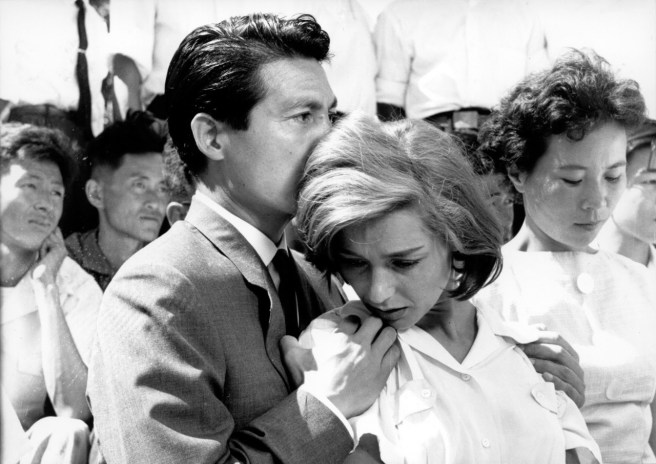
Hiroshima mon amour. DNF. Just couldn’t hang with this one. I don’t know if it would have been easier to watch if I’d known more or less about its impact on the film world (see: French New Wave). Might try this one again another day. Criterion essay.
In the past, nothing is irretrievably lost but everything is irrevocably stored.
 Mark Larson