David Grady: The Conference Call.
(Source: https://www.youtube.com/)
The real risk is in not changing. I have to feel that I’m after something. If I make money, fine. But I’d rather be striving. It’s the striving, man, it’s that I want.

This is pretty much perfect. See also the wisdom of Communicatrix: “Family. Friends. Health. Work. Pick any three.”
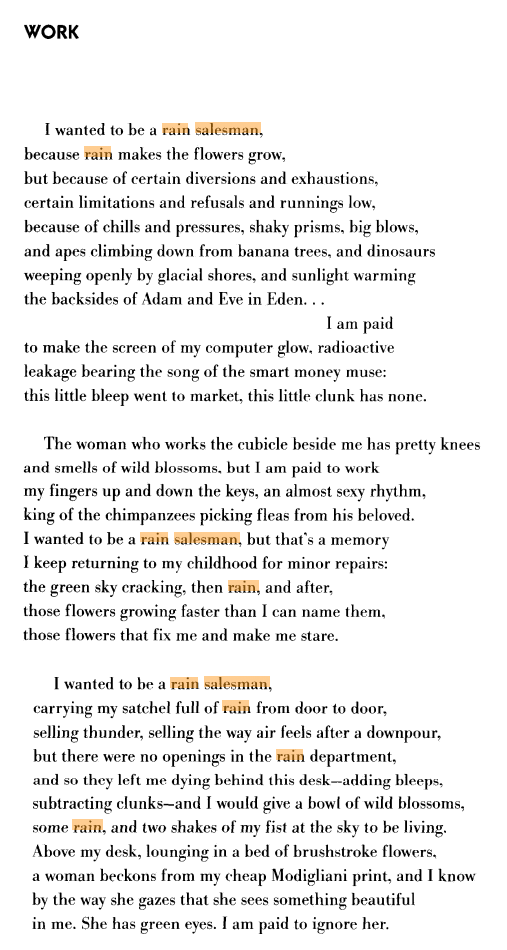
“Work,” by John Engman, from Temporary Help
I wanted to be a rain salesman…but…I am paid
to make the screen of my computer glowMary Karr on John Engman (she excerpted “Work” in her great memoir, Lit):
In prosperous America, the poet’s economic reality usually involves working a crap job while scribbling nightly in a cheap apartment. Before my pal John Engman suffered a brain aneurysm in his 40s, he toiled in such obscurity. He lived in Minnesota, bussed tables, did standup comedy for a while, taught a class or two at a local community center, but only published two books. From his long-time job as an aide in an adolescent psych ward came poems rich in pathos, each tinged with his signature irony.
Family. Friends. Health. Work. Pick any three.
More specifially, on books about “how to succeed”:
It is perfectly obvious that in any decent occupation (such as bricklaying or writing books) there are only two ways (in any special sense) of succeeding. One is by doing very good work, the other is by cheating. Both are much too simple to require any literary explanation.
Ben Casnocha infers two myths from Derek Sivers’ How to Get Hired:
The first is that we all have one or two things we are destined to do. In fact, I think you can become good (and thus) really interested in a range of things. The second is that the way to find what you “really want to do” is through inspection and reflection. In fact, introspection seems never to bear the fruit you’re promised; personal discoveries and self-knowledge seem sooner found via experiments and activity.
Whenever an artist has been able to say, “I came, I saw, I conquered,” it has been at the end of patient practice. Genius at first is little more than a great capacity for receiving discipline.
Movie directors, or should I say people who create things, are very greedy and they can never be satisfied, … That’s why they can keep on working. I’ve been able to work for so long because I think next time, I’ll make something good.
Things won are done; joy’s soul lies in the doing.
Very interesting article. One good bit:
The typical Harvard undergraduate is someone who: (a) is very good at school; (b) has been very successful by conventional standards for his entire life; © has little or no experience of the “real world” outside of school or school-like settings; (d) feels either the ambition or the duty to have a positive impact on the world (not well defined); and (e) is driven more by fear of not being a success than by a concrete desire to do anything in particular. (Yes, I know this is a stereotype; that’s why I said “typical.”) Their (our) decisions are motivated by two main decision rules: (1) close down as few options as possible; and (2) only do things that increase the possibility of future overachievement.
And another one:
You internalize the rationalizations for the work you are doing. It’s easier to think that underwriting new debt offerings really is saving the world than to think that you are underwriting new debt offerings, because of the money, instead of saving the world. And this goes for many walks of life. It’s easier for college professors to think that, by training the next generation of young minds (or, even more improbably, writing papers on esoteric subjects), they are changing the world than to think that they are teaching and researching instead of changing the world.
Why Do Harvard Kids Head to Wall Street? « The Baseline Scenario
Money is like gasoline during a road trip. You don’t want to run out of gas on your trip, but you’re not doing a tour of gas stations. You have to pay attention to money, but it shouldn’t be about the money.
The life I have chosen gives me my full hours of enjoyment for the balance of my life. The Sun will not rise, or set, without my notice, and thanks.
Don’t say you don’t have enough time. You have exactly the same number of hours per day that were given to Helen Keller, Pasteur, Michaelangelo, Mother Teresa, Leonardo da Vinci, Thomas Jefferson, and Albert Einstein.
Stumbled across this in Dan Pink’s book, Drive:
You need not see what someone is doing
to know if it is his vocation,you have only to watch his eyes:
a cook mixing a sauce, a surgeonmaking a primary incision,
a clerk completing a bill of lading,wear the same rapt expression,
forgetting themselves in a function.How beautiful it is,
that eye-on-the-object look.
Personally and emotionally it surprised me that I could actually stay committed to something so consuming without ruining my life. It’s almost axiomatic that people in the arts have to be willing to jettison their friends, marriages, loves, in order to really push through and break out. That is a hefty quantity of bullshit, and is an excuse for not living a full life and integrating work into it. This more than anything was the most positive outcome for me.
What you have to find is your own niche that will allow you to keep feeding and clothing and sheltering yourself without getting downtown. (Laughs.) Because that’s death. That’s really where death is.

 Mark Larson