Sprig-type operations drain agency and expertise out of the world. They centralize, aiming to build huge hubs with small spokes; their innermost mechanisms are hidden. They depend on humans behaving as interchangeable units of labor.
Tag: startups
Living and Dying on Airbnb — Matter
Startups that redefine social and economic relations pop up in an instant. Lawsuits and regulations lag behind.
Alex Payne — Letter To A Young Programmer Considering A Startup
Here are some things to consider that, in my experience, you’re less likely to hear about working in startups.
Good essay. I’ve been thinking this for a while:
Startups are portrayed as an exciting, risky, even subversive alternative to traditional corporate work. Startups are thought of as more free, more open and flexible. Some companies surely begin that way, but a few interviews at later-stage startups will make clear just how quickly they ossify into structures that look very much like the organizations that came before them.
As there was in the first dot com bubble, there is a current proliferation of startups, incubators, accelerators, angel/seed funding, and so forth. In order for the “startup community” to replicate itself, nanobot-like, the mechanics of “doing a startup” have been reduced to an easily transmitted sequence of actions accompanied by a shared set of values, norms, and language.
Alex Payne — Letter To A Young Programmer Considering A Startup
Blake Masters: Peter Thiel’s CS183: Startup – Class 5 Notes Essay
Stephen Cohen on learning:
We tend to massively underestimate the compounding returns of intelligence. As humans, we need to solve big problems. If you graduate Stanford at 22 and Google recruits you, you’ll work a 9-to-5. It’s probably more like an 11-to-3 in terms of hard work. They’ll pay well. It’s relaxing. But what they are actually doing is paying you to accept a much lower intellectual growth rate. When you recognize that intelligence is compounding, the cost of that missing long-term compounding is enormous. They’re not giving you the best opportunity of your life. Then a scary thing can happen: You might realize one day that you’ve lost your competitive edge. You won’t be the best anymore. You won’t be able to fall in love with new stuff. Things are cushy where you are. You get complacent and stall. So, run your prospective engineering hires through that narrative. Then show them the alternative: working at your startup.
Working at a startup is an alternative rather than the alternative, but the career principle is the same: learning’s good and it’s wise to choose it over just about everything else. Cf. Penelope Trunk, Annie Clark, Charlie Munger, etc.
Blake Masters: Peter Thiel’s CS183: Startup – Class 5 Notes Essay
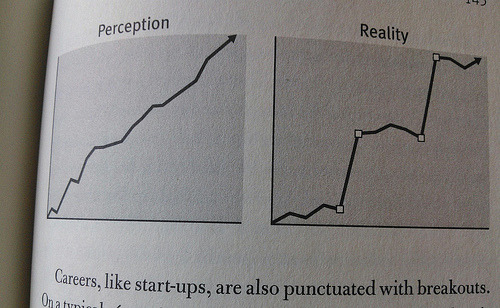
Perception vs. Reality. An excerpt from The Start-up of You.
 Mark Larson