The public does not like bad literature. The public likes a certain kind of literature and likes that kind of literature even when it is bad better than another kind of literature even when it is good. Nor is this unreasonable; for the line between different types of literature is as real as the line between tears and laughter; and to tell people who can only get bad comedy that you have some first-class tragedy is as irrational as to offer a man who is shivering over weak warm coffee a really superior sort of ice.
Tag: quotes
What you have to find is your own niche that will allow you to keep feeding and clothing and sheltering yourself without getting downtown. (Laughs.) Because that’s death. That’s really where death is.
Interview with Nora Watson in Studs Terkel’s Working.
People say you teach during the day and you’re free at so-and-so, but there’s a certain energy that goes into teaching people, it seems to me… and if you don’t give them that energy, then you’re immoral. And if you do give them that energy, then you’re wiped out. Because there’s only so much energy anyone has. So I’d rather drive a cab – I had a good time driving the cab, I wasn’t invested in it, you know what I mean? I could think about music, I could bug the cab, I could take time off to play a show – it really fit me. And I was making more money than most assistant professors too!
Steve Reich on resisting academia and driving a cab back in the early days.
Not every end is a goal. The end of a melody is not its goal; however, if the melody has not reached its end, it would also not have reached its goal. A parable.
Nietzsche. Yeah, I kind of hate to be that Nietzsche-quoting guy, but I read it in Gretchen Rubin’s book The Happiness Project this morning and it stuck with me.
Satisfaction is a product not of where you are, but of where you’re going. To get calculistic, it ain’t about your value, it’s about your first derivative (and maybe your second). In this light, statements like “When x happens, I’ll attain happiness” don’t make sense, but ones like “While x is happening, I’ll be happy” make somewhat more.
One result of the internet, I think, is that it makes almost everyone smart more eclectic, whether in terms of substance or presentation.
And suddenly everything he had been doing stood up…
The five texts « Snarkmarket. Great line.
The crisis in performance is, I believe, based on one simple fact. When it started, rock n roll was dance music. One day we stopped dancing to it and started listening to it and it’s been downhill ever since. We had a purpose, had a specific goal, an intention, a mandate, we made people dance or we did not work, we didn’t not get paid, we were fired, we were homeless. That requires a very different energy. To compel people to get out of their chairs and dance, it’s a working-class energy, not an artistic, intellectual, waiting-around-for-inspiration energy. It’s a get-up, go-to-work-and-kill energy. Rip it up, or die trying.
Little Steven (via austinkleon). There’s some good discussion of this in How the Beatles Destroyed Rock ‘n’ Roll. A while back I tumbled one of the good quotes about music critics versus those who dance.
Someone from R.E.M. was saying to me the other night, ‘Get nervous when you realize you can do it. When you can go through a whole evening having talked to 50 people and not remember a fucking word of any of it. Then you really are in trouble.’
Thom Yorke on the perils of fame. Addicted to Noise interview, 1996.
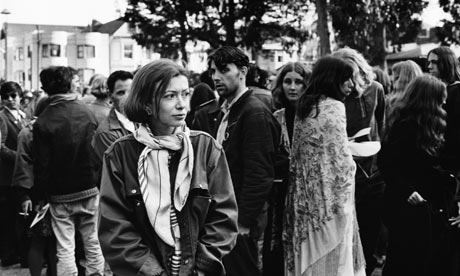
Although I have felt compelled to write things down since I was five years old, I doubt that my daughter ever will, for she is a singularly blessed and accepting child, delighted with life exactly as life presents itself to her, unafraid to go to sleep and unafraid to wake up. Keepers of private notebooks are a different breed altogether, lonely and resistant rearrangers of things, anxious malcontents, children afflicted apparently at birth with some presentiment of loss.
Joan Didion, On Keeping a Notebook [pdf].
To shift the structure of a sentence alters the meaning of that sentence, as definitely and inflexibly as the position of a camera alters the meaning of the object photographed. …. The arrangement of the words matters, and the arrangement you want can be found in the picture in your mind. …. The picture tells you how to arrange the words and the arrangement of the words tells you, or tells me, what’s going on in the picture.
Joan Didion (via bobulate)
Childhood is a branch of cartography.
from Michael Chabon’s The Wilderness of Childhood in Manhood for Amateurs.
I am frankly embarrassed that most of my musical life has been spent in the search for new materials. The significance of new materials is that they represent, I believe, the incessant desire in our culture to explore the unknown. Before we know the unknown, it inflames our hearts. When we know it, the flame dies down, only to burst forth again at the thought of a new unknown. This desire has found expression in our culture in new materials, because our culture has its faith not in the peaceful center of the spirit but in an ever-hopeful projection onto things of our own desire for completion.
John Cage. What silence taught John Cage: The story of 4’33" by James Pritchett. (via)
Nobody has any business to destroy a social institution until he has really seen it as an historical institution. If he knows how it arose, and what purposes it was supposed to serve, he may really be able to say that they were bad purposes, that they have since become bad purposes, or that they are purposes which are no longer served. But if he simply stares at the thing as a senseless monstrosity that has somehow sprung up in his path, it is he and not the traditionalist who is suffering from an illusion.
The great enemy of the truth is very often not the lie — deliberate, contrived and dishonest, but the myth, persistent, persuasive, and unrealistic. Belief in myths allows the comfort of opinion without the discomfort of thought.
John F. Kennedy (via mihirai)
Remember too on every occasion which leads thee to vexation to apply this principle: not that this is a misfortune, but that to bear it nobly is good fortune.
My heart goes is going ba bump ba bump ba bump.
The general glut of information and opinion makes it disconcertingly easy to kid yourself about how well you understand a particular topic.
Reading through the histories of both jazz and rock, I am struck again and again by the fact that although women and girls were the primary consumers of popular styles, the critics were consistently male–and, more specifically, that they tended to be the sort of men who collected and discussed music rather than dancing to it. Again, that is not necessarily a bad thing (some of my best friends…), but it is relevant when one is trying to understand why they loved the music they loved and hated the music they hated.
Another selection from How the Beatles Destroyed Rock ‘n’ Roll. Over the past year or so, I find I’m more and more reluctant to condemn music I don’t like, maybe partly because I’m more willing to dance than I used to be.
 Mark Larson