dusttodigital:

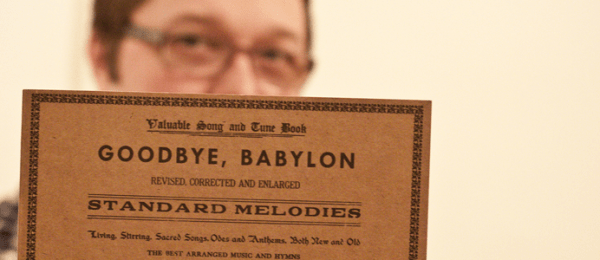
Los Angeles-based artist Steve Roden has worked in an overwhelming variety of forms throughout his career, creating everything from conceptual recordings and sound installations to color field paintings and experimental films. For his latest project, Roden has teamed up with Atlanta-based record label and publisher Dust-to-Digital to release a book and two cds culled from his extensive collections of early photographs and 78 rpm recordings. (via Preview: Steve Roden’s collections at the Contemporary | Atlanta A&E Blog)

https://www.tumblr.com/audio_file/mlarson/3877420797/tumblr_li2xqux5wK1qzdvhi?plead=please-dont-download-this-or-our-lawyers-wont-let-us-host-audio
http://mlarson.tumblr.com/post/3877420797/audio_player_iframe/mlarson/tumblr_li2xqux5wK1qzdvhi?audio_file=https%3A%2F%2Fwww.tumblr.com%2Faudio_file%2Fmlarson%2F3877420797%2Ftumblr_li2xqux5wK1qzdvhi

oldhollywood:

Duke Ellington – Midnight Indigo (via Anatomy of a Murder: Original Motion Picture Soundtrack)

One of the great soundtracks.

Woody Guthrie’s New Year’s Rulin’s, 1942. (via). See also Johnny Cash’s to-do list and David Foster Wallace on the philosophical depth of country music.

  1. Work more and better
  2. Work by a schedule
  3. Wash teeth if any
  4. Shave
  5. Take bath
  6. Eat good – fruit – vegetables – milk
  7. Drink very scant if any
  8. Write a song a day
  9. Wear clean clothes – look good
  10. Shine shoes
  11. Change socks
  12. Change bed clothes often
  13. Read lots good books
  14. Listen to radio a lot
  15. Learn people better
  16. Keep rancho clean
  17. Don’t get lonesome
  18. Stay glad
  19. Keep hoping machine running
  20. Dream good
  21. Bank all extra money
  22. Save dough
  23. Have company but don’t waste time
  24. Send Mary and kids money
  25. Play and sing good
  26. Dance better
  27. Help win war – beat fascism
  28. Love Mama
  29. Love Papa
  30. Love Pete
  31. Love everybody
  32. Make up your mind
  33. Wake up and fight

What you want to do is build the people up. You start ‘em off and you give them this first half, and their feet, and next thing they got their heads goin’, and the next thing they got their mouths open and they’re yellin’ and they’re screamin’. It’s a great feeling when you can have your audience get involved with you […] where everyone can jump in and have a real good time. “What’d I Say” is my last song onstage. When I do “What’d I Say,” you don’t have to worry about it — that’s the end of me. There ain’t no encore, no nothin’. I’m finished!

The Baroque is that style which deliberately exhausts (or tries to exhaust) its possibilities and borders on its own caricature.

I think painters and sculptors react to music, more naively, in a sense, because their politics are a lot different from our politics. It’s very hard for one composer to listen to another composer without somehow bringing his own mind-set to the music he’s listening to. It’s not that it’s impossible. And that’s only natural, whereas someone in another art field is going to listen to it very naively, in a sense (you hope), and that’s a worthwhile, unbiased opinion. Ultimately, it’s a naive opinion that rules the roost.

Riff Market: Theoretically Unpublished Piece About Girl Talk

I endorse this criticism, particularly regarding the uniformity of timbre/texture/tempo. And/or I’m just old and cranky and don’t understand kids these days. (via)

With Girl Talk, we get that blissful moment of recognition without having to suffer through the next three minutes and thirty seconds remembering exactly why it hasn’t been Hammertime for more than a decade now.

Also:

Girl Talk’s insistence on not being a pure DJ is a key to why the music sounds like it does, why it has only one speed, one timbre, and one density: if he lets a sample or phrase or loop breath on its own without some kind of additional percussion or secondary element, he is violating his own semantic scruples. Rule Number One of Girl Talk Club: Everything must be mashed at all times or otherwise the whole musique concrete / “art compounded from other art” rationale falls away, and Gillis is “just a DJ.”

This was intriguing, but has maybe been true for decades:

With Girl Talk compositions, one wonders how much of Gillis’s ease is a testament to his technical prowess, and how much is just an articulation of the fact that pop music has become increasingly standardized.

And also:

Forget art. The question is, without a public hungry for the references, is Feed the Animals anything at all? Does Girl Talk hold up as “music” without all the extratextual information? If you had no idea about mash-ups or hip-hop or “No Diggity” or “Epic” by Faith No More would you really be all that impressed? It would just be a long stream of unstructured pop drone. Imaginary straw-men that have lived in a underground bunker for fifty years would totally hate Girl Talk!

Riff Market: Theoretically Unpublished Piece About Girl Talk

Love has never failed. It has won every battle. And today and forever more it will go on undefeated.

R. Kelly in an interview with Will Oldham. I had no idea he started as a busker.

Playboy Interview: Metallica (April 2001)

This interview is packed with wonderful tidbits. James Hetfield on day jobs and the early tour routine:

We worked at day jobs. After that, we’d throw parties, take the furniture out of the house and smash the joint. We smashed dressing rooms just because you were supposed to. Then you’d get the bill and go, “Whoa! I didn’t know Pete Townshend paid for his lamp!” Come back off the tour and you hadn’t made any money. You bought furniture for a bunch of promoters.

Hetfield on growing up differently from Lars Ulrich:

I could afford maybe one record a week, and he would come back from the store with 20. He bought Styx and REO Speedwagon, bands he’d heard of in Denmark. I would go, “What the fuck? Why did you buy Styx?“

Kirk Hammett on Hetfield’s Nothing Else Matters:

All I could think of at the time was, James wrote a fucking love song to his girlfriend? That’s just weird.

Hetfield on alcohol abuse and parenthood:

You can’t be hung over when you got kids, man. “Dad, get the fuck off the couch!” Well, they don’t say that—yet.

Ulrich on Matt Damon:

PLAYBOY: Your wife, Skylar, used to date Matt Damon, and he made her the model for the female lead in Good Will Hunting. A few years ago, Matt described you as “a fucking rock star who’s got $80 million and his own jet—a bad rock star, too.”

ULRICH: He said that before we met. And he’s apologized about a hundred times. The first five times I saw him, he would spend 10 minutes apologizing profusely. He really is a sweetheart.

Ulrich on collecting art:

Hanging out backstage with Kid Rock is an amazing turn-on, no less so than sitting and staring at my Dubuffet for an hour with a fucking gin and tonic.

Playboy Interview: Metallica (April 2001)