It seems to me that the ears that are listening make more difference than the way the music sounds.
Will Oldham aka Bonnie “Prince” Billy. This notion applies outside of music, too. Also? He put on one of my favorite concerts of all time a few years ago here in Atlanta. Brilliant dude. Excited to read this new book. (via Austin Kleon)
“In Augusta, to photograph James Brown, these pictures were taken when he suggested we go for a ride. He told me he would show me ‘his town.’ So we jumped into an old car and drove around. He would stop the car when he saw someone sitting in their yard, run up, do the split, yell out, ‘I feel good,’ and jump back in the car and drive off. It was all so spontaneous and hilarious, and it took the onlookers by such surprise. Brown was a fun-loving character and a good sport.” Harry Benson, Photographer
The King of 78s: Joe Bussard. This guy has 15,000 records and hilariously cantankerous taste in music. Although maybe that passion and nerdery foments and requires this kind of dismissive focus:
Q: Is there a music genre that you avoid?
A: Rock-n- roll. Period. Any of it. Hate it. Worse thing that happened to music. Hurt all types of music. They took blues and ruined it. It’s the cancer of music….ate into everything. Killed Country music, that’s for sure.
Q: A lot of people would claim the complete opposite. that Rock-n-Roll re invented and recharged music. What is it about rock-n-roll that annoys you so much?
A: Don’t like. Just my personal taste. Don’t like the sound of it, the meaning of it…doesn’t promote anything beautiful or meaningful. Idiotic noise, in my opinion.
Q: So artist like Miles Davis, John Coltrane don’t deserve your time?
A: Oh my god, you gotta be kidding me. None of that music moves me.
Only a person who can perceive the different weights of strong and weak phrasings in musical form can really feel the distinction between the comma and the semicolon.
[Hair-metal musicians] are idealists, some of the last true believers in a weird idea that had floated around for decades: that rock music could be used to escape all the moral and hygienic values of the working and middle classes–self-restraint, work ethic, humility, sexual decency–and live happily among baser pleasures.
Steve Reich’s tape piece “Come Out”, from 1966. When people talk about someone “coming out” this track often shows up in my head, unannounced. Even though it is, obviously, about something very different.
From listening to this track, I learned something about how my mouth makes sounds and my brain turns those sounds into meaning. Say “come out to show them” over and over for a minute and understand the difference between a vowel and a “sh”, and how the “sh” can very easily become a rhythmic device not unlike a hi-hat. And when you say it over and over you can feel how the phrase turns from “words” into “sounds” and you can get a sense of how your brain has been trained to extract meaning from these sounds but can sort of fall asleep on the job, lulled by repetition.
I remember being invited up to NYC or WBAI–before they became so political they were very musical–and being asked to play “Come Out,” and the switchboard lit up like a tree. “Your transformer’s broken and the needle’s stuck in the groove! Will you PLEASE fix it?”
“Are you OK with making compromises with your art, or is it just better off for you to have your big compromise be walking into an office every day and getting to do whatever you want?” she says, without a fleck of judgment in her voice. “I think there’s arguments to be made for both.”
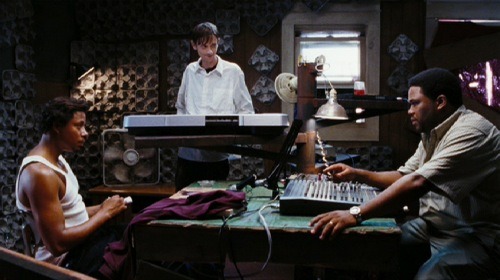
Hustle & Flow. I was expecting a more formulaic rags-to-riches story, but got several wonderful surprises and setbacks in how this one played out. The main characters here are so, so, so well-done. Terrence Howard is great as he works through what’s basically a mid-life crisis. Damp, dumpy Memphis is the perfect backdrop and it’s just a generally nice change of scenery from most movies. Ludacris has a decent turn here as Skinny Black, but Big Boi’s menacing Marcus in ATL puts it to shame. Also, this one has Isaac Hayes.
Calling this the funkiest bassline in the history of recorded music. After it kicks into the main groove at 1:30, an entire universe with a six-billion-year history opens up between the beat and the delayed third note Michael Henderson plays each bar.
The best thing that hearing music can do for you is make you want to make your own. I find it close to absurd that some people are musicians and singers and others are silent apostles who never let out a peep, maybe not even in the shower. Music seems like a basic human right, much like the right to prayer and the right to fall in love.
We’ve all spent years talking about taste in the age of the mp3, and how listeners can shuffle happily from Hank Williams to Too $hort to Katy Perry. Minaj might force some people to accept that a musician might have more than one inclination as well — that she might, unsurprisingly, be interested in steely rapping and sugar-rush pop at the same time.
Disco’s success at capturing glamour and sex as an aesthetic can be frightening — in approximately the same way it’s frightening to watch the world do similar things to weddings, turning them into sites of glittery yearning where one’s sense of self and love turns strangely prop-filled and expensive. This seems like one of the more-flattering reasons why rock fans treated disco with so much hostility: It’s a puritan’s gut instinct that there’s something dangerous about a sex-and-glamour bubble floating too exuberantly beyond the realm of reality, becoming too stylized and commercial. And of course straight, white, male rock fans were the ones who’d feel that fear and loathing most strongly: They’d have been the listeners with the least to gain from actively reimagining love, sex, and glamour. Disco claimed the audience with the most critical stake in reframing those things — gay, black, female, and Latino listeners chief among them.
Atlanta [is] the post-civil rights city that worked. I think that’s the real legacy. All this foolishness we be doin’ as rappers is just something for the old guys to laugh at,“ he says with a conciliatory chuckle. "They did this on Simpson [Road] 50 years ago.”



 Mark Larson