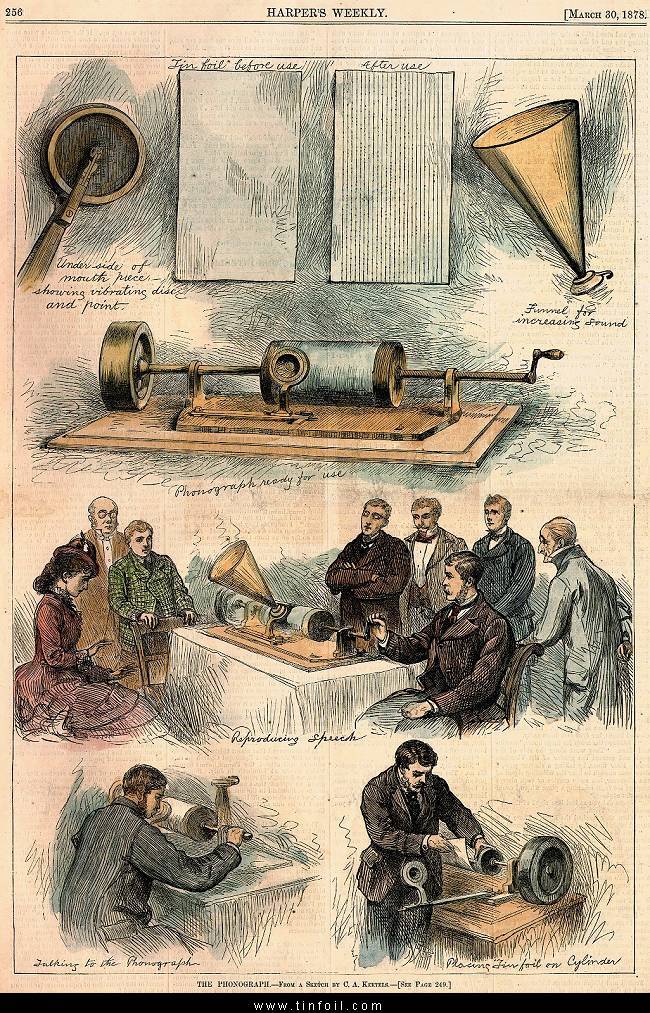
Explanatory illustration in the March 1878 article in Harper’s Weekly about Edison’s phonograph.

If you like love and/or music, I think you will like Love Is a Mixtape: Life and Loss, One Song at a Time. Rob Sheffield wrote the book after the unexpected death of his wife of five years, Reneee. He didn’t write it right away—the story came welling up again as he was moving to a new apartment, unpacking some old tapes of theirs. The book’s 15 chapters each touch on a different mixtape and a different time. It explores the music and life and love they shared. It captures part of the Charlottesville music scene (they were both DJs) and the bigger stuff in the ’90s: Nirvana, Pavement, R.E.M., etc.
I liked Sheffield’s writing. The passage of time helps to bring out this sort of humorous self-awareness, like when he describes a moment shortly after they were married:
Now we were alone with each other.
Which meant we had all these neighbors to deal with. The old lady next door dropped by with a plate of muffins one Sunday afternoon, right in the middle of Studs. Renee explained that in the South, this is normal—you just drop in on your married neighbors. I was aghast. I was a husband in the South now. We had married into this alien landscape with its strange customs.
Or when he talks about his love as a supporting role, after a moment when he was driving and singing back-up on “Midnight Train to Georgia”:
When we got to the final fade-out with Gladys on board the train and the Pips choo-chooing their goodbyes, Reneee cocked an eyebrow and said, ‘You make a good Pip.’ That’s all I ever wanted to hear a girl tell me. That’s all I ever dreamed of being. Some of us are born Gladys Knights, and some of us are born Pips. I marveled unto my Pip soul how lucky I was to choo-choo and woo-woo behind a real Gladys girl.
And everywhere it’s saturated with pop-culture references, so the time comes alive. And that’s what makes it (and other good memoirs?) special: that the story is so specific. It’s not just a love story, but a story about what it’s like to be a music-lover in love with a music-lover mostly in Charlottesville in the early and mid-’90s. And when you read his enthusiasm (“how lucky I was to choo-choo”), you can’t help be a bit jealous/understanding of what he has, and you feel the loss more acutely than in a story that seems like it could be set anywhere (The Notebook, maybe, or how about Romeo and Juliet?). I think you should read it.
Last.fm tracking deleted scrobbles and “guilty pleasure” tags to figure out which musicians are the least cool. (via)
Once the music plays, it creates me.

Louis Armstrong, takin’ care of business without a shirt. I wish I knew some background on this photo.
I’m not sure how big it got, but I know I missed this growing up in rural north Georgia. Apparently, for a time in the late ‘80s and early ’90s (as LPs and 45s were fading but before CDs made a big splash, way before our idyllic days of mp3 ubiquity), you could buy singles for $0.50-$1.50 or so, and have them recorded on a custom-labeled mixtape. (via retro thing)

97. Harpsichord. Plus ça change…

via alex ross
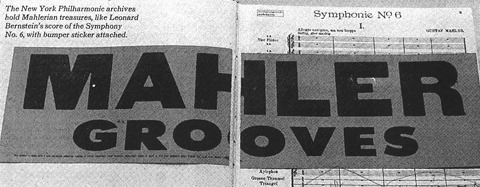
Mahler Grooves [via alex ross]

If you ever get stuck on that next note/chord, try Musician’s Dice. [via classicalconvert]
I never think of anything as finished until it’s released. If you came round to my house one day and I said, “This is something I haven’t finished yet, but it’s going to be much better when I’ve mixed it,” and blah blah blah – all these defenses – and then I played it for you, that’s one thing. But if you pick up my album at a shop and take it home and put it on your record player and I’m not there to give you all those excuses, that’s quite a different thing. A work is finished for me when it’s no longer in the domain of my excuses about it.
Brian Eno – Music For Airports Interview:
I thought that it would be much better to have music that said, “Well, if you die, it doesn’t really matter.”
There are so many subsubgenres. Lord. (via funkaoshi)
They skipped a few minutes’ worth of the opening toccata section, but man, how cool. That footwork! (via kottke)
I’m wondering what someone could do if they spent their life practicing an instrument like this one. Or what could a group of players (dancers?) make of it? One of the things that can make percussion ensembles (or say, a drummer in a band) more interesting than other chamber groups is all the movement. It can be really visual and just plain fun to watch, which you don’t always get from a pianist or string quartet or whatever.
“Musician John Heitzenrater fuses the ragas of classical Indian music with the twang of down home bluegrass.” (via Wehr in the World)
When you learn from the awesome 80-year-old instruction book written by dudes like George Hamilton Green, it’s nice to hear him play, too.

A favorite from Cliff Robert’s Book of Jazz. The St. Louis Blues is really nice, too.
Terry Riley’s In C meets Kutiman’s Mother of All Funk Chords.

 Mark Larson
