People say you teach during the day and you’re free at so-and-so, but there’s a certain energy that goes into teaching people, it seems to me… and if you don’t give them that energy, then you’re immoral. And if you do give them that energy, then you’re wiped out. Because there’s only so much energy anyone has. So I’d rather drive a cab – I had a good time driving the cab, I wasn’t invested in it, you know what I mean? I could think about music, I could bug the cab, I could take time off to play a show – it really fit me. And I was making more money than most assistant professors too!

Steve Reich on resisting academia and driving a cab back in the early days.

“The Greatest Love Story of the 20th Century”

austinkleon:

Sarah Vowell on June Carter’s “Ring of Fire,”

In this song, to compare love to fire isn’t just the music sexy/heat cliche like you give me fever, or, hunka-hunka burnin’ love, or, it’s gettin’ hot in here. This is fire as in brimstone. Old time religion. Written by the daughter of a people who believe in the eternal flames of hell. June Carter was coveting her neighbor’s spouse, which meant she was breaking one of the Ten Commandments. Loving Johnny Cash was a sin. And for her, the wages of sin were death. A death in which the sinner spent all eternity as nothing more than kindling. When June Carter admitted to herself that she loved Johnny Cash, it is, in a small country and western love song way, not unlike the moment Huck Finn resolves to help the slave Jim escape, even though he’s been told that doing so would be wrong. Alright then, he says, I’ll go to hell.

Act Three of This American Life #247, about 47 minutes into the show.

“The Greatest Love Story of the 20th Century”

Music = dye

I’ve been listening to more Indian classical music lately, so I was reading about ragas, these traditional musical forms that guide how you play and develop a piece. Instructions for creating a mood, if I can semi-ignorantly generalize. And take a look at the etymology…

Raga. 1788, from Sanskrit raga-s “harmony, melody, mode in music,” literally “color, mood,” related to rajyati “it is dyed.”

I like this idea of music as a “dye” for the mind.

Oscar Levant daydreams a total performance of Gershwin’s Concerto in F. From the film “An American in Paris”.

A couple of other things that you might not have heard yet, because they’re not available: There’s a fantastic compilation of music that was recorded and released originally on 78s, and it’s called Black Mirror: Reflections In Global Musics. I would recommend it to anybody. But anyway, on that album there’s a song, and when I first heard that song, it just completely blew me away, because all the sudden I had heard the greatest note that I’d ever heard anybody make up to that point. The song is called “Smyrneiko Minore,” and it was sung by Marika Papagika, a young woman who emigrated from Greece to the United States, and she recorded it in 1919 in New York. When you listen to that song, you’re totally unprepared. At least I was. I was totally unprepared for her entrance. When she comes in, that first note, it’s unbelievable, the sense of human sorrow and the feeling of that note.

The best way to describe it is I’m like this energy-gathering dynamo. I suck in the energy from the crowd and right at the point they’re drained, ready to slump over and fall over and pass out, I bring it to a crescendo and [expletive] shoot it all back at ‘em. And then I’m [expletive] slumped over and ready to pass out and they’re energized and ready for the next artist or end of the party or whatever.

Interview with Coolio, describing what it’s like to perform.

The Rules of the Game: A Fuller Thought on J. Hopper and Vampire Weekend

The critic, ever wary of a band like Vampire Weekend’s likely privilege, doesn’t look very far into what, if anything, they’re saying about class — so sure is she that her take on class issues will be more important and incisive. The critic, ever wary of the band’s interest in African music being dilettantish, doesn’t much ask how that influence is operating — so sure is she that her relationship with African music is deeper, more solemn, more respectful. And at some point we’re barely reading criticism anymore: we’re just watching the refereeing of a game we’re all too familiar with.

(via. see also)

Not every end is a goal. The end of a melody is not its goal; however, if the melody has not reached its end, it would also not have reached its goal. A parable.

Nietzsche. Yeah, I kind of hate to be that Nietzsche-quoting guy, but I read it in Gretchen Rubin’s book The Happiness Project this morning and it stuck with me.

Beethoven’s laptop. That’s a clever little desk, no?

In the last weeks of Beethoven’s life this travel desk was placed right next to his bed. Three days before he died, he wrote a codicil to his will at the desk, in which he named his nephew Karl as his sole heir. Beethoven probably kept his letter to the Immortal Beloved in the open compartment shown here.

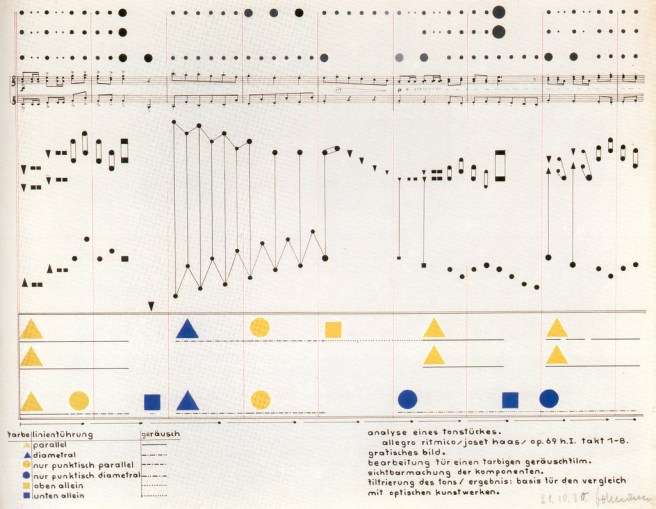
Heinrich-Siegfried Bormann – Visual analysis of a piece of music from a color-theory class with Vasily Kandinsky. October 21, 1930. (via)

noiseforairports:

Here is a more in-depth video about Pat Metheny’s Orchestrion Tour. In it, you can see more of the variety of instruments LEMUR has constructed for Metheny, and you can see the awesome processing that allows him to play a xylophone with his guitar, live. (Yeah, whoa.)

It’s all really interesting stuff, and exciting for me personally to see this potential resurgence of explicitly “mechanical” music.

I have a love/hate relationship with Pat Metheny’s music but I find this fascinating. So many possibilities!