Ten Ragas to a Disco Beat – Charanjit Singh.

Performed on the synths that would later define Acid House, the Roland TB-303 and TR-808, the album sounds light years ahead of its time with its repetitive beats and hypnotic electronic melodies. Its maker, Bollywood session musician Charanjit Singh, set out to translate ancient Indian classical Ragas to the modern synthesizer and in doing so seems to have invented House music along the way.

More on the album and the culture of ‘80s Indian synthesizer stuff here and here.

It was at a concert of lovely old music. After two or three notes of the piano the door was opened of a sudden to the other world. I sped through heaven and saw God at work. I suffered holy pains. I dropped all my defenses and was afraid of nothing in the world. I accepted all things and to all things I gave up my heart. It did not last very long, a quarter of an hour perhaps; but it returned to me in a dream at night, and since, through all the barren days, I caught a glimpse of it now and then.

Herman Hesse’s Steppenwolf on musical ecstasy.

Recent juxtapositions

A cluster of articles that came up in life and/or the RSS reader within the span of a couple days, without my looking for them. There are no coincidences:

austinkleon:

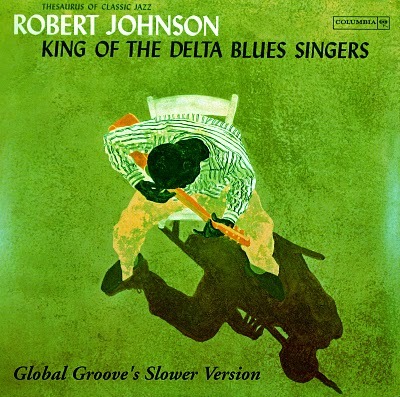
Robert Johnson, King of the Delta Blues Singers, Slower Version, Columbia

If you’ve some means of slowing the LP down – like a direct drive turntable – you’ll suddenly find yourself listening to a sexy young black guy with a cool guitar sound – less of paranoid gabbler, more of a human being

See also: Steady Rollin’ Man: a revolutionary critique of Robert Johnson

With the disclaimer that I’m not *supersuper* into old blues, I find these *much* better than the earlier, speedier versions.

Bird

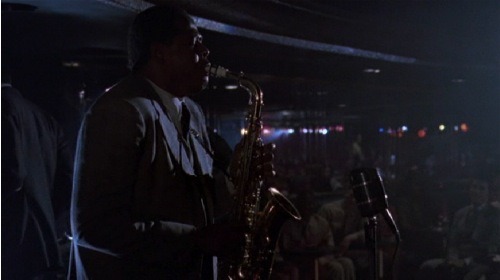
Bird. A pretty good Eastwood-directed biopic about Charlie Parker, though I’m not sure it’s that interesting for people who lack at least a mild enthusiasm for jazz. This is not a three-act story of redemption a la Ray or Walk the Line. This one seems more of a collage, cutting back and forth. It’s a blur, short of detail, but heavy on mood, aided in that most of the movie’s shots are so dark, murky, noir-ish. Parker–alcoholic, junkie–doesn’t seem a raging, violent, destructive artist, but one more burdened and resigned. I’ve got a new appreciation for Forest Whitaker now that I’ve seen him in a leading role. Makes me curious about The Last King of Scotland. Here’s a nice bit from Ebert’s review:

Two of the subtler themes running through much of Eastwood’s work – and especially the 14 films he has directed – are a love of music, and a fascination with characters who are lonely, heroic drifters. There is a connection between the Parker of “Bird” and the alcoholic guitar player in “Honkytonk Man.” They are both men who use music as a way of insisting they are alive and can feel joy, in the face of the daily depression and dread they draw around themselves.

austinkleon:

The story behind James Carr’s “At The Dark End Of The Street”:

historyofsoul:

It amazes me that THIS is the story behind one of the best soul songs ever recorded:

It was the Summer of ‘66, and Memphis was chock full of DJs in town for a convention.  Songwriter Dan Penn and session guitarist Chip Moman were taking advantage of the situation, cheating Florida DJ Don Schroeder out of his money in a card game.

They wrote the song about two lovers in an illicit affair while on break from the game.  ”We were always wanting to come up with the best cheatin’ song ever,” Penn explained.

They went to Quentin Claunch, partner in Goldwax Records and a fellow alumnus of the Muscle Shoals music scene, and asked to borrow his hotel room for a half hour.  He agreed, on the condition that whatever song they wrote, they give it to Claunch for his singer, James Carr.  A deal was struck and the rest is history.

Terrific song. A Youtube search will show you all the cover versions out there.

One of my favorite new-to-me songs from earlier this summer.

https://www.tumblr.com/audio_file/mlarson/932406630/tumblr_l6wyq7ypq01qzdvhi?plead=please-dont-download-this-or-our-lawyers-wont-let-us-host-audio
http://mlarson.tumblr.com/post/932406630/audio_player_iframe/mlarson/tumblr_l6wyq7ypq01qzdvhi?audio_file=https%3A%2F%2Fwww.tumblr.com%2Faudio_file%2Fmlarson%2F932406630%2Ftumblr_l6wyq7ypq01qzdvhi

oldhollywood:

Ennio Morricone Once Upon a Time in the West (via Once Upon a Time in the West: Original Motion Picture Soundtrack) (vocals by Edda D’ell Orso)

“For me the music is fundamental, especially in a Western where the dialogue is purely aphoristic. The films could just as well be silent; one would understand all the same. The music serves to emphasize states of mind, facts and situations more than the dialogue itself does. In short, for me the music functions as dialogue.”

-Sergio Leone

15th Anniversary: The Brian Eno Evolution

What do people want from Art? I don’t know the full answer, but one thing I’m increasingly sure of is that they want life. They want the sense that there is something going on, that something real and exciting and of its moment has been captured […]

In an age of digital perfectibility, it takes quite a lot of courage to say, “Leave it alone” and, if you do decide to make changes, quite a lot of judgment to know at which point you stop. A lot of technology offers you the chance to make everything completely, wonderfully perfect, and thus to take out whatever residue of human life there was in the work to start with. […] It’s a misunderstanding to think that the traces of human activity — brushstrokes, tuning drift, arrhythmia — are not part of the work. They are the fundamental texture of the work, the fine grain of it.

15th Anniversary: The Brian Eno Evolution

wnbrgr:

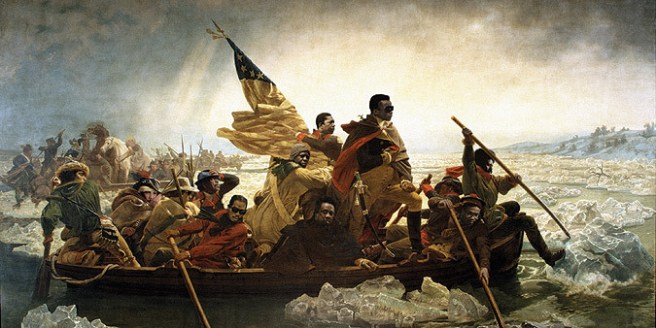
Jazzcats Crossing the Hudson

Jazzcats Crossing the Hudson is an 1851 oil-on-canvas painting by German American artist Emanuel Gottlieb Leutze. It pre-emptively commemorates the arrival in New York City of jazz greats Miles Davis, John Coltrane, Sun Ra, Pharoah Sanders, Steve Kuhn and others. The painting is remarkable for the fact that it was created decades before the birth of any of these jazz artists.”

via mastertone

You have to reinvent reasons for playing, and one year’s answer might not do for another.

Yo-Yo Ma on keeping things fresh. (via)