I bet we all in this room live about the same. We eat about the same and sleep about the same. We pretty much drive a car for 10 years. All this stuff doesn’t make it any different. I will watch the Super Bowl on a big screen television just like you. We are living the same life. I have two luxuries: I get to do what I want to do every day and I get to travel a lot faster than you.
Tag: living
Hang around people who are better than you all the time. You do pick up the behavior of people who are around you. It will make you a better person. Marry upward. That is the person who is going to have the biggest effect on you. A relationship like that over the decades will do nothing but good.
Warren Buffett. And if you can’t find/identify people who are better than you, you’re probably an asshole.
In which I ponder former selves
How much have I changed? Andy McKenzie and Ben Casnocha wrote recently about the wisdom of former selves. Their posts reminded me of a note I jotted down the other day:
Things that, while I was in college, I wish I’d had/made more time to learn about: film, psychology, business, economics.
Things that, since college, I’ve found myself learning more and more about, without applying any special focus: film, psychology, business, economics.
Which relates to another note-to-self from a few weeks ago:
Some careers I considered, ages 5-15: archaeologist, carpenter, National Geographic explorer, SWAT team, writer, conductor.
Plus ça change… I would, for the most part, still have interest in certain aspects of these (maybe even the whole thing). Discovery, craft, research, suspense, mastery, performance. And over the past few weeks I’ve spent some time re-reading my journals from previous long hikes and travel. It’s both amusing and a little frustrating that some of the same ideas that consume me now popped up 1, 3, 5, 10 years ago. Or some of the really funny and observant things I wrote could have been written yesterday. As Andy writes:
It’s harder to construct a personal narrative of growth when the sentences showing that you used to be just as sweet remain visible.
Just makes me wonder if I’m really changing that much (do I want to?), or if I’m just becoming more like me. The metaphor that comes to mind is like when you’re downloading a large image file, and it gradually becomes less and less pixelated. Same Mark, more data, more detail.
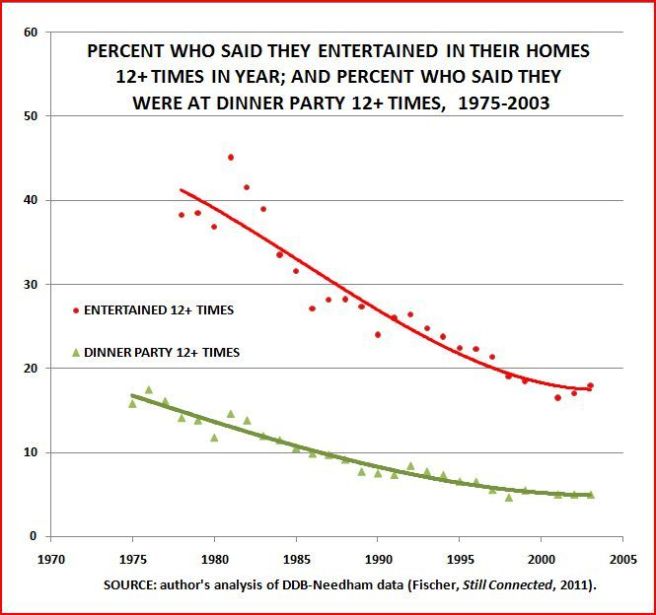
No Dinner Invitations? – Made in America. Suspected causes: both parents working, more commuting. But our socializing, in general, trends upward: more phone calls, texts, jaunts to restaurants, bars, etc.
A Cruel Country by Roland Barthes : The New Yorker
“Journal excerpts by Roland Barthes about mourning his mother, Henriette, who died at eighty-four, in October, 1977.” It’s a real shame this one is behind a paywall. Favorite bits:
What I find utterly terrifying is mourning’s discontinuous character.
And:
Mourning: not a crushing oppression, a jamming (which would suppose a “refill”), but a painful availability: I am vigilant, expectant, awaiting the onset of a “sense of life”.
And also:
1st mourning
false liberty
2nd mourning
desolate liberty
deadly, without
worthy occupation
Ars longa, vita brevis, occasio praeceps, experimentum periculosum, iudicium difficile.
Hippocrates. We know it best as the phrase “life is short”, but I didn’t know that was shortened from a longer, more interesting line: “Life is short, the art long, opportunity fleeting, experiment fallible, judgment difficult.” Ars longa, vita brevis – Wikipedia, the free encyclopedia.
Beware the barrenness of a busy life.
That’s attributed to Socrates, but who knows? Nonetheless, mental note. It pays to keep a healthy skepticism of how you spend your time, busy or not.

This is pretty much perfect. See also the wisdom of Communicatrix: “Family. Friends. Health. Work. Pick any three.”
Family. Friends. Health. Work. Pick any three.
Communicatrix. Reminds me of an optimist-realist mantra I either invented or stole sometime around high school, and occasionally have to remind myself: “You can have anything you want. Just not all at the same time.”
Be true to yourself. Make each day a masterpiece. Help others. Drink deeply from good books. Make friendship a fine art. Build a shelter against a rainy day.
A message from John Wooden’s father that he always kept with him. John Wooden, 99, Legendary U.C.L.A. Coach, Dies – Obituary (Obit) – NYTimes.com.
Things won are done; joy’s soul lies in the doing.
College and the Art of Life – David Salesin, Convocation Address, 28 September 2003
College is such an amazing time of freedom. For many of you, this is the first time in your life when it’s completely up to you, and you alone, to decide what you study, what activities you engage in, and how you structure your day. One idea I came up with as an undergrad was to try to maintain balance by making sure I engaged in four different types of activities every single day. These were:
-something intellectual (not so difficult at school);
-something physical (like running, biking, a team sport);
-something creative (like music, art, or writing); and
-something social (like lunch with a friend).
College and the Art of Life – David Salesin, Convocation Address, 28 September 2003
Seth’s blog: Optimal Daily Experience
Forgot to share this a while back. (via)
Connecting some threads: a well-balanced life
Me, tweetin’ earlier this evening:

And I went on to remind myself: “Gotta be constantly tweaking the recipe, right? I kinda know the ingredients but the ratios get out of whack”. I say all this because it reminded me of something that I bookmarked a couple months ago and forgot to share, which is Seth Roberts on Optimal Daily Experience (via Justin Wehr):
Everyone knows about RDAs (Recommended Daily Allowances) of various nutrients. In a speech to new University of Washington students, David Salesin, a computer scientist, advised them to “maintain balance” by getting certain experiences daily:
something intellectual [such as a computer science class] (not so hard in college); something physical (like running, biking, a team sport); something creative (like music, art, or writing); and something social (like lunch with a friend). This served him well in college, he said, and he continued it after college.
Roberts goes on to propose his own list. This isn’t rocket surgery. Make some basic priorities, try to check them off on a regular basis, re-evaluate every so often. So I think to myself, how simple would it be to take a basic calendar, divide each day into four quadrants for these four, and add a little check marks as appropriate so you can track yourself? Very simple. Done.
It also kinda ties in with Austin Kleon’s tumble about Ben Franklin and pros and cons lists. Says Ben:
And tho’ the Weight of Reasons cannot be taken with the Precision of Algebraic Quantities, yet when each is thus considered separately and comparatively, and the whole lies before me, I think I can judge better, and am less likely to take a rash Step; and in fact I have found great Advantage from this kind of Equation, in what may be called Moral or Prudential Algebra.
First off, I love the phrase “Moral or Prudential Algebra”. It ties in with my general attitude of 19th-century optimism (which phrase I stole for my Twitter bio), the idea that with a little forethought and pluck and some striving, you can make Good Life Decisions. And secondly, there’s that idea that you should lay it all out where you can look at it–and this is not just for quote creative unquote stuff. The point is, your life is the Ultimate Creative Project, if you will, so you’d best keep an eye on the how the stuff’s accumulating. Not the details themselves, but the pattern, the trend. To quote Colin Marshall again:
Satisfaction is a product not of where you are, but of where you’re going. To get calculistic, it ain’t about your value, it’s about your first derivative (and maybe your second). In this light, statements like “When x happens, I’ll attain happiness” don’t make sense, but ones like “While x is happening, I’ll be happy” make somewhat more.
And a bit later in the evening I was reading Derek Sivers’ excellent notes on The Happiness Hypothesis (in the bookpile now) and I came across a couple quotes that tie in with Roberts, Salesin, and Franklin. First on moral education:
Moral education must also impart tacit knowledge – skills of social perception and social emotion so finely tuned that one automatically feels the right thing in each situation, knows the right thing to do, and then wants to do it. Morality, for the ancients, was a kind of practical wisdom.
and then on choices vs. conditions:
Voluntary activities, on the other hand, are the things that you choose to do, such as meditation, exercise, learning a new skill, or taking a vacation. Because such activities must be chosen, and because most of them take effort and attention, they can’t just disappear from your awareness the way conditions can. Voluntary activities, therefore, offer much greater promise for increasing happiness while avoiding adaptation effects.
Note to self: moral education (not just ethics stuff, but we’re venturing into Franklin’s thirteen virtues here) involves a set of skills that you can practice. Practice and it becomes voluntary, habitual, sustaining. That’s my working theory, in any case. So what have I learned today? Pay attention. Make good choices. Nail the basics, consistently. Basically, the most vague, mundane things ever, but sometimes having a new sense of the gestalt of the whole endeavor can be very refreshing.
The relative relativity of material and experiential purchases
Do more, buy less…
We found that participants were less satisfied with their material purchases because they were more likely to ruminate about unchosen options (Study 1); that participants tended to maximize when selecting material goods and satisfice when selecting experiences (Study 2); that participants examined unchosen material purchases more than unchosen experiential purchases (Study 3); and that, relative to experiences, participants’ satisfaction with their material possessions was undermined more by comparisons to other available options (Studies 4 and 5A), to the same option at a different price (Studies 5B and 6), and to the purchases of other individuals (Study 5C). Our results suggest that experiential purchase decisions are easier to make and more conducive to well-being.
More here [pdf]. (via)
The relative relativity of material and experiential purchases
 Mark Larson