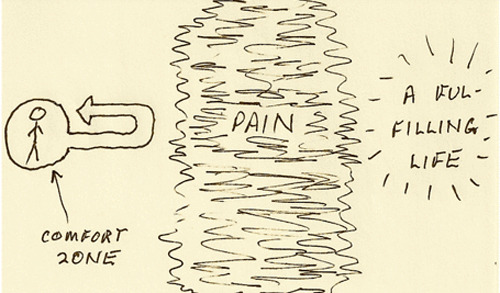
THE NEW YORKER: Barry Michels’s & Phil Stutz’ Therapy Drawings
See also: “Opportunity is missed by most people because it comes dressed in overalls and looks like work.” -Thomas Edison.
THE NEW YORKER: Barry Michels’s & Phil Stutz’ Therapy Drawings
See also: “Opportunity is missed by most people because it comes dressed in overalls and looks like work.” -Thomas Edison.
4. Obsessiveness is a powerful solution for physical and social problems. Unfortunately it’s also a major cause of emotional problems.
9. Your mind ages at a slower rate than you expect when you’re young, your body at a faster rate.
40 Things I Learned in My First 40 Years – Bryan Caplan | EconLog
People just wait for you to grow up and do the right thing. They’re just waiting for you to participate in the improvement of your life as a human being. When are you going to do it?
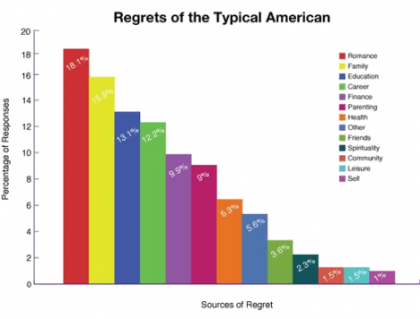
Regrets of the Typical American. And I like this bit from the abstract of the study: “inaction regrets lasted longer than action regrets”.

Woody Guthrie’s New Year’s Rulin’s, 1942. (via). See also Johnny Cash’s to-do list and David Foster Wallace on the philosophical depth of country music.
- Work more and better
- Work by a schedule
- Wash teeth if any
- Shave
- Take bath
- Eat good – fruit – vegetables – milk
- Drink very scant if any
- Write a song a day
- Wear clean clothes – look good
- Shine shoes
- Change socks
- Change bed clothes often
- Read lots good books
- Listen to radio a lot
- Learn people better
- Keep rancho clean
- Don’t get lonesome
- Stay glad
- Keep hoping machine running
- Dream good
- Bank all extra money
- Save dough
- Have company but don’t waste time
- Send Mary and kids money
- Play and sing good
- Dance better
- Help win war – beat fascism
- Love Mama
- Love Papa
- Love Pete
- Love everybody
- Make up your mind
- Wake up and fight
When I was younger I developed what I called the Baseball Theory of life. At that point the average life expectancy was something like 72 years. If you divide that by nine, it’s eight years an inning. Once you turn 32 you’re in the top of the fifth inning. At 36 you’re in the bottom of the fifth. It’s an official game at that point. You can’t mess around any more.

Via mhsteger, a few of Sydney Smith’s prescriptions for low spirits, from a February, 1820 letter to Lady Georgiana Morpeth:
6th. See as much as you can of those friends who respect and like you.
7th. And of those acquaintances who amuse you.
11th. Don’t expect too much from human life—a sorry business at the best.
14th. Be as much as you can in the open air without fatigue.
15th. Make the room where you commonly sit gay and pleasant.
17th. Don’t be too severe upon yourself, or underrate yourself, but do yourself justice.
18th. Keep good blazing fires.
I’ve come back to read this several times over the past couple weeks. (via)
Abandon resolutions. Stop looking for a soulmate. Reject positive thinking | Science | The Guardian
Besides, I am destined to perish, definitively, and only some instant of myself can survive in him. Little by little, I am giving over everything to him.
Besides, I am destined to perish, definitively, and only some instant of myself can survive in him. Little by little, I am giving over everything to him.
Life gets a lot easier when you give up being outwardly sad about anything.
Life gets a lot easier when you give up being outwardly sad about anything.
I bet we all in this room live about the same. We eat about the same and sleep about the same. We pretty much drive a car for 10 years. All this stuff doesn’t make it any different. I will watch the Super Bowl on a big screen television just like you. We are living the same life. I have two luxuries: I get to do what I want to do every day and I get to travel a lot faster than you.
Hang around people who are better than you all the time. You do pick up the behavior of people who are around you. It will make you a better person. Marry upward. That is the person who is going to have the biggest effect on you. A relationship like that over the decades will do nothing but good.
How much have I changed? Andy McKenzie and Ben Casnocha wrote recently about the wisdom of former selves. Their posts reminded me of a note I jotted down the other day:
Things that, while I was in college, I wish I’d had/made more time to learn about: film, psychology, business, economics.
Things that, since college, I’ve found myself learning more and more about, without applying any special focus: film, psychology, business, economics.
Which relates to another note-to-self from a few weeks ago:
Some careers I considered, ages 5-15: archaeologist, carpenter, National Geographic explorer, SWAT team, writer, conductor.
Plus ça change… I would, for the most part, still have interest in certain aspects of these (maybe even the whole thing). Discovery, craft, research, suspense, mastery, performance. And over the past few weeks I’ve spent some time re-reading my journals from previous long hikes and travel. It’s both amusing and a little frustrating that some of the same ideas that consume me now popped up 1, 3, 5, 10 years ago. Or some of the really funny and observant things I wrote could have been written yesterday. As Andy writes:
It’s harder to construct a personal narrative of growth when the sentences showing that you used to be just as sweet remain visible.
Just makes me wonder if I’m really changing that much (do I want to?), or if I’m just becoming more like me. The metaphor that comes to mind is like when you’re downloading a large image file, and it gradually becomes less and less pixelated. Same Mark, more data, more detail.
After us they’ll fly in hot air balloons, coat styles will change, perhaps they’ll discover a sixth sense and cultivate it, but life will remain the same, a hard life full of secrets, but happy. And a thousand years from now man will still be sighing, “Oh! Life is so hard!” and will still, like now, be afraid of death and not want to die.
Happiness and the right to pursue it are sometimes wildly unrealistic as ideals; and, because wildly unrealistic, unconsciously self-destructive.
Interesting essay with some good tidbits. This bit on pathologies could also apply, more mildly, to how we react to differing opinions:
We tend to pathologise the forms of happiness we cannot bear.
And on education:
There are, for example, only two reasons for children to go to school – apart, that is, from acquiring the werewithal to earn a living: to make friends, and to see if they can find something of absorbing interest to themselves.
Happy endings in life, and in fiction too perhaps, are really about where you decide to roll the credits.
Ars longa, vita brevis, occasio praeceps, experimentum periculosum, iudicium difficile.
 Mark Larson