I read an interview with Tom Waits, around the time of his album “Rain Dogs,” in which he talked about how you come to a point on an instrument where you have to stop playing it and find another instrument that you don’t know what you’re doing with. Part of songwriting is having that naïve excitement about not quite realizing why you’re getting off on it, because you haven’t had time to pull it apart yet. Songwriting relies on not pulling things apart: the best ideas are the simple ideas.
Tag: interview
Paris Review – The Art of Nonfiction No. 3, John McPhee
Great interview. McPhee says gathering facts and writing nonfiction (as opposed to more self-generated fiction stuff) is like going from the grocery store to the kitchen:
I always say to my classes that it’s analogous to cooking a dinner. You go to the store and you buy a lot of things. You bring them home and you put them on the kitchen counter, and that’s what you’re going to make your dinner out of. If you’ve got a red pepper over here—it’s not a tomato. You’ve got to deal with what you’ve got. You don’t have an ideal collection of material every time out. […]
Once I’ve written the lead, I read the notes and then I read them again. I read them until they’re coming out my ears. Ideas occur, but what I’m doing, basically, is looking for logical ways in which to subdivide the material. I’m looking for things that fit together, things that relate. For each of these components, I create a code—it’s like an airport code. If a topic is upstate New York, I’ll write UNY or something in the margin. When I get done, the mass of notes has some tiny code beside each note. And I write each code on an index card.
That’s laying it all out where he can look at it. It’s a technique he got from his high school writing teacher. One cool thing he found is that when you get the structure set, you can let the juxtapositions do some storytelling for you. In Encounters with the Archdruid, for example:
The whole book had thirty-six components. What I ended up with was thirty-six three-by-five cards, each with a code word. Some of these things are absolutely dictated by the story of the journey down the Colorado River. But the choices are interesting where it’s not dictated, like the facts of David Brower’s life.
I knew where I was going to start, but I didn’t know the body of the thing. I went into a seminar room here at the university, and I laid the thirty-six cards out on the table. I just looked and looked at them. After a while I was looking at two cards: Upset Rapid, which is a big-time rapid in the Colorado River, and Alpinist. In Upset Rapid, Brower doesn’t ride the rapid. Why doesn’t he ride the rapid? His answer to Floyd Dominy is, “Because I’m chicken.” That’s a pretty strong scene. What next? Well, there are more than seventy peaks in the Sierra Nevada that were first ascended by David Brower, hanging by his fingernails on some cliff. “Because I’m chicken”? This juxtaposition is just loaded with irony, and by putting the Alpinist right after Upset Rapid, in the white space between those two sections there’s a hell of a lot of stuff that I don’t have to say. It’s told by the structure. It’s all crackling along between those two things. So I put those two cards side by side. Now there are thirty-four other parts there on the table.
Paris Review – The Art of Poetry No. 30, Philip Larkin
I think a young poet, or an old poet, for that matter, should try to produce something that pleases himself personally, not only when he’s written it but a couple of weeks later. Then he should see if it pleases anyone else, by sending it to the kind of magazine he likes reading. But if it doesn’t, he shouldn’t be discouraged. I mean, in the seventeenth century every educated man could turn a verse and play the lute. Supposing no one played tennis because they wouldn’t make Wimbledon? First and foremost, writing poems should be a pleasure. So should reading them, by God.
You’re probably better off if you can tolerate, or even enjoy, your own mediocrity as long as it takes to get something made. What’s obvious to you could be amazing to others. And fortunately, whether it’s good or bad, joy’s soul lies in the doing.
Nowadays, while literary men seem to have neglected their epic duties, the epic has been saved for us, strangely enough, by the Westerns.
Jodie Foster goes to college :: rogerebert.com
I don’t see myself getting married much before I’m 26. I won’t have the time, and, besides, I’m not mature enough to be nice to anyone else. I like being alone, without anyone to bother me. What if I got married to someone who wouldn’t let me lock myself in my room for six days and read?
I ain’t that particular. Between Scotch and nothing, I’ll take Scotch.
All Paris Review Interviews Now Online (!!!)
This is fantastic:
To mark the debut of Lorin Stein’s first issue of The Paris Review, the publication has put its entire interview archives online….Moreover, they’ve replaced the old PDF format with normal HTML pages, meaning that they can be Instapapered or Apple-Fed for those in a rush to find the secrets of good writing (e.g. find all: “ideas,” “where do you get them”).
Vonnegut, Larkin, Burroughs, Williams, Amis, Baldwin, Barthelme, Maxwell, Allen, Calvino, Wilder, Karr, Ryan, Tate, Crumb…
Oh, my stars and garters. Where to begin?
Frank Sinatra Has a Cold – Esquire
“Ava didn’t want Frank’s men hanging around all the time,” another friend said, “and this got him mad. With Nancy he used to be able to bring the whole band home with him, and Nancy, the good Italian wife, would never complain – she’d just make everybody a plate of spaghetti.”
Adam and I visited the wonderful public radio program (and podcast) The Marketplace of Ideas, and they’ve just posted the show. A lot of in-depth talk both about our philosophies of dress and about the behind-the-scenes of Put This On.
My favorite idea from this interview: style qua semiotics.
Interview with William Gibson – Viceland Today
What we call terrorism is always asymmetric warfare. You’re a small group with no reputation, and you start covertly blowing up or murdering the people of a big group, like a government or a nation-state or a whole race. And you can’t just do it and then go and do the next one. You have to do it, and then go and do your PR. “We just bombed your mall. It was us.” And then maybe you do it, and some other guys, these upstart assholes across town, are calling up the news and saying, “We did it! We bombed the mall!” So then you have to get your PR guy on the phone and say, “No, they’re full of shit. WE bombed the mall.” So it’s about branding to that extent.
Slaughterhouse 90210: Where high meets low | Jacket Copy | Los Angeles Times
TMR: An Interview with George Saunders
George Saunders in a wonderful, wonderful interview.
Success is nice because then you don’t have to worry so much about having been unfairly robbed of your very richly deserved success. Success is bad because momentary good fortune can temporarily hide the fact that you are still, despite your success, full of shit.
So much good stuff here:
Interviewer: So much of your fiction is charged with social import. Given our recent political upheavals, have you ever thought of writing overt political satire?
Saunders: I’m not very interested in that kind of satire because it works on the assumption that They Are Assholes. Fiction works on the assumption that They Are Us, on a Different Day.
And:
Any mastery you can achieve in writing is totally personal and incredibly nuanced. It’s a sort of antimastery, feeling comfortable with being unsure.
And also:
One of the wonderful benefits of energetically pursuing a writing career is that I’ve come to understand the staggering limitations of my abilities. […] So one way I cope with this humbling state of affairs is via a little mantra: If I just stay fully engaged in whatever has presented itself, things will be fine. That is, I try not to think about things like: Next, I begin MY NOVEL!
Art really saved my life because art is how I proved that I wasn’t a malingerer.
15th Anniversary: The Brian Eno Evolution
What do people want from Art? I don’t know the full answer, but one thing I’m increasingly sure of is that they want life. They want the sense that there is something going on, that something real and exciting and of its moment has been captured […]
In an age of digital perfectibility, it takes quite a lot of courage to say, “Leave it alone” and, if you do decide to make changes, quite a lot of judgment to know at which point you stop. A lot of technology offers you the chance to make everything completely, wonderfully perfect, and thus to take out whatever residue of human life there was in the work to start with. […] It’s a misunderstanding to think that the traces of human activity — brushstrokes, tuning drift, arrhythmia — are not part of the work. They are the fundamental texture of the work, the fine grain of it.
The Wrong Stuff: On Air and On Error: This American Life’s Ira Glass on Being Wrong
It kind of gives you hope. If you do creative work, there’s a sense that inspiration is this fairy dust that gets dropped on you, when in fact you can just manufacture inspiration through sheer brute force. You can simply produce enough material that the thing will arrive that seems inspired.
The Wrong Stuff: On Air and On Error: This American Life’s Ira Glass on Being Wrong
The Wrong Stuff : Hoodoos, Hedge Funds, and Alibis: Victor Niederhoffer on Being Wrong
It’s terrible to be a bad loser. I like Soros’s proverb that you should never marry a woman you wouldn’t want to divorce.
The Wrong Stuff : Hoodoos, Hedge Funds, and Alibis: Victor Niederhoffer on Being Wrong

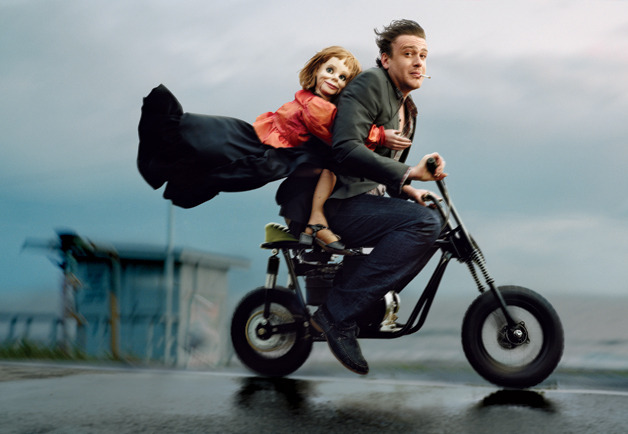
This is a surprisingly great interview with Jason Segel (via Austin). My favorite bit:
I had two friends in high school who sort of showed me how a piano works. And I just spent two years being terrible at it until I was good at it. That’s just me. There’s no way I’m actually intrinsically talented at writing, acting, playing music, puppeteering. It’s that I’m willing to be shit at them for a while, until I’m good at them.
Interview with Joyce Carol Oates | Arch Literary Journal
Who knew Joyce Carol Oates was a runner? On how running and dreaming are alike:
I think that when we’re stationary, we have a somewhat thickened sense of the ego or the “I,” and we’re just sort of self-conscious and aware of ourselves. But when we’re in motion, or when we’re in a dream, the “I” entity starts to dissolve. Some people, including myself, and possibly you, are capable of having dreams in which your own personality is really almost dissolved. You know, way, way down in the depths of the ocean there are creatures that are transparent. They’re like jellyfish, a lot of very transparent creatures. And I was thinking it’s almost analogous to the human experience of sleep, where when you’re really, really deep into sleep, your own physical self is often not even there. It’s like you’re transparent. And, it may be a process that we just will never understand, descending somehow deep into the primitive brain – like the brain almost at the brain stem – and away from the consciousness. And, somehow running replicates that, I think. I would think that if you were running very fast, if you were in an instinctive situation where you were terrified – say you were being pursued, and your life was in danger – you would be flooded with adrenaline. I would think probably the “I” or ego was almost gone, that you’re just running like a physical entity, the way a soldier might just start [running], or a boxer, or someone like that. But when you’re writing, there’s … as I say, we have this more thickened or more solid sense of the self, because it’s usually in some stationary situation with social definitions.
I’m a typical American. Half of me is dying to give myself away, and the other half is continually rebelling.
It seems to me that making escapist films might be a better service to people than making intellectual ones and making films that deal with issues. It might be better to just make escapist comedies that don’t touch on any issues. The people just get a cool lemonade, and then they go out refreshed, they enjoy themselves, they forget how awful things are and it helps them—it strengthens them to get through the day. So I feel humor is important for those two reasons: that it is a little bit of refreshment like music, and that women have told me over the years that it is very, very important to them.