Colin Marshall on Creative Community from Colin Marshall on Vimeo.
Colin Marshall on Creative Community. In which I continue to admire Colin’s thoughtfulness and wonder when his film based on an awesome Borges story is gonna drop.
Colin Marshall on Creative Community from Colin Marshall on Vimeo.
Colin Marshall on Creative Community. In which I continue to admire Colin’s thoughtfulness and wonder when his film based on an awesome Borges story is gonna drop.
A really, really good episode about the business of hip hop from the beginnings to now. Worth a listen/read.
Dan Charnas, Author of The Big Payback: Interview on The Sound of Young America
I used to beat up all the kids on the block. I used to confiscate their marbles, snatch them up!
It’s a very odd thing with Hollywood, where you do stand-up, you’re good at it, then they go, “How would you like to be a horrible actor?” Then you say, “All right, that sounds good. I’ll do that.” So I’m fucking excited about not having to pretend to know what I’m doing with acting.
Also:
I love abandoning shit, because I don’t like doing shit over and over and over. I’ve thrown so many jokes away. First of all, I’m not a good enough performer to pretend that “I just thought of this,” that kind of shit. It’s saying the same word over and over again, it loses its fucking meaning. Also, generally I don’t like traveling around saying the exact same thing. I don’t think that’s a very good thing to do with your life.
And also:
I don’t really care about success or money or shit. I could give a fuck. I hate fame. I hate being recognized, because I don’t know how to talk to people. I see Sandler, man, and I’m like fuck, goddamn, I don’t know how he does it, those people are fucking everywhere he walks. If you’re walking with him, all you hear behind is people whispering. It’s almost like being fucking stoned, or a paranoid schizophrenic or something, where you think people are talking about you, but they actually are talking about you. It’s fucking surreal.
What you want to do is build the people up. You start ‘em off and you give them this first half, and their feet, and next thing they got their heads goin’, and the next thing they got their mouths open and they’re yellin’ and they’re screamin’. It’s a great feeling when you can have your audience get involved with you […] where everyone can jump in and have a real good time. “What’d I Say” is my last song onstage. When I do “What’d I Say,” you don’t have to worry about it — that’s the end of me. There ain’t no encore, no nothin’. I’m finished!

Dust-to-Digital: “Goodbye” to Obscurity – PURGE. Good interview with the Dust-to-Digital folks.
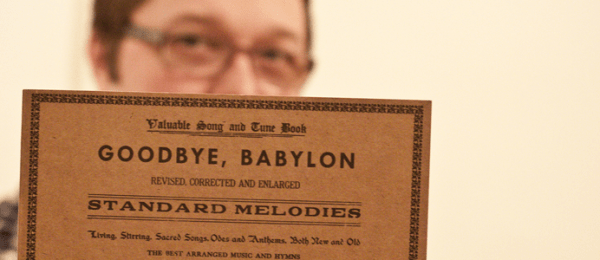
Neil Young was on Weekend Edition saying that Bob Dylan gave him a copy [of Goodbye, Babylon]. That actually freaked me out more than the Grammys. I almost fell on the floor.
I think painters and sculptors react to music, more naively, in a sense, because their politics are a lot different from our politics. It’s very hard for one composer to listen to another composer without somehow bringing his own mind-set to the music he’s listening to. It’s not that it’s impossible. And that’s only natural, whereas someone in another art field is going to listen to it very naively, in a sense (you hope), and that’s a worthwhile, unbiased opinion. Ultimately, it’s a naive opinion that rules the roost.
Love has never failed. It has won every battle. And today and forever more it will go on undefeated.
You should just sit down, there should be a bottomless thing of chips and really good salsa and then your meal starts. This whole thing about sitting down and ordering chips and salsa and paying $5.00 for it is insane.
This interview is packed with wonderful tidbits. James Hetfield on day jobs and the early tour routine:
We worked at day jobs. After that, we’d throw parties, take the furniture out of the house and smash the joint. We smashed dressing rooms just because you were supposed to. Then you’d get the bill and go, “Whoa! I didn’t know Pete Townshend paid for his lamp!” Come back off the tour and you hadn’t made any money. You bought furniture for a bunch of promoters.
Hetfield on growing up differently from Lars Ulrich:
I could afford maybe one record a week, and he would come back from the store with 20. He bought Styx and REO Speedwagon, bands he’d heard of in Denmark. I would go, “What the fuck? Why did you buy Styx?“
Kirk Hammett on Hetfield’s Nothing Else Matters:
All I could think of at the time was, James wrote a fucking love song to his girlfriend? That’s just weird.
Hetfield on alcohol abuse and parenthood:
You can’t be hung over when you got kids, man. “Dad, get the fuck off the couch!” Well, they don’t say that—yet.
Ulrich on Matt Damon:
PLAYBOY: Your wife, Skylar, used to date Matt Damon, and he made her the model for the female lead in Good Will Hunting. A few years ago, Matt described you as “a fucking rock star who’s got $80 million and his own jet—a bad rock star, too.”
ULRICH: He said that before we met. And he’s apologized about a hundred times. The first five times I saw him, he would spend 10 minutes apologizing profusely. He really is a sweetheart.
Ulrich on collecting art:
Hanging out backstage with Kid Rock is an amazing turn-on, no less so than sitting and staring at my Dubuffet for an hour with a fucking gin and tonic.
On the first tour through America, my spandex—I fucking hate saying, “my spandex”. It’s a pretty evil phrase.—They were wet from the night before, and I was drying them by the heater. A big hole melted right in the crotch. It was like, “They’re like pantyhose.” I just opted to keep my jeans on, and that was the best thing that ever happened.
When I open my mouth, most of the time something somewhat eloquent comes out, and once in a while I talk a bunch of fucking bullshit. I’m aware of that.
An interview is a halfway point between a psychoanalytical sitting and a competitive examination.
This interview is packed with wonderful tidbits. James Hetfield on day jobs and the early tour routine:
We worked at day jobs. After that, we’d throw parties, take the furniture out of the house and smash the joint. We smashed dressing rooms just because you were supposed to. Then you’d get the bill and go, “Whoa! I didn’t know Pete Townshend paid for his lamp!” Come back off the tour and you hadn’t made any money. You bought furniture for a bunch of promoters.
Hetfield on growing up differently from Lars Ulrich:
I could afford maybe one record a week, and he would come back from the store with 20. He bought Styx and REO Speedwagon, bands he’d heard of in Denmark. I would go, “What the fuck? Why did you buy Styx?“
Kirk Hammett on Hetfield’s Nothing Else Matters:
All I could think of at the time was, James wrote a fucking love song to his girlfriend? That’s just weird.
Hetfield on alcohol abuse and parenthood:
You can’t be hung over when you got kids, man. “Dad, get the fuck off the couch!” Well, they don’t say that—yet.
Ulrich on Matt Damon:
PLAYBOY: Your wife, Skylar, used to date Matt Damon, and he made her the model for the female lead in Good Will Hunting. A few years ago, Matt described you as “a fucking rock star who’s got $80 million and his own jet—a bad rock star, too.”
ULRICH: He said that before we met. And he’s apologized about a hundred times. The first five times I saw him, he would spend 10 minutes apologizing profusely. He really is a sweetheart.
Ulrich on collecting art:
Hanging out backstage with Kid Rock is an amazing turn-on, no less so than sitting and staring at my Dubuffet for an hour with a fucking gin and tonic.
On the first tour through America, my spandex—I fucking hate saying, “my spandex”. It’s a pretty evil phrase.—They were wet from the night before, and I was drying them by the heater. A big hole melted right in the crotch. It was like, “They’re like pantyhose.” I just opted to keep my jeans on, and that was the best thing that ever happened.
When I open my mouth, most of the time something somewhat eloquent comes out, and once in a while I talk a bunch of fucking bullshit. I’m aware of that.
We have a limit, a very discouraging, humiliating limit: death. That’s why we like all the things that we assume have no limits and, therefore, no end. It’s a way of escaping thoughts about death. We like lists because we don’t want to die.
And also:
I was fascinated with Stendhal at 13 and with Thomas Mann at 15 and, at 16, I loved Chopin. Then I spent my life getting to know the rest. Right now, Chopin is at the very top once again. If you interact with things in your life, everything is constantly changing. And if nothing changes, you’re an idiot.
I just love musicians. They’re not all super-happy all the time, but when they’re playing they’re happy, and it’s such a beautiful thing. I also like them because they sleep late in the morning; they’re more like children.