High Plains Drifter

High Plains Drifter. This is one of those movies where you have to remember that the protagonist doesn’t always reflect the values of the real, actual live human being director. Here, the Stranger kills three guys and rapes a woman within, oh, 10-15 minutes. It’s not the most subtle movie you’ll ever see. Honestly, I finished this one out of a sense of obligation and curiosity because I love westerns and I love Clint Eastwood. This was the second movie he directed, after Play Misty for Me. Aside from a few excellent parts here and there, this one is more enjoyable when reading and thinking about it after you’ve watched it than while actually watching. It doesn’t all hold together so well. Comparing this to his directing work in the 1990s and 2000s is like night and day. That said, objectively awesome bits include a great opening mirage entrance scene, a spooky, eerie score that would fit right in with a horror or 1950s scifi movie, and the tough guy one-liners. Speaking of tough guys, I really need to make some time for the Dirty Harry flicks…

Blue Valentine

Blue Valentine. My first reaction: it’s a snuff film. My second reaction: it’s not entertainment. Which is right and wrong. Tragedy isn’t fun, but it is appealing in that train-wreck-in-slow-motion kind of way. The shifting back and forth in time lets you see, in parallel, their courtship (including a falling-in-love montage I will lazily/accurately describe as “cloyingly indie”) and their crumbling. Nice to see signals of their growing union fall into place (e.g., She starts wearing his jacket. One tune played is later revealed to be “their song” from back in the day. Etc.). Ebert observes wisely: “Dean thinks marriage is the station. Cindy thought it was the train.”

Mystic River

Mystic River. Great movie. Dang. I was immediately convinced this one would be worth it. On the surface it’s a whodunnit crime thriller kind of thing, but by the end it’s beside the point. It’s about hurt and healing, history and fate. My respect for Clint Eastwood grows with every film I watch. My overall impression is that he just seems to use his time really well, which is not a small compliment. I also realized during the movie that the score was recognizably Eastwoodian–I hadn’t known he wrote it before I started watching, but it’s definitely got his touch there, too. And I can’t not mention the kickass cast that kicks ass like you think they would: Penn, Robbins, Bacon, Fishburne, Linney. Good stuff.

My updated rankings for Eastwood’s directing:

  1. Unforgiven
  2. Gran Torino
  3. Million Dollar Baby
  4. Mystic River (or maybe one ranking higher, not sure)
  5. The Outlaw Josey Wales
  6. Changeling
  7. Play Misty for Me
  8. Bird
  9. Midnight in the Garden of Good and Evil

I think I’ve seen more movies directed by Eastwood than anyone except for Hitchcock (also 9 movies) and Spielberg (20-something!). Buster Keaton and Tim Burton come in at 6 and Martin Scorsese and Christopher Nolan at 5, if I’m remembering correctly. Can’t think of anyone else with more than 4 right now.

Drive

Drive. I liked it about as much as I liked the book, which is to say it’s a damn fine way to pass a couple hours. Excellent opening scene, then putters just slightly. Much slower, quieter than I expected but the supporting cast keeps it alive. It’s like a lot of film noir in that way – much of the movie’s momentum is from the hero cornered, reacting to other people’s plans. Interpretive tip: it’s not about driving cars. Good soundtrack. The movie wouldn’t be the same (wouldn’t be possible?) without it. Gosling’s role makes me think of Eastwood’s roles as the Man With No Name and William Munny, and Delon’s in Le Samouraï and a little bit of Clooney’s in The American.

Ivan’s Childhood

Ива́ново де́тство (Ivan’s Childhood). This was my second TarkovskySolaris was amazing. This one is impressive, especially for his first film. It’s told non-linearly with occasional flashbacks, memories, dreams, and voiceovers creeping in. Ivan is a child orphan who, when we meet him, is doing recon/intelligence for the Soviets during World War II. This movie has a similar gritty take on the war that you find in The Cranes Are Flying. It’s less rhapsodic, but the black and white photography is just as ridiculously good. My favorites are the haunting nighttime scenes along the riverbanks and swamps, and the scenes in those Russian birch forests that are just impossible to make look bad. Criterion essay.

Changeling

Changeling. Man, Clint Eastwood has a steady hand. He will take his damn time and everything will be in its place. He even did the music. There’s no razzle-dazzle here, it’s just firm, reliable storytelling. I’m glad he didn’t go into the more lurid aspects of the story, focusing more on building your outrage and indignation. You only see one death in full and its impact caught me off-guard. Heavy stuff. Angelina Jolie is excellent. The only other Jolie films I’ve seen are one of the Tomb Raider films (ugh) and Mr. & Mrs. Smith (eehhhh), so this was a nice change.

My current rankings for Eastwood’s work as director:

  1. Unforgiven
  2. Gran Torino
  3. Million Dollar Baby
  4. The Outlaw Josey Wales
  5. Changeling
  6. Play Misty for Me
  7. Bird
  8. Midnight in the Garden of Good and Evil

Lots of good work there. Cf. Hitchcock.

The Naked Prey

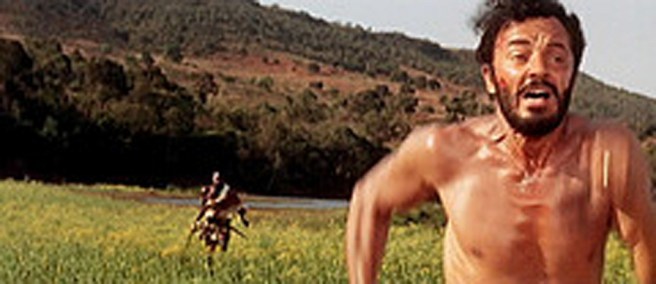
The Naked Prey. Speaking of chase movies stripped down to loincloths… This one was inspired by the true(ish?) story of John Colter’s escape from the Blackfeet in 1809, but it’s set in the African savannah somewhere. A safari trip goes wrong because the financial backer is a jackass and Cornel Wilde, the guide who’s been there enough to pick up a few languages, ends up running from the locals. It’s pulpy popcorn stuff, but there’s an interesting balance in how everything is portrayed. This is not the Africa with the sunsets and acacia trees and newborn knock-kneed giraffes. This is the dusty, thorny one with all the snakes. Neither hunters nor prey are acting all that honorably or dishonorably, they’ve just been reduced and everyone’s running on instinct and resourcefulness. Ebert didn’t like it much, for fair reasons that seem to related to having scene this kind of absurd stuff before, but I think that non-realistic ≠ non-enjoyable. The script could probably fit on a page or two. The soundtrack is almost entirely percussion. Plot aside, there’s some really great nature interludes that reminded me of how much I loved wildlife film when I was a kid.

The Seventh Seal

Det Sjunde Inseglet (The Seventh Seal). First time I’d seen anything from Ingmar Bergman. Strange reaction to this one: when I was watching it, I wasn’t swept away. It was good, shot beautifully, funnier than I expected, etc. etc. But afterward, I kept thinking about it, turning it over, remembering scenes. Those ideas of morality, religion, existence, fear, and vulnerability in a meaningless universe have some staying power. You can definitely see why Woody Allen loves his work. Allen recommends starting with this one, Wild Strawberries, The Magician, Cries and Whispers, and Persona.

Murder, My Sweet

I don’t know which side anybody’s on. I don’t even know who’s playing today.

Murder, My Sweet. Not excellent, not bad. Every new character brings a new complication to the story. Plenty of the snappy writing that you’d expect from Raymond Chandler. (Other film noir I’ve watched.)

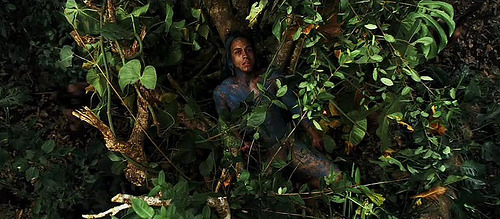
Apocalypto

Apocalypto. I got a kick out of this one. At its heart, it’s a chase movie, stripped down to loincloths. It did not at all feel like 140 minutes. Many thanks to the Battleship Pretension episode on Mel Gibson’s directing for spurring me to watch it.

If you’ve seen Braveheart or The Passion of the Christ, you’ll be prepared for the frequent, unsubtle graphic violence. I cringed a lot, but that’s okay. Actually, funny thing when I was watching, the violence actually got me curious about psychological health in ancient times. Given that levels of violence, trauma, and death were much higher than today, you have to wonder.

I’m not suggesting that this movie is historically accurate in any way. That’s very much beside the point, I think. Every movie set in the past gets something wrong. It’s just context, people. Not a documentary. I think that some folks have gotten up in arms about the depiction of the Mayans is actually kind of a bonus – it hasn’t really been explored on film, so they’d like to get it right. Understandable. The benefit for the viewer, accuracy aside, is that the novelty forces your attention. It’s all in Yucatec Maya language, so you have to keep your eyes on the screen for subtitles. Clothing and environment are novel. You probably don’t recognize any of the actors, so you can come to watch their performance without any expectations. When I watched Brief Encounter I had a similar reaction to an unknown-to-me cast:

One of the most enjoyable things about old/foreign movies is that I often don’t know the cast. It can feel more immediately immersive to see the characters as characters, rather than recognizing actors and trying to set aside that I know they’re portraying people. There’s no baggage, no expectations, no known quirks or ticks. It all feels very fresh.

Along the same lines, familiar scenes feel less loaded. There’s a slave-trading scene that’s somehow more touching because it’s Mayans selling Mayans, rather than whites selling blacks. Put a familiar, undeniable evil in a different cultural frame, and you feel it more powerfully, I think. You can’t bring your baggage as easily. I feel no hesitation in recommending this one.

Sex and the City 2

Sex and the City 2. DNF. There is some good writing in there, but there’s a sense of overstuffedness and improbability and awkward timing. It doesn’t feel SATC-y, from the season or so I’ve seen. I feel bad for the super-fans who got sucked into this one, and who will presumably still pay up for the third.

General Orders No. 9

General Orders No. 9. Man, what a frustrating movie. There’s one refrain that appears throughout the movie: “Deer trail becomes Indian trail. Indian trail becomes county road.” And so we have a history of Georgia, or part of it anyway. It’s about the march of time, progress, “progress”, cities, bygone ways, and maybe about struggling to suck it up and move on without forgetting where you came from or resenting what’s now around you. Recurring images include water towers, courthouses, cemeteries, rivers, lonely trees in open fields, interstates, damp southern forests. Visually, it’s like 70 minutes of (what in many other films would be used for) b-roll and pillow shots, but a lot of it is beautiful.

There’s narration sprinkled throughout, with sets of lonely sentences bookending the sections of the movie. I feel like maybe he could have used an editor for both text and image. Would that rob it of its deeply personal heart and soul? Maybe. (I also got to wondering at one point if I would like the narration even less if he didn’t have a southern accent. It’s what I grew up around, so there will always be a soft spot. I would not be surprised if the words sounded more crude or banal in another voice.) The title refers to Lee’s Farewell Address, by the way.