Bronson

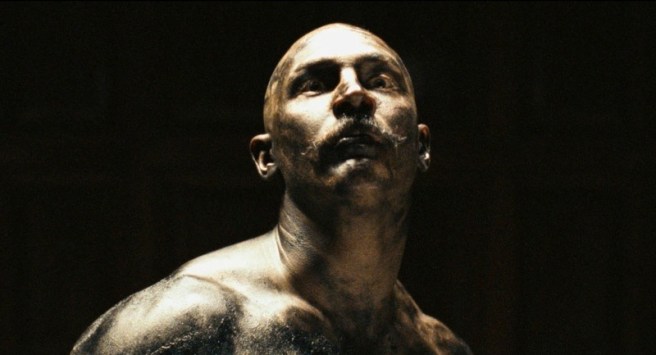
Bronson. It’s an oddball comedy-horror character portrait, goofier and more stylized than I expected, e.g. the frequent juxtaposed opera in the soundtrack. My respect for Tom Hardy keeps growing. Refn really has a thing for these violent loner types. Hunger is a very, very different look at a UK prison experience that’s worth seeing.

Frances Ha

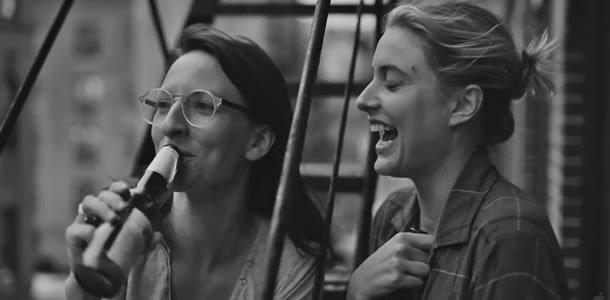
Frances Ha. I loved it. We’re all incomplete; this is about filling in the gaps. The way it treats deep friendship is so rare in movies. There’s a great California interlude with family that underscores the theme. Home can be so comfortable, but we leave it and we have to figure out how to find that support elsewhere. Other things I liked: Gerwig has a delightfully expressive face, and great timing. I thought the script was funny and loose – it didn’t feel have the volleyball bump-set-smash rhythm to the jokes, just kept rolling along through the bad ones and the good ones. And a good bit of the humor is cinematic, based on a cut/juxtaposition, or underscored with music and a lingering camera. The black-and-white photography and marvelous bursts of music throughout bring to mind Woody Allen + French New Wave. It doesn’t feel like an homage, but it’s similarly joyful. Good flick.

Valhalla Rising

Valhalla Rising. I wonder if, seen in a different state of mind, I would call this brooding rather than plodding. So much slow motion and silence, which is punctuated by some astounding brutality. There are hints at good things, but just didn’t do it for me. I’m trying to catch up on the Refn filmography before Only God Forgives, and I definitely have to recommend Drive over this one.

Fast Five

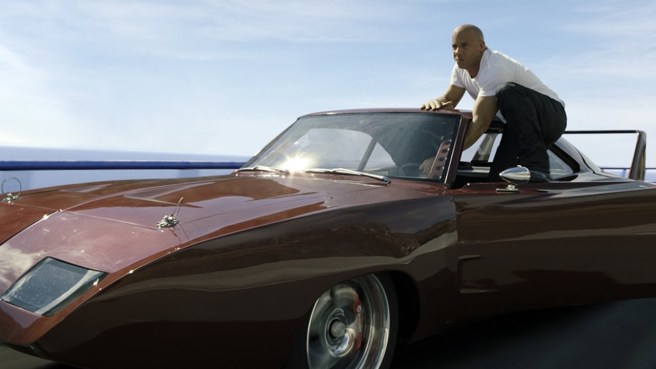
Fast Five. My, my. This franchise has gone a long way from where it started. I’m struggling to keep up. More is more, but also more is not more. The movie warms up with bus-jacking followed by a high-speed train robbery. Street races feels so quaint in comparison. But it also means this movie doesn’t feel as idiosyncratic as the earlier ones in the series, and there’s more standard-fare crude language, violence, vulgarity. Exploding toilets? Come on, guys. Although, there was one scene where Walker had this goofy, exhilarated smile and just seemed so happy to be at the heart of all the destruction, and I’m like, yeah, I get that. The final tow-chase was legit.

This one also has the undeniable joy of a cast reunion and team chemistry. It’s heist time! (Downside: Sorkin-style teamsplaining the plot, and the inevitable camera that rotates around the planning table at HQ.) And alas, I couldn’t help but let out a resigned sigh when I saw the team’s bundle of new gadgets and spy-tech. Vin Diesel seems to have acquired superhuman strength, and a new rival in the no-nonsense fast-talking Dwayne Johnson (hints of TLJ in The Fugitive), and they get in a fight that’s not very interesting.

The family/togetherness theme was more upfront in this one than the others. “Money will come and go. We know that. But the most important thing in life will always be the people in this room.” And earlier, “Promise me we stick together.” It made me remember back to Tokyo Drift: “I have money. It’s trust and character I need around me. You know, who you choose to be around you lets you know who you are.” With that in mind, I think that’s why some of the best tension of the franchise isn’t in this film: for the most part, they’ve staked out their loyalties and they don’t have to wrestle with them very much.

Two last notes: One, I was disappointed to hear a greater reliance on fairly standard orchestral scores; I remember the earlier movies having more song-based soundtracks that were connected with locale. And two, I love how they did the subtitles, floating and fading out on the screen instead of hugging the bottom edge. Small touch, but it’s cool that they took the time to make it cool.

Fast & Furious

Fast & Furious. Decent. Most franchises don’t stay strong after three movies. It’s definitely grown up: multi-national settings, gratuitous helicopter flyover shots, fancier locations, and pretty fireball explosions among the big-budget must-haves. The obvious CGI in the tunnel scenes was a bit of a letdown. The races more frenetic and choppy; the crashes were definitely more… comprehensive. I was also thinking this is first in the series that’s felt wholly like a work of the 2000s. Even has teal and orange in full force, along with some shaky-cam here and there. Good to see Vin Diesel back in a bigger role here, though sometimes it seems like he’s following instructions or something. Gotta like him, though. I also really, really enjoy John Ortiz as a villain. So good. He has a knack for balancing the malice and the charm without turning into a sideshow (see also his role in Miami Vice). I don’t think the music is as strong as in the previous three. Also, border crossings and expendable, replaceable labor force? Where have I heard that before? Final thought: I’d love to know how many times in movie history there’s been a woman/man/couple carrying groceries into a house, unloading in the kitchen, and then devolving into an argument/outburst/tears/etc. It’s movie boilerplate.

I’m now four deep into the F&F franchise. My top and my bottom picks are pretty secure, but for the middle ones, right now I think I’d rank them like…

  1. The Fast and the Furious: Tokyo Drift
  2. The Fast and the Furious
  3. Fast & Furious
  4. 2 Fast 2 Furious

The Fast and the Furious: Tokyo Drift

The Fast and the Furious: Tokyo Drift. Now we’re getting somewhere! Better than the first, way better than the second. I like how the physical/technical strain of the driving is more evident. Definitely a contrast with the delinquent joyride thrills of the second movie. And the change to mostly night-time, dense, urban driving makes for all kinds of crazy lighting and colors that gives the restless camera more to ogle. The two opposing father-son stories work. One son rebellious, one obedient. A possibly inadvertent dramatic bonus: what with the setting not being conducive to reckless gun-play in the streets, the few times when a gun is drawn are a bit more potent. Great job on audio across the board. Also, the scene with Neela driving is reminiscent of Toretto’s “10 seconds” monologue, but it also instantly made me think of the balcony scene in Heat.

2 Fast 2 Furious

2 Fast 2 Furious. Not as good as the first one, bro. Seemed more exploitative, more dopey, more juvenile. Tyrese is funny and charismatic, whereas Paul Walker’s performance reaches new levels of… subtlety (Ebert perfectly describes him as Don Johnson lite). BUT, those chases are fun. Nice to see them driving in legitimate traffic this time around. Also: Luda + Eva Mendes. Out of Sight and Miami Vice are far better Miami movies. I still haven’t seen either of the Bad Boys films, unfortunately.

The Fast and the Furious

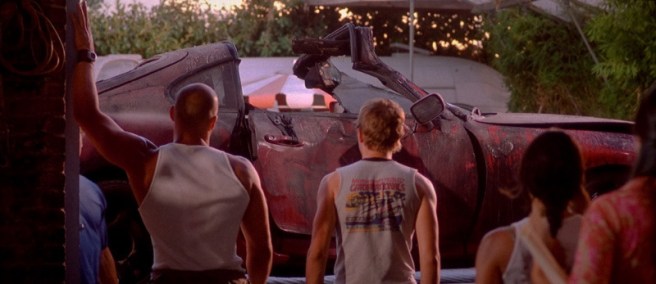
The Fast and the Furious. Almost exactly what I was expecting. One surprise, though: I figured there would be some fun, gratuitous style flourishes, but didn’t think it would be so cinematically interesting. The way they edited the racing scenes, the warps and perspective shifts, reminded me of the welding scene in Thief. It goes from a more neutral third-person observer perspective into this subjective-experience interpretive moment. Nicely done. It’s not high drama, but credit for making some gestures towards character-building, even though that’s not the point. And there’s a fun soundtrack. Two-Lane Blacktop is another good movie with itchy street racers.

Girl Rising

Girl Rising. Got suckered into seeing this two-hour commercial. Some vignettes are better than others (depending on the spunk of the girls and the writers’ adaptation), but some seemed a dangerous mix of exploitative and/or pandering. And the didactic interludes just grate after a while. Like, say, a Michael Moore film, I’m not sure that anyone who agrees really needs to see it, no one who disagrees (and who might that be?) will be persuaded.

Days of Heaven

Days of Heaven. Third viewing (first, second). I don’t typically use words like “rapturous” or “transfixed”, but I feel like I need to here. I just sit there slack-jawed for 90 minutes. I don’t know how you can make a biblical, romantic prairie drama have such momentum. This is the first Terrence Malick movie I ever saw, and I still think it’s his best. I have to keep it in my top three, up there with Out of the Past and Heat.

Upstream Color

Upstream Color. The speculative hook is a strange cycle of events driven by some sort of parasite, I guess. A microbe that seems to enhance empathy or connection in all of its hosts. And you can interpret the rest in about seven million ways. I’m thinking: identity and self-construction. The first half-hour or so, with the thief, is just perfectly tense. Interesting that the personal resolution at the end of the story is misplaced justice. We don’t always know better. Oh, and there’s one scene, when the heroine is waking up, where the image and sound are so well-executed you kinda want to yawn and stretch, too. I didn’t like this one as much as Primer, but I will continue to support and hold out hope for more good, weird movies. Shane Carruth knows his stuff.

Primer

Primer. It was early on in the film when I stopped trying to understand the technical details. Just let it ride for now and watch it again soon. Very cool movie. There’s a fine line in (many genres but especially in) science fiction where budgets force decisions about how you show crazy things. I love seeing the conservative work-arounds. You reduce the spectacle so you can preserve the speculative heart of the thing. This not all science fiction, though. There’s a good human core about invention, entrepreneurship, risk, paranoia, trust, etc. Looking forward to seeing Shane Carruth’s Upstream Color this week.

The Goonies

The Goonies. A friend had never seen it, so we had to correct that. I remember a period of my life where I watched this every afternoon for a couple weeks straight, and knew that, any day now, I’d have an adventure, too. It still holds up. I certainly miss the days before VFX when moviemakers would build ridiculous sets. A huge sailing ship, in a large pool of water, in a vaulted cave? That’s still amazing.

To the Wonder

To the Wonder. This is probably a Malick-fans-only affair, given that he’s brought all his Malickisms to expected highs/belabored lows. So I liked it, naturally. It’s very chopped and fragmented, both within scenes and through time, but there is a clear arc here. Yet maybe it’s understated enough that you get as much drama out of it as you put in. The thing starts with Kurylenko’s narration, her camera, her self-documentation, so there’s an interpretation that most of it is her record. Regardless, just that little bit of self-shot camerawork helps to set up the interiority of the rest.

Affleck is given almost nothing to say, and he’s muted repeatedly even when it looks like he’s saying something. And the voices we can hear from other characters, it’s often just barely. The dance analogy I’ve heard fits well. Where words are absent, gesture and music have to carry it. It’s also like, y’know… silent film. Great score, though you too may chuckle if you’re familiar with some of the music selected (e.g. Górecki, Rachmaninov, Wagner).

Ridiculous desktop wallpaper camera porn abounds. Malick needs to sell his b-roll for the TVs in waiting rooms and airports. I love the transition from the water shot of coastal France to the tall grass in the States. And another transition from the sunlit exteriors of the U.S. to the damp claustrophobic fluorescence of Paris at night. And that final shot. Man. That made it all worth it for me.

Themes. Taking it back to the early sequence at Mont Saint-Michel shows the two becoming one, a little island drawing off from the rest. And the first early versions of how the camera is drawn, again and again, to light, tracking toward windows and doors, trying to get up and out. So that’s love as a combinatory force, bringing two into one, making the inside the outside, drawing you out of yourself (note the barely furnished home). So there’s love as awesome, and there’s love as absent. Bardem carries this part. Note how he’s sequestered himself inside too much. By the end, maybe he’s trying a little harder. Or praying at least, girding himself to get out there again, narrating a common excerpt from St. Patrick’s Breastplate:

Christ with me,

Christ before me,

Christ behind me,

Christ in me,

Christ beneath me,

Christ above me,

Christ on my right,

Christ on my left,

Christ when I lie down,

Christ when I sit down,

Christ when I arise,

Christ in the heart of every man who thinks of me,

Christ in the mouth of everyone who speaks of me,

Christ in every eye that sees me,

Christ in every ear that hears me.

I liked Pico Iyer’s review. Ebert’s take will continue to be good for extra-filmic reasons. And the Terrence Malick community blog has a nice blow-by-blow.

My Terrence Malick rankings and reviews:

  1. Days of Heaven
  2. The New World
  3. Badlands
  4. To the Wonder
  5. The Tree of Life
  6. The Thin Red Line

Bringing Up Baby

Bringing Up Baby. Too much of a muchness w/r/t silly characters and storytelling contortions to keep the laughs coming. Of all the Cary Grant I’ve seen, this is the first straight-up goofy comedy role (sillier than in The Philadelphia Story). He’s got a knack for it, apparently. I love seeing a new side of an actor I know mostly for being dashing. Favorite Howard Hawks movies? Gotta take Scarface over The Big Sleep, and then this one after Gentlemen Prefer Blondes.

The Place Beyond the Pines

The Place Beyond the Pines. It’s a bummer that the wind goes out of the sails when Gosling leaves the screen, but that’s still to his and the director’s credit for those parts of the movie. And Mendes was fantastic. What a talent. I just wish the third act hadn’t run out of gas. But, then again, I think that’s partly me being snob-weary-dreary-bonehead, “Oh, another fathers and sons tale” and not wanting to give in to it. It’s good, though. Derek Cianfrance’s Blue Valentine is pretty sharp, too.

Crouching Tiger, Hidden Dragon

Crouching Tiger, Hidden Dragon. I didn’t know anything about wuxia when this came out; fun to remember my first moments seeing the wirework and acrobatics, I could feel the neurons lighting up and stretching out. There are movies that, although perhaps not Great Films, you remember because they open up a new world for you. Respect for an interesting balance here. It gave some philosophical weight to ass-kicking, and gave some visual fireworks to solemn melodrama. And what melodrama it is, so drawn out. Our two heroes’ relationship is traced in three conversations spaced out over two hours, and doesn’t culminate until the last breaths. Even the fighting deaths are delayed. And the flashback? Dang, a full half-hour? I still think Jen is an asshole.

On the Waterfront

On the Waterfront. Second viewing, this time on the big screen. Knowing the right thing isn’t always enough. Like Edie says, “Was there ever a saint who hid in the Church?” Can’t have it both ways. But sometimes it takes some hectoring and cajoling to get your courage up. Finally Terry gets on the good side, and switches his wardrobe along with it. He moves from the (conflicted) buffalo plaid jacket to the dark solid jacket formerly owned by Joey (Edie’s universally beloved, upstanding brother). Terry rejects his genetic brother in favor of the broader brotherhood of his community. And you gotta love that Bernstein soundtrack. It’s not just supportive, it barges in and demands your attention every now and then.