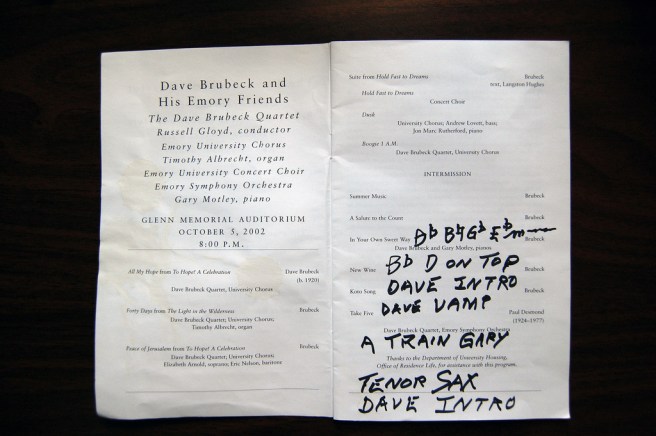
Dave Brubeck’s set list, October 5, 2002. When I was in college, I played percussion about 5 feet behind and to Dave’s left in this concert. He left his notes sitting on the piano after the show. So I took it. What a guy.
Dave Brubeck’s set list, October 5, 2002. When I was in college, I played percussion about 5 feet behind and to Dave’s left in this concert. He left his notes sitting on the piano after the show. So I took it. What a guy.

Clean-up from a Coca-Cola spill on campus. Hazards of Emory student life.
Philip Glass is coming to Atlanta, and giving a couple talks just a few miles down the road from me. Awesome.

Tonight I went to listen to E.O. Wilson talk about ÄùDarwin and the Future of BiologyÄù. Biology is most definitely not a strong interest of mine, but it was cool. It also reminded me that I’ve been meaning to read his book, Consilience: The Unity of Knowledge.
He opened with what seemed like an elementary review of Darwin, his books, his journeys, and his influence; then on to biology as it is today and the two major approaches to biology: functional versus evolutionary, the how versus the why, the lab versus the field, the problem solvers versus the naturalists. (He wasn’t trying to paint them as warring factions, just equally valid methods that serve scientists with different interests and temperaments.) He also talked a bit about intelligent design and made the most basic, pragmatic, friendly critique I’ve heard yet: we just don’t need it. It’s a solution in search of a problem. He also did a good job of saying there’s no point in antagonizing or mounting a heavy offense against ID advocates.
Lastly, the dreaded Q&A afterwards. This one wasn’t too painful, but I recommend this as general advice: if you’re going to quote the speaker, at least *listen* and quote the speaker accurately. There is such a thing as a stupid question. I suppose when you get to be as old and wise as Wilson, you learn to be as generous and polite as he was tonight.

This year, Emory University’s Ellmann Lectures in Modern Literature are delivered by Umberto Eco. I didn’t know much about him before, but he kind of blew my mind. This afternoon I stopped by to hear him talk about “How I Write”. I was *really* impressed with how much he plans out his worlds beforehand, even making maps, blueprints, and sketches of his characters. I would love to see some of his doodles. These are mine:

Here are some notes deciphered from my handwriting:
And some aphorisms:
The event was followed by a reception with wine and cookies (and some other things, but I had my priorities).

Holy crap. I just noticed that there’s a LibX plug-in for Emory University libraries. There are a couple hundred other schools that use LibX. From the comfort of my own Firefox toolbar, I can search Emory’s catalog, journals, and databases, as well as Google Scholar and WorldCat. This makes me unreasonably happy.
 Mark Larson