Most culture is dark matter.
Tag: culture
Lately, I’ve been wondering if sitting quietly in a café, pretending to read a newspaper, and not writing is the most earnest expression in our age: no echoes of language, nothing to reblog, just pure unmitigated self sitting with self. I might, after a time of blank staring, find myself constructing a sentences in my head, maybe a paragraph, simply letting the words roll around in my mind. I will not. I repeat. I will not write them down. They are my secret sentences, not yours.
One result of the internet, I think, is that it makes almost everyone smart more eclectic, whether in terms of substance or presentation.
The End of Solitude

Overcoming Bias : Key Disputed Values. I’m tempted to look at extremes (would I rather be in the Zimbabwe corner or the Sweden corner?) but I’m even more curious about life near the moderate middle: Spain, Croatia, Uruguay, Israel.
Nobody has any business to destroy a social institution until he has really seen it as an historical institution. If he knows how it arose, and what purposes it was supposed to serve, he may really be able to say that they were bad purposes, that they have since become bad purposes, or that they are purposes which are no longer served. But if he simply stares at the thing as a senseless monstrosity that has somehow sprung up in his path, it is he and not the traditionalist who is suffering from an illusion.
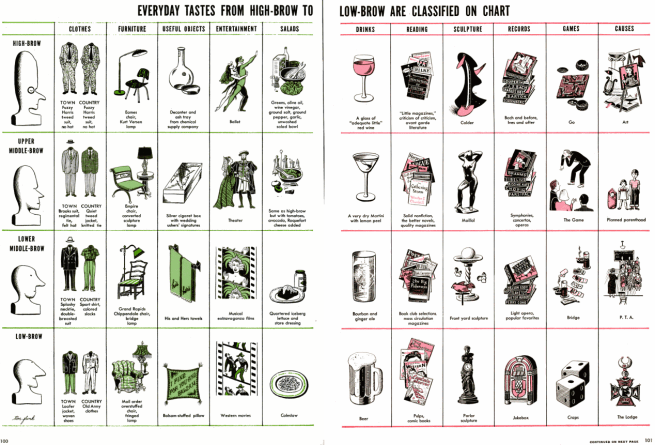
Everyday Tastes from High-brow to Low-brow. Life Magazine, 1949.
Being Individuals in an Increasingly Individualistic Culture
It would be nice… if the career advice industry would frame their obsession with passion in larger sociological context, and reinforce how new a concept it really is.
Being Individuals in an Increasingly Individualistic Culture
TV is the epitome of Low Art in its desire to appeal to and enjoy the attention of unprecedented numbers of people. But it is not Low because it is vulgar or prurient or dumb. Television is often all these things, but this is a logical function of its need to attract and please Audience. And I’m not saying that television is vulgar and dumb because the people who compose Audience are vulgar and dumb. Television is the way it is simple because people tend to be extremely similar in their vulgar and prurient and dumb interests and wildly different in their refined and aesthetic and noble interests. It’s all about syncretic diversity: neither medium nor Audience is faultable for quality.
…David Foster Wallace in his essay E Unibus Pluram: Television and U.S. Fiction [pdf], collected in A Supposedly Fun Thing I’ll Never Do Again, which I am loving so far.
Online monoculture and the end of the niche. In summary: online recommendation systems tend to offer a more diverse selection, but tends to reward fewer products more greatly than others:
In Internet World the customers see further, but they are all looking out from the same tall hilltop. In Offline World individual customers are standing on different, lower, hilltops. They may not see as far individually, but more of the ground is visible to someone. In Internet World, a lot of the ground cannot be seen by anyone because they are all standing on the same big hilltop.
I wish I followed the math better. Interesting stuff in the comments, too.
It is upsetting when we have to conclude that someone is “simply a bastard.” Partly, we are upset because of the initial offense that led us to conclude that. But we are also upset because, as tolerant, educated, broad-minded, empathetic people, we want to have a better explanation. We want to be able to attribute people’s behavior to legitimate differences in philosophies, perspectives, cultures, priorities. When we cannot, we feel that we have failed, and we are angry at having been put into such a narrow-minded, thoughtlessly reactive position.
Highbrow/Lowbrow: The Emergence of Cultural Hierarchy in America (review: 5/5)
In 1800s America, Shakespeare productions had juggling and singing amidst the acts, and theatergoers would cheer the heroes, boo the villains, shout out lines along with the actors, even walk about on the stage. Opera divas would sing “Yankee Doodle,” “Home Sweet Home,” Irish ballads and other folk songs, and take requests from the audience. Orchestras would choose a few excerpts from Beethoven, Mozart, Bach, and mix them in with popular reels, jigs, and other dance tunes. It was a different world:
GRAND CONCERT OF MUSIC…
An African Monkey
and several
CHINESE DOGS
Come One Come All
I dog-eared Highbrow/Lowbrow: The Emergence of Cultural Hierarchy in America more heavily than any book in recent memory. Lawrence Levine doesn’t argue that the old ways of interacting with art were necessarily better. But it is important to know that it was different. The book gives a whole different history and perspective on our inherited rituals, kind of like hearing a whole new arrangement of a familiar melody.
Levine opens the book with a focus on Shakespeare in American cultural life. Shakespeare was really popular. At home, in books (like Mark Twain’s parodies in Huckleberry Finn), on the road, in the theaters. Even the illiterate mountain man Jim Bridger knew it was worth hiring someone to read it to him enough that he could recite long passages.
In performance, this popularity and relevance made it fairly common for the actors to shorten or lengthen the monologues as they saw fit, and companies would commonly rewrite the endings. In a typical account from a local newspaper, when the audience disapproved, “Cabbages, carrots, pumpkins, potatoes, a wreath of vegetables, a sack of flour and one of soot, and a dead goose, with other articles, simultaneously fell upon the stage.” What’s cool is not only that the audience was carrying vegetables to the show, but also that they knew Shakespeare well enough to know the difference when changes were made to voice their opinion. And audience and performers alike weren’t just mutely receiving the Greatness of Shakespeare, but participating and engaging with it.
Events like the Astor Place Riot in 1849 helped mark the growing division between the audiences for art (the Cultured and the Masses), and the “sacralization” of the works themselves. A lot of it was tied to the economics of the art industry. Amateur actors and musicians were gradually replaced with professional payrolls. Wealthy patrons became the primary financial support for the organizations, so the programming was less reliant on popular approval and ticket sales at the door. With the Masses weeded out, the new superstar conductors began to program entire works, instead of just excerpts.
And along with that came programs of behavioral control (dimming the lights, refusal to encore, training audiences in when to clap, etc.). Levine ties in “the taming of the audience” to a broader cultural change that separated public and private space, and public and private behavior. As art became more hierarchical, the classes weren’t attending the same types of performances or sharing the same spaces. The cultural institutions were active in “teaching their audiences to adjust to the new social imperatives, in urging them to separate public behavior from private feelings.” By the early 1900s,
the masterworks of the classic composers were to be performed in their entirety by highly trained musicians on programs free from the contamination of lesser works or lesser genres, free from the interference of audience or performer, free from the distractions of the mundane; audiences were to approach the masters and their works with proper respect and proper seriousness, for aesthetic and spiritual elevation rather than mere entertainment was the goal.
In other words, it changed to the modern, frosty atmosphere that lingers in performance halls and museums today. No more audience outrage, no more spontaneous celebrations. The groups were transformed “strove to concentrate on the music rather than the performance.” The orchestra plays, the audience receives. You see a similar transformation in museums and libraries at the same time. They change from the fantastic freak shows and cabinets of curiosity to sacred archives, filled with carefully curated items for preservation or quiet contemplation.
One really interesting bit that Levine touches on is how knowledge of these cultural manners (like knowing when to clap) helps classes distinguish themselves. In this way, knowledge becomes both a status symbol and a barrier to entry:
Thorsten Veblen constructed his concept of conspicuous consumption, he included not only the obvious material possessions but also the “immaterial” goods—“the knowledge of dead languages and the occult sciences; of correct spelling; of syntax and prosody; of the various forms of domestic music… of the latest proprieties of dress, furniture, and equipage”; of the ancient “classics”—all of which constituted a conspicuous culture that helped confer legitimacy on the newly emergent groups. This helps explain the vogue during this period of manuals of etiquette, of private libraries and rare books, of European art and music displayed and performed in ornate—often neoclassical—museums and concert halls.
It’s a really fantastic book. Levine to close it out:
When the art forms that had constituted a shared culture for much of the nineteenth century became less accessible to large segments of the American people, millions of them satisfied their aesthetic cravings through a number of the new forms of expressive culture that were barred from high culture by the the very fact of their accessibility to the masses: the blues, jazz or jazz-derived music, musical comedy, photography, comic strips, movies, radio, popular comedians, all of which though relegated to the nether world culturally, in fact frequently contained much that was fresh, exciting, innovative, intellectually challenging, and highly imaginative. If there is a tragedy in this development, it is not only that millions of Americans were now separated from exposure to such creators as Shakespeare, Beethoven, and Verdi, whom they had enjoyed in various formats for much of the nineteenth century, but also that the rigid cultural categories, once they were in place, made it so difficult for so long for so many to understand the value and importance of the popular art forms that were all around them.
David Byrne has a new art installation that connects an organ keyboard to various parts of a large building. Playing the Building makes a giant musical instrument out of the structure of columns, walls, pipes:
I’d like to say that in a small way it turns consumers into creative producers, but that might be a bit too much to claim. However, even if one doesn’t play the thing, it points toward a less mediated kind of cultural experience. It might be an experience in which one begins to reexamine one’s surroundings and to realize that cultureÄîof which sound and music are partsÄîdoesn’t always have to be produced by professionals and packaged in a consumable form.
This interview with Bill Bishop, about the increasing social segmentation in America, has some cool tie-ins with a book I’ve been loving lately, Lawrence Levine’s Highbrow/Lowbrow: The Emergence of Cultural Hierarchy in America. Levine touches on the changing use of public space in the early 1900s as “Culture” was increasingly associated with the wealthy, and patrons and directors exerted more control over how we experience art:
The relative taming of the audience at the turn of the century was part of a larger development that witnessed a growing bifurcation between the private and public spheres of life. Through the cult of etiquette, which was so popular in this period, individuals were taught to keep all private matters strictly to themselves and to remain publicly as inconspicuous as possible… People were similarly taught to remove from the public to the private universe an entire range of personal reactions… The individual mirrored the increasing segmentation of society in a segmentation of self.
Bishop mentions in the interview that “The best-educated citizens are the least likely to have a political discussion with someone with a different opinion.” Public spaces and self-selection. Two interesting ideas that I hope Bishop talks about in his upcoming book, The Big Sort: Why the Clustering of Like-Minded America Is Tearing Us Apart. It’s on my reading list. [via book design review]
Merriam-Webster’s words of the year, with the lovable “w00t” winning the number one spot.
In the NYT, a reflection on the newly-discovered photos of Abraham Lincoln at Gettysburg:
What would the photographic record show if it reached back, say 500 years, instead of 180?
One answer is that it would show us this same structure over and over again: a fiercely concentrated knot of people hanging on the words of someone at the center of the crowd. And around them? People standing in looser and looser concentrations, until finally Äî far enough from the epicenter Äî their attention turns away from history and focuses on the abiding interest of almost anything else. And this is somehow the inherent bias of the camera. It always directs us toward the center of attention, never away to the periphery, even though that is where our attention eventually wanders.
[via librarycrunch]
 Mark Larson