
From Kircher’s Musurgia Universalis: Birds!!
(via xtina)
“The book is one of the seminal works of musicology and was hugely influential in the development of Western music – in particular on J.S.Bach (1685-1750) and Beethoven (1770-1827).”
From Kircher’s Musurgia Universalis: Birds!!
(via xtina)
“The book is one of the seminal works of musicology and was hugely influential in the development of Western music – in particular on J.S.Bach (1685-1750) and Beethoven (1770-1827).”

Score for “Piano Etudes” (2009) by Jason Freeman. (via)
Tom & Jerry – Hungarian Rhapsody No. 2. One funny bit of trivia from Note by Note… the pianist Lang Lang was inspired to take up the piano after seeing Tom & Jerry’s Cat Concerto episode.
The audio examples are really fascinating. (via).
When composers wrote for these instruments they sometimes loved them and sometimes chafed at their limitations, but in any case they wrote for those sounds, that touch, those bells and whistles. From old instruments, performers on modern pianos can get important insights into the sound image that Mozart, Schubert, et al., were aiming for. But music from the 18th and 19th centuries doesn’t just sound different now than on the original instruments; some of it can’t even be played as written on modern pianos.
Why you’ve never really heard the “Moonlight” Sonata. – By Jan Swafford – Slate Magazine
Oscar Levant daydreams a total performance of Gershwin’s Concerto in F. From the film “An American in Paris”.

Beethoven’s laptop. That’s a clever little desk, no?
In the last weeks of Beethoven’s life this travel desk was placed right next to his bed. Three days before he died, he wrote a codicil to his will at the desk, in which he named his nephew Karl as his sole heir. Beethoven probably kept his letter to the Immortal Beloved in the open compartment shown here.

King Cotton March. So apparently John Philip Sousa’s ♫ King Cotton March premiered in Atlanta. It was written for the the 1895 Cotton States and International Exposition, one of a few, which took place where the lovely Piedmont Park now lies. Awesome. (via)
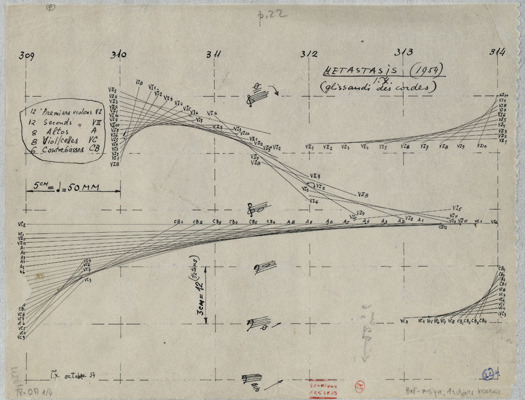
Study for Metastaseis, c. 1953. Iannis Xenakis Archives, Bibliothèque nationale de France, Paris. One of the pieces in Iannis Xenakis: Composer, Architect, Visionary, an exhibition at The Drawing Center. (via)

The Magic Flute. Today’s snowy day/working from home soundtrack.

An Eroica Project. “This site uses the Eroica as the starting point for several different kinds of exploration.” (via)
Passacaglia in C Minor. Aleksandr Hrustevich on the accordion playing one of Bach’s best. That’s just incredible. (via)
I’m not particularly religious, but Christian Zeal and Activity has become one of my favorite bits of classical music. See also the Lego version that focuses on the preacher segments.
How to play piano like Philip Glass
I so love this guy.
Nothing so refreshing as naked enthusiasm.
“If Beethoven is standard American orchestral fare today, it’s because a group of Bostonians in the 1830s and ’40s decided he was the next big thing.”
Brook Farm group was among the first to hear Beethoven’s brilliance – The Boston Globe
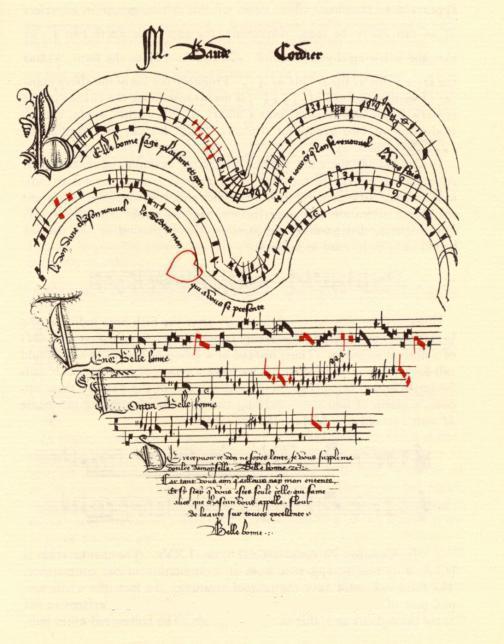
Score for “Belle, Bonne, Sage” (lyrics), a song with eye music by Baude Cordier included in the Chantilly Codex. Part of the ars subtilior music tradition of the early Renaissance.
Alex Ross’ new music blog on the New Yorker website. Nice counterweight to the blog of Sasha Frere-Jones .
A visual interpretation of Erik Satie’s famous piano suite… The movement of each column maps the physical activity of each the pianist’s fingers respectively. The pitch of each key struck is represented by an assigned colour.

Score for Clapping Music by Steve Reich. Video of Reich playing it with Russell Hartenberger, I think. See also the Rise and Fall of Steve Reich.

 Mark Larson