Wehr in the World: Introducing my new book-thingy: 446ish* Ideas** Worth*** Considering. This is on my must-read list. Hurry up with that shipping, Justin.
Wehr in the World: Introducing my new book-thingy: 446ish* Ideas** Worth*** Considering. This is on my must-read list. Hurry up with that shipping, Justin.
Imagine Marilyn Monroe, the star commonly thought to be an airhead, keeping up with Somerset Maugham’s birthday and taking the trouble to send him a telegram.
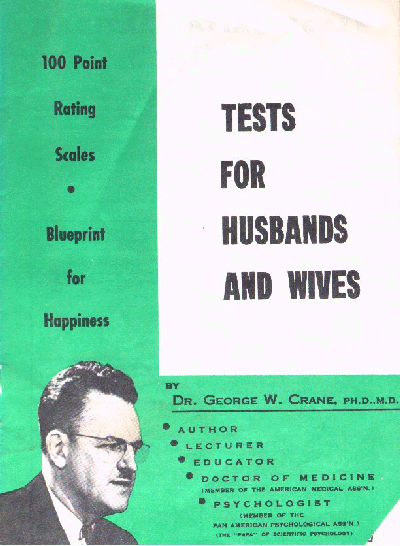
Tests for Husbands and Wives. Rate yourself on the 1930s Marital Scale. I scored… umm… 17.
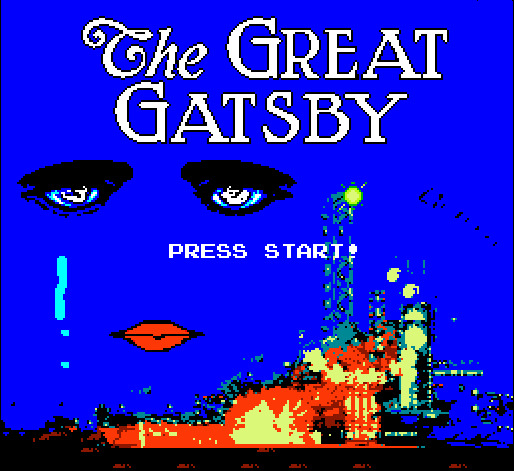
The Great Gatsby – for NES. I fully support this. (via)
There was a time when you had to earn the right to draft a memoir, by accomplishing something noteworthy or having an extremely unusual experience or being such a brilliant writer that you could turn relatively ordinary occurrences into a snapshot of a broader historical moment. Anyone who didn’t fit one of those categories was obliged to keep quiet. Unremarkable lives went unremarked upon, the way God intended.
The authors of picture books are often relatively “agenda-less,” since most people don’t read the text, the selling point is the pictures, and the book is so expensive that the publisher doesn’t want to rule out the broadest possible audience.
What Wallace is often trying to say in his fiction and essays—the message, as it were, at the heart of so much outpouring of feeling—is simple: think about someone else besides yourself.
Our Psychic Living Room: Why It’s Particularly Important to Read David Foster Wallace – TCR
What Wallace is often trying to say in his fiction and essays—the message, as it were, at the heart of so much outpouring of feeling—is simple: think about someone else besides yourself.
Our Psychic Living Room: Why It’s Particularly Important to Read David Foster Wallace – TCR
Good round-up and commentary on his year in reading. New to/of interest to me:
Good round-up and commentary on his year in reading. New to/of interest to me:
This is a good idea.
My friend turns on their Kindle the morning of the day I select for the book to arrive. Their Kindle syncs with the Kindle cloud and — oh, look! A gift! The book is automatically downloaded. My personalized message — long or short — is displayed and kept as a part of that book. Furthermore, if I’ve opted to have my notes and highlights included with the book, those too, are downloaded.
“Therapy is not about insights. It’s about change.” Some of these sound really good.
Gotta say, these past two months have been pretty good for reading. From the most recent to the more distant in time:
1. Why Mahler?. This might be better for people who already care at least a little bit about Mahler, one of those characters that lends to incompleteness. Like talking about his music. Too vast, too contradictory, too universal, too personal. Still, it’s a breezy, rangy biography mixed with some memoir, and it’s a good read.
2. Listen to This. Alex Ross is one of my favorite writers. This book is mostly a collection of stuff he’s written for The New Yorker. The essays I dog-eared most heavily were Chacona, Lamento, Walking Blues, Infernal Machines, The Storm of Style, Song of the Earth, Verdi’s Grip, and his writings on tour with Radiohead and Bob Dylan were interesting, too. He’s also got a great audio guide for Listen to This like the one for The Rest is Noise (which is awesome).
3. The Art of Non-Conformity. Got curious about this one because I recognized the brand. The blog is better.
4. The Music Instinct. Author Philip Ball struck me first and foremost as a very fair writer. It seems like he doesn’t have very many bones to pick, aside from the fact that we should stay open-minded and open-eared. The first 60-70% of the book, the best part, is nerdy stuff about music theory—the science of pitch, scales, harmony, timbre, rhythm, etc. He’s glad to branch out across the world and not just focus on Western tradition. I found it quite good.
5. The Substance of Style. Couldn’t finish. Seemed sort of argument-by-anecdote-y, which is fine, but not what I wanted at the time.
6. The Art of Travel. This is mostly worthwhile, the first half in particular. Each section centers around a topic (Anticipation, Curiosity, the Exotic, the Sublime, etc.), a tour guide of sorts (e.g. Huysmans, Humboldt, Baudelaire, Flaubert, Van Gogh), and de Botton’s own observations and musings. It’s a good, quick read.
7. The Book of Basketball. I thought it was awesome. Rare to find any book, nonfiction or otherwise, that keeps you up late a few nights in a row.
8. On Kindness. Another one that I really, really liked and shared a bunch of quotes from. Great brain food here.
9. Steppenwolf. I read this one right after “The Moviegoer”, below. They both deal with existential angst, but this one is much more over-the-top, orotund, and, um, German. I think you could get your time’s worth just reading the first 40 pages or so.
10. The Moviegoer. I liked this one alright. Nothing much happens in the story, but the narrator’s struggles—with his own ambivalence, with relating to people, with finding satisfaction outside of passive distractions, etc.—were good food for thought.
11. Jane Eyre. This was a bit of a drag. Either I’m a curmudgeon with no heart or it’s kind of boring. This was, however, the first book I read mostly on my iPad, so it was nice to have that experience. I would have shared a bunch of quotes and bon mots, but, alas, as of now there’s no way to export highlights from iBooks other than tedious cut and paste. Maybe get to that later…
I think I’m due for some more fiction soon. More of what I’ve read lately can be found in volumes one, two, and three.
Five books about one of my favorite genres.
Many good ideas on mercenary reading here. Feel free to set aside the “rules” of front-to-back reading. Gotta participate actively and take what you need.
The work is an expression of the message, not the message itself. So forget everything but that message and how to apply it to your life. Dates, names, pronunciations–-they only matter in how they provide context for the lesson at hand.
And also:
You ought to ruin the ending–-or find out the basic assertions of the book–-because it frees you up to focus on your two most important tasks: 1) What does it mean? 2) Do you agree with it? The first 50 pages of the book shouldn’t be a discovery process for you; you shouldn’t be wasting your time figuring out what the author is trying to say. Instead, your energy needs to be spent on figuring out if he’s right and how you can benefit from it.
Read to Lead: How to Digest Books Above Your “Level” – RyanHoliday.net
Re-read this great story last night. I’ll have to try some other translations.
It suffices that a book be possible for it to exist.
Books and other writings by/recommended by/about Warren Buffett.

 Mark Larson